
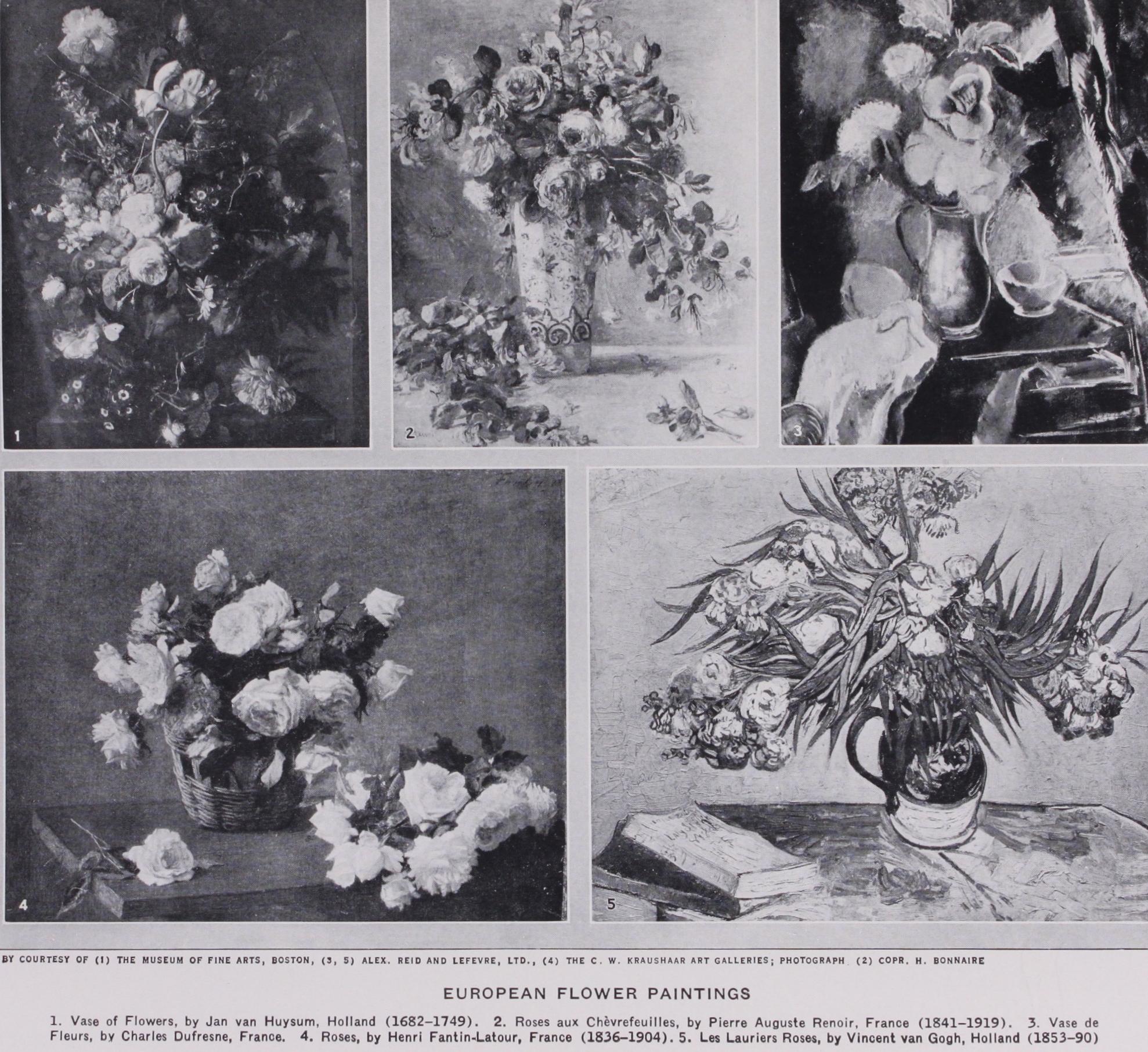
FLOWER PAINTING. Broadly speaking, flower painting may be divided into two big classes: that of the East, and that of the West. In the East, flower painting very early attained to a high state and became an individual, extremely beautiful art in China between the 7th and 17th centuries. Japanese painters, adopting many of the traditions of Chinese art, created a phase of flower painting which rose to superb heights in the 16th and 17th centuries. In the West, flower painting proceeded slowly from Egyptian, Grecian and Roman days, on through the Italian Renaissance, until, mainly in the north of Europe, again in the 16th and 17th centuries, almost with one bound, it reached a dis tinctive and highly developed form of painting in the Netherlands, and from there spread to nearly every country of Europe. The two schools grew under conditions so separated that each remained until recent times quite untempered by the other.
Flower painting of modern times is something of a heritage of both these divisions, but mainly of the Western group, to which has been added a richer and fuller sense of colour, finer and more subtle effects of light and atmosphere resulting from the greater development of visual perception and the delving into the realms of science, as developed by the French impressionists. The man ner of painting flowers has followed the changes that have taken place in painting generally, whether of the East or of the West. In method, in the West, the early form was fresco, then oil ; now water-colour and pastel are employed in addition. With the Chinese and Japanese, except in wall painting, it has always been a phase of water-colour painting, and their marvelous use of the brush on silk or paper has given a character found nowhere else in the world of art. In the Western world, flowers have been associated for the most part with man. They have appealed to his finer feelings; they have graced his life. He has used them as symbols, decorations, adornments, offerings and as enrichments to his home and his surroundings, while in the East they have always been thought of as a beautiful part of the great order of things in the universe, a part nature of which man himself is likewise but a part. Flower painting, therefore, has developed along a far different line in the East from what it has in the West. In the East it has always been approached from a contemplative, philosophic and poetic point of view, while in the West it has been, for the most part from an objective one. In the West, we find flowers used in the early days only as accessories in the art of painting. At first they are painted as symbolical and decorative adjuncts. Later they assume a realistic phase in their conjunction with the religious and mythological subjects. But not until about the 16th century do they appear as subjects for paintings for their own beauty. In the East, however, they have formed a very distinct branch of painting for over a thousand years. The Chinese divided their paintings into four general subjects : landscape, man and objects, flowers and birds, plants and insects. Three of these main divisions deal directly in the broad field of nature; the third and, f ourth divisions are closely related, and being based on much the same conceptions as their landscape painting, follow it as a natural development.
The close observation and contemplation of nature by the artists of the East have produced in their work a rare character and charm. Their flower paintings vibrate with life and force; they are beautifully rhythmic. Their lilies nod and sway on delicate stems ; lotus flowers vigorously grow from earth and water into light and sunshine. Their vines hang and sway in the breeze, their peonies unfold, their plum blossoms spread their petals and gently float away in the breeze almost as they open. Flowers in their paintings are associated with the passing of the seasons and the moods of nature. Generally they are painted with the birds of the seasons naturally associated with them at the time of flowering, in their natural habitat, and always with a great understanding of their life and growth. The Chinese artists ever communed with nature. It is said of Chao Chang, of the early nth th century, that "every morning he would walk round the gardens and examine some flower carefully, turning it over and over in his hand. Then he would paint." Of I Yuan-chi, it is said that "he laid out a garden, planted it with bamboos and rushes, and kept there a variety of water fowl, so as to be able to watch them in movement and repose." Kuo Hsi writes about this same time : "Those who study flower painting take a single stalk and put it into a deep hole and then examine it from above, thus seeing it from all points of view. Those who study bamboo painting take a stalk of bamboo, and on a moonlight night project its shadow on to a piece of white silk on a wall." Of the early Chinese flower paintings few remain to the present day, but of those known, the earliest are of the Tang dynasty (A.D. 600-900) and show an art that must have been highly developed through many earlier centuries. Pien Luan, of the late 8th century, was noted for his paintings of birds and flowers. Hsiao Yueh of the same century painted the bamboo exclusively. Hsu Hsi, of the early loth century, was famous for his painting of flowers. "Peonies in the Wind" and "Ducks in a Lotus Pond" are typical titles. In his time he was considered an artist of the front rank, and has been called "the father of bird and flower painting." He was famous for his paintings of the lotus flowers which were the inspiration for many painters in later times both in China and Japan. Huang Cheiian and his son Huang Chii-tseai were noted painters of flowers of this same century. Two pictures, "Fowls" and "Peonies," in the British Museum are attributed to the father, while there is record of a large number of paintings of birds and flowers by the son.
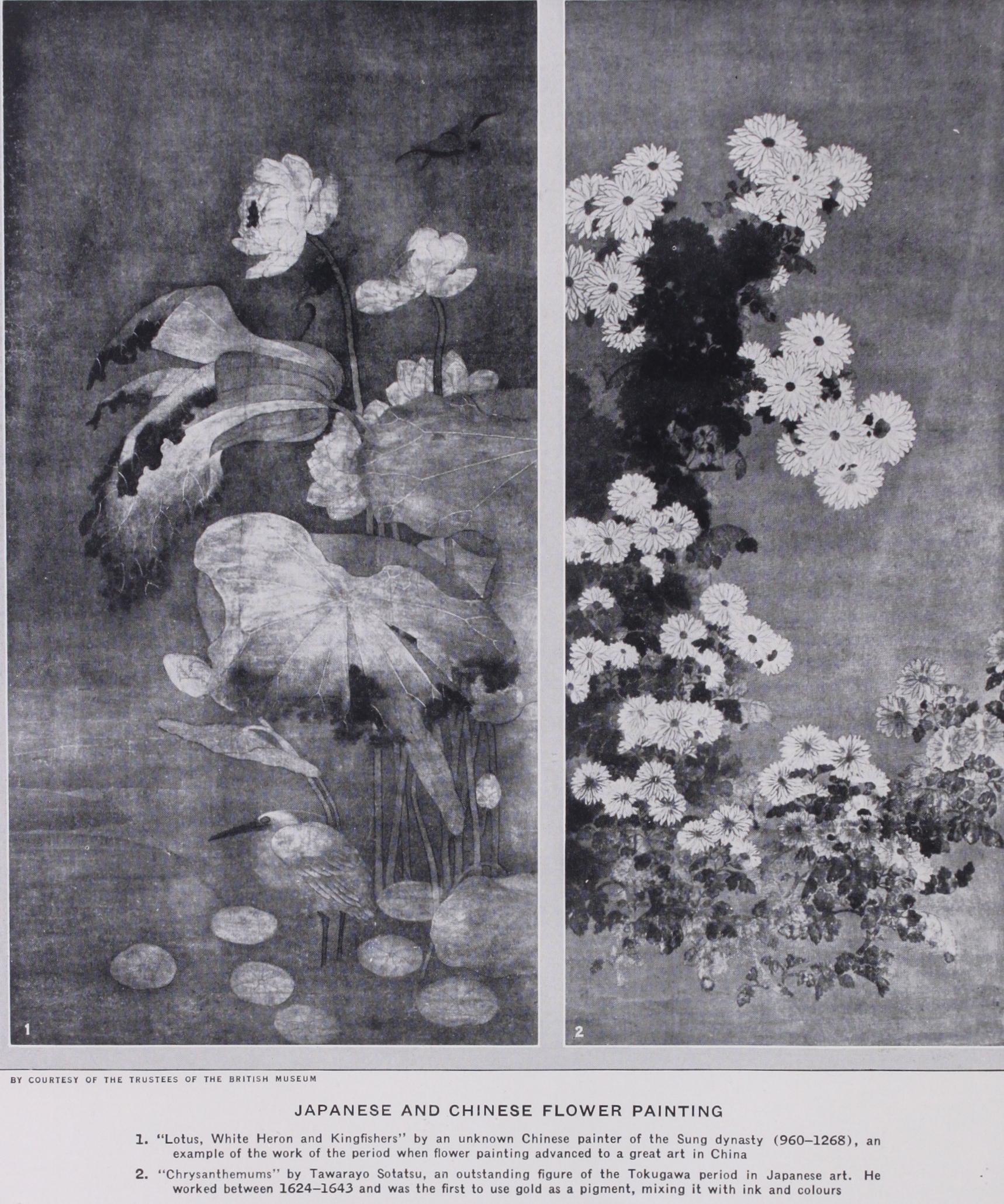
The three centuries of the Sung dynasty (96o-126o) saw flower painting advanced to a great art. It was a period of intense nature study, a period where a passion for flowers was common, a period when flowers were associated with nature and with every mood of nature. Many flower painters flourished, and their paintings are filled with an elusive poetic quality, combined with accurate form and rhythmic beauty growth. In this phase of Chinese art, the Sung artists are pre-eminent. Hsu Cheung-ssu was a painter of flowers and insects, and is accredited with being the first to paint directly without first sketching the subject. Chao Chang, who followed something of his methods, attained great fame. It is said of him that he "not only produces an accurate resemblance, but hands over to you the very soul of the flower" also. Cheeng Tang was famous for his paintings of bamboo, as was Chou Shun. Li-Ti excelled as a flower painter, Chao-Meng-Chien delighted in painting the plum and narcissus, while Cheng Ssu-hisao devoted himself to the painting of orchids.
In the Yuan period, 126o-1368, there are few outstanding flower painters. Chien Hsiian, born in the earlier dynasty, was noted, and Li Kean achieved great fame as a painter of the bamboo. In the Ming dynasty, 1368-1644, though a decline had set in, much of the tradition of the golden age of the Sung period was carried on, and a number of flower painters are found. Mr. Fenollosa claims for Lin Liang first place of all Ming artists. Lu Chi painted his flowers and birds with a landscape back ground. Sun K`an specialized in the painting of the chrysanthe mum. Other flower painters of this time were Chen Shun, Kao Ku, Sun K'o-hung, whose paintings were noted for beauty of movement in flowers, and Chou Chih-mien, also noted for the rhythm and spirit he attained. In the Ch'ing or Manchu dynasty, 17th to the loth century, though no new vigour has been added, and marked signs of decadence are seen, many of the traditions in flower painting of the earlier Sung and Ming periods were main tained with vitality, at least to the beginning of the 18th century.
In Japan, flower painting, inspired greatly by the Chinese mas ters of the Tang, Sung and Ming periods, possess many of their characteristics, grafted often on to the traditions of their own Japanese native schools of painting.
The most impressive periods were the Ashikaga period ' 573) and the Tokugawa, from about 1600 into the 19th century. The first strongly upheld traditions of the Sung painters. The native Japanese tradition slumbered, and a sort of Chinese renais sance in Japan took place. The gorgeous coloured scrolls, which had been typical, were replaced by bold simple ink paintings of birds and flowers and landscape. It was the philosophic, con templative art of earlier Chinese painters. So far as flower paint ing was concerned, it was the interpretation of the life and growth of the flowers and their association with nature. Sesshiu and Kano Masanobu, the first of the great Kano school, both of whom had great influence and many followers, painted flowers in the classic Chinese style. Utanosuke, son of Kano Masanobu, achieved a great reputation for his distinguished painting of flowers and birds. He died in 1575. About 160o began the Tokugawa period of Japanese art. Chinese ideals were developed along with the Japanese tradition for rich colour and sumptuous decorative effects. Artists with great skill and understanding vied with each other in producing a phase of flower painting, combining all the beauty of the growing flower with superb design and gorgeous colour, that remains unique in the entire field of painting. The three outstanding masters of flower painting of this period are Koyetsu (1557-1637), the leader in this movement, Sotatsu, considered by Japanese critics as the greatest of flower painters after Utanosuke, and Korin (1661-1716) who "is perhaps the most Japanese of all the artists of Japan." Their influence carried forward to recent times, but there are few, if any artists since who have inherited their skill or genius.