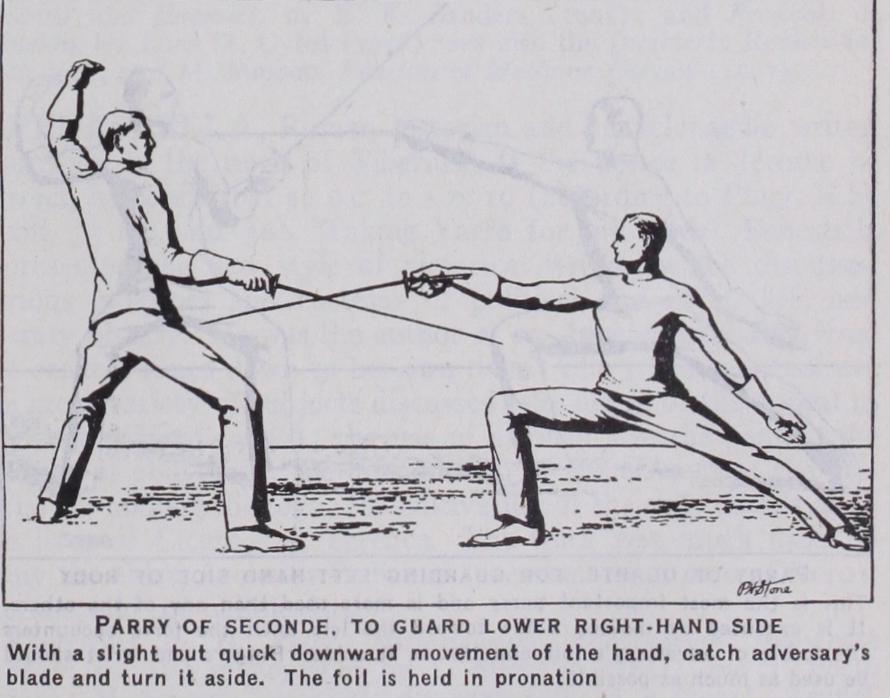
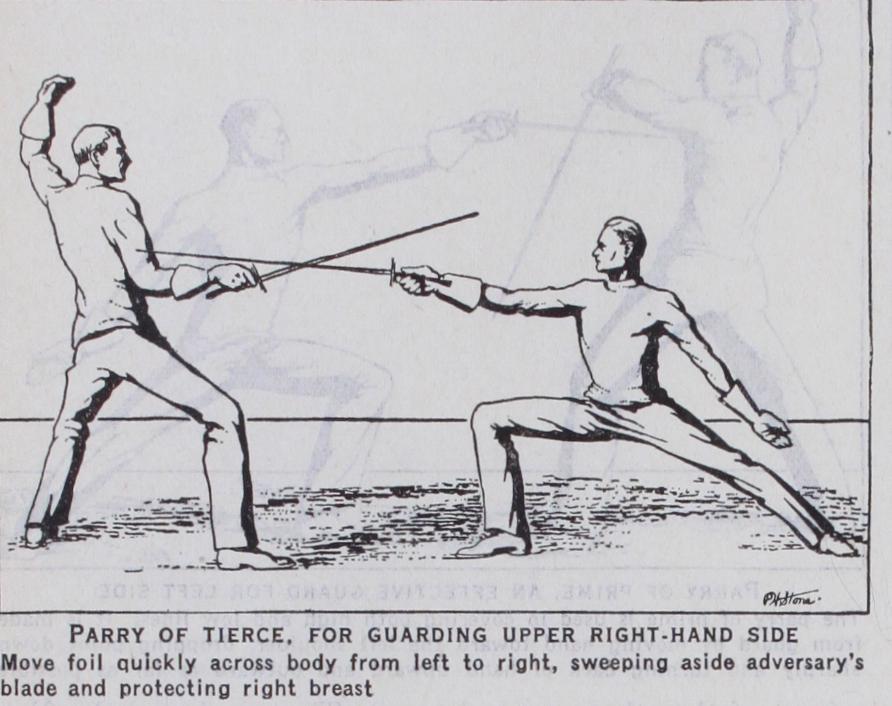
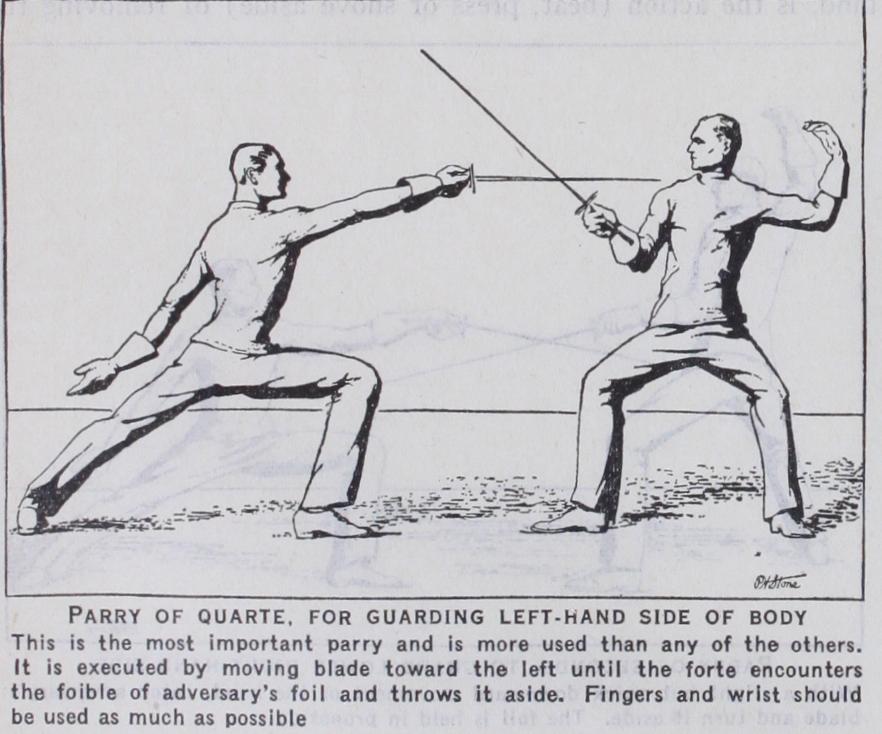
HOW TO FENCE Foil Fencing.—The target is limited to the bust, which is di vided by four imaginary lines varying according to the position of the hand. There are two prin cipal lines, one vertical and one horizontal, which cross each other at the place where the foil is held. For a right-handed fencer the inside-high line or left-high line is the space to left, of vertical line and above hori zontal line ; inside-low line or left-low line is the space at left of vertical and below horizontal line; outside-high line or right high line is space at right of ver tical line and above horizontal line; outside-low line or right low line is the space at right of vertical line and below horizontal line. For a left-handed fencer it is just the opposite. For each section there are two parries. The parries are direct or circular (counter). The direct parry wards off the opponent's thrust in the same line as the attack was made. The circular parry counter-wards off the opponent's Thrust in the opposite line the attack was made by means of a circular movement.
There are two parries for each line. In one the hand is held in supination, in the other in pronation. There are eight parries, each having its counter High-line right:— Tierce: Hand in pronation at height of chest towards right, foil pointed at opponent's eyes.
Sixte: Hand in supination at height of chest towards right, foil pointed at opponent's eyes.
High-line left: Quinte: Hand in pronation at height of chin towards left, foil pointed at opponent's waist.
Quarte: Hand in supination at height of chest towards left, foil pointed at opponent's eyes.
Low-line right: Seconde : Hand in pronation at height of waist, towards right, foil pointed at opponent's groin.
Octave: Hand in supination at height of waist towards right, foil pointed at opponent's groin.
Low-line left:— Prime : Hand in pronation at height of waist towards left, foil pointed to left and above hand.
Septime: Hand in supination at height of chest towards left, foil pointed at groin.
In executing all these parries the hand must not travel beyond the body.
In the on guard position the legs and arms are bent, ready for quick action, whether for attack or for defence. The attack is the ensemble of movements. by which one tries to touch an opponent, and of which the last is called "coup" (hit) and consists in bringing the point of the foil squarely on the opponent's body. The attack is made by lunging, marching or running (fleche). The lunge immediately follows the extension of the arm and consists of bringing the forward foot forward and at the same time straightening the other leg, the foot remaining in place. The march consists in bringing the forward foot forward to be fol lowed immediately by the other one, retaining the on guard posi tion. In the running attack or fleche one brings the back foot in front of the other one, and so on. The march and the fleche can be done backwards by reversing the movements.
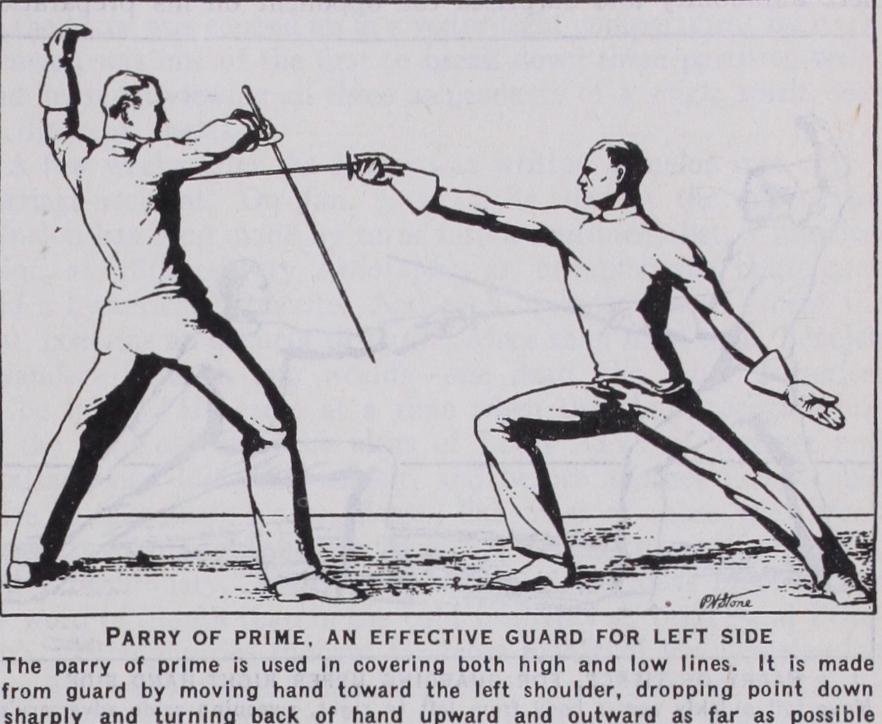
With the foil an attack correctly executed must be parried or else completely evaded. The attack is correct when the arm is properly extended before the lunge or advance. The feint is the semblance of an attack and is done by extending the arm without trying to touch, its aim being to make the adversary try to parry this movement, and then to deceive the intended parry. The false attack is a feint with a displacement of the body and has the same purpose as the feint. The attack may be simple (when not preceded by a feint) or composed (when preceded by one or many feints or by a bind on the blade). The attack on the blade, or bind, is the action (beat, press or shove aside) of removing the opponent's blade when in a threatening position, also to open the line. The bind is a movement by which one brings the opponent's blade from the high-line to the low-line, the low-line being the target and vice-versa. There are three simple attacks : straight thrust, disengage and the cut-over. In the straight thrust one touches the opponent in the same line as one is engaged in. The disengage is carried in another line than the one one is engaged in, by passing the tip of the blade under the opponent's blade. The cut-over is a disengage, executed by passing the point of the foil above the opponent's blade at the same time flexing slightly the arm. The composed attack ends always by one of the afore mentioned attacks. The riposte follows the parry and is done by extending the arm without moving the body, or by any other combinations of attack. The counter-riposte follows the parry of the riposte and can be made on the lunge or any of the other riposte combinations. The attack on preparation starts from com plete immobility and surprises the opponent on his preparation of attack. The time-thrust is at the same time a parry and a riposte. The stop-thrust stops the opponent on his advance. The "remise" is a time-thrust on a riposte or on a counter-riposte. The redoublement is a second attack after the first one has been parried without riposting.