
HOW TO PLAY AMERICAN FOOTBALL The five important fundamentals of offence and defence are line play, backfield play, tackling, passing and kicking.
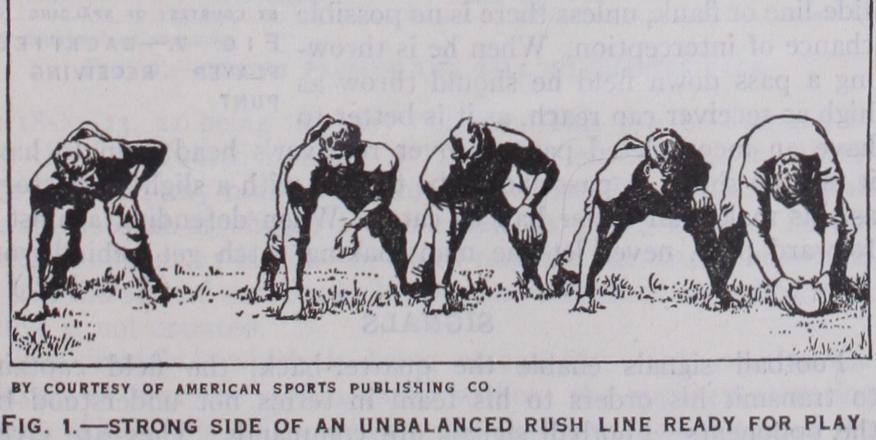
On defence position of middle or centre, linemen remain the same : when they charge they should immediately raise arms, keeping forearms stiff and using their hands freely to break through opponents. The tackles and ends on defence take an other position, with one foot behind the other, slightly spread, and both hands swinging slowly until the ball is passed, then their hands cross line of scrimmage, with forearms rigid, and they use hands freely on opponents. The defensive lineman should keep eyes open while breaking through line of scrimmage.
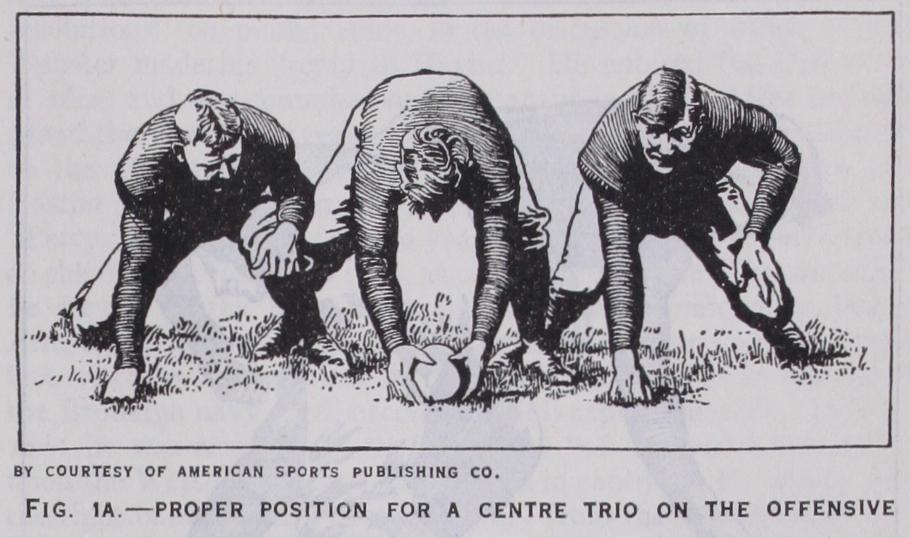
It is necessary for linemen, either on offence or defence, to get the jump on opponents; that is, to leave their marks quickly and with all power and speed possible. In charging or blocking opponent, the offensive lineman must not use hands or hold the opponent in any way. He can by use of head and neck, assist his charging greatly.
The three methods of defensive line play are: (I) in, under and up; (2) knifing; and (3) splitting. In, under and up is placing head and shoulders under opposing lineman and lifting up in time to stop ball carrier. Knifing is twisting the body and shoulders through the offensive line. Splitting is using one hand on each of two opponents, thus dividing them as defensive man makes charge. In both offensive and defensive football the original charge is straight ahead, and fighting should continue until ball carrier is tackled.
The back must side-step, pivot and cross-step when carrying ball. When using straight-arm he should hold arm rigid and snap defensive player's head or shoulders as latter is about to make tackle. When bucking line, he should hit it with head down and eyes up, body slanting forward, using short piston-like steps, and lifting knees as high as possible. In open field he should run as swiftly as possible, never giving any ground to opponents, but always going ahead so that when tackled he falls forward.
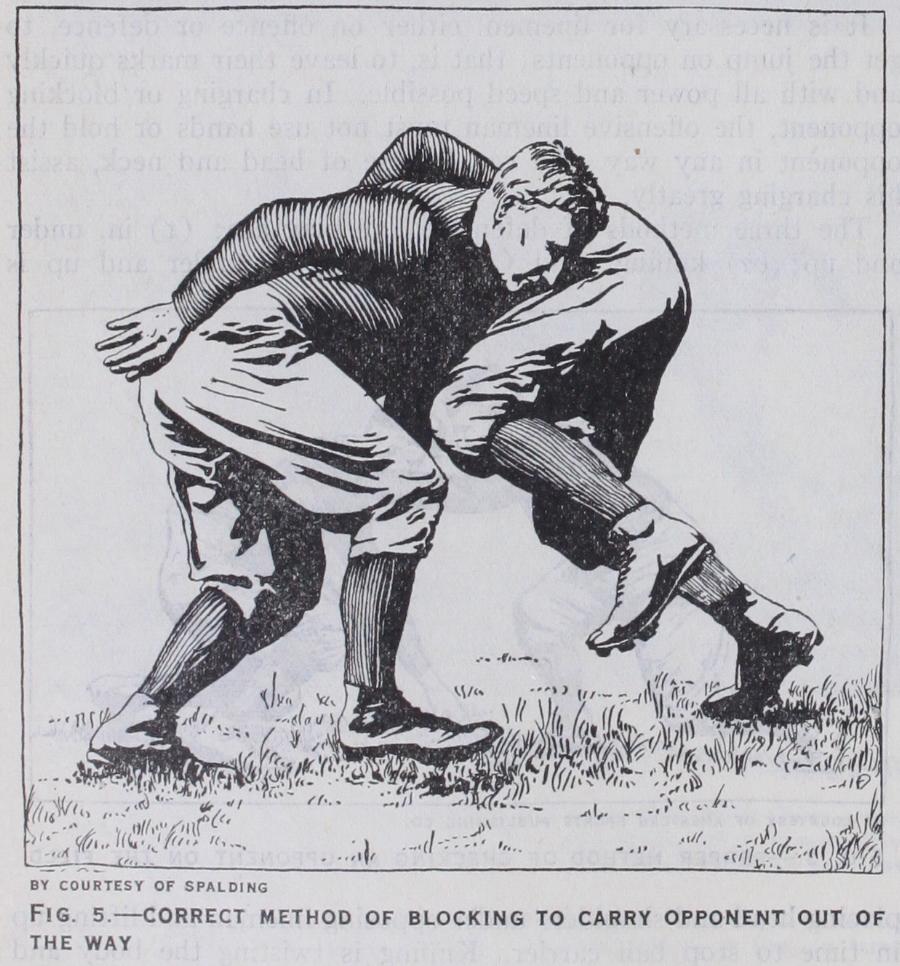
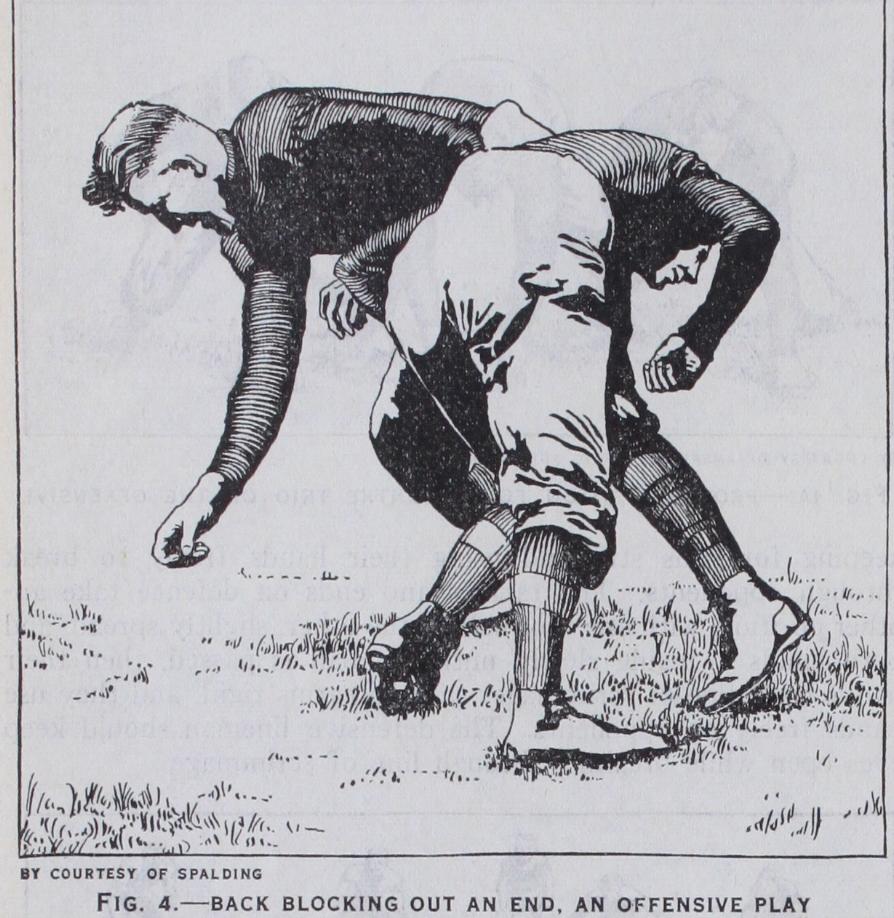
The most important backfield man in any combination is the back who has ability to block his opponent. To block an oppo nent, he must turn slightly while driving through air so as to hit opponent with the side of body or hip with enough speed and force to break through defensive man's stiff forearms. On de fence the backfield man must be alert and must not leave position until he makes sure which man is carrying ball. His tackle should be hard and aggressive, and he must keep his eyes open. He should always try to develop his passing and kicking ability.
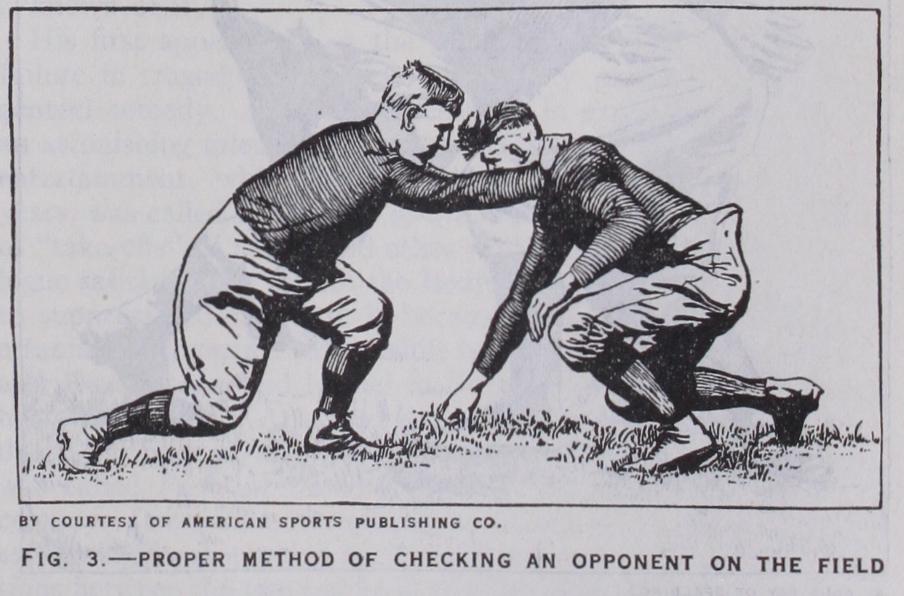
The opponent can be momen tarily stopped or checked even though held only by finger tips.
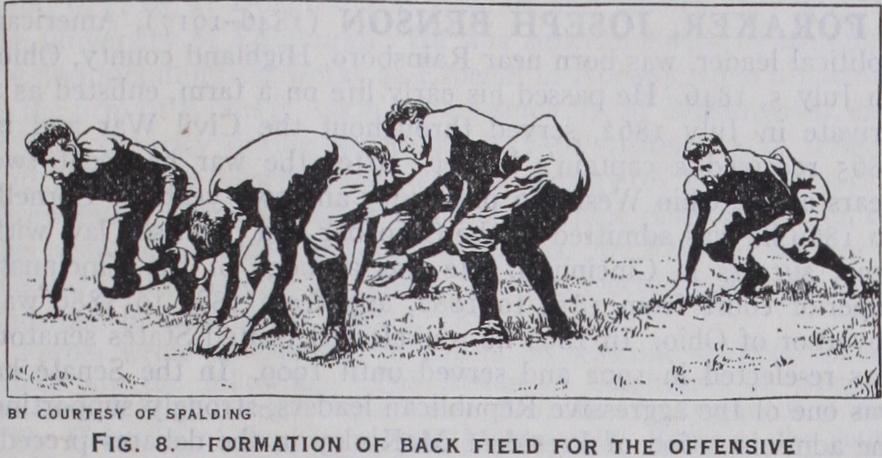
A signal must be plain and simple enough so that it will be easily and quickly understood by the players on the offence. Leading coaches agree that the best system of signals is to have one number or signal for each play. This number or signal not only tells each player the formation from which the play is to be run but tells him what he is to do in that play, i.e., whether the player blocks, runs with the ball, goes out to receive a pass, kicks, goes down under a punt, makes the pass, etc. All systems of signals are made up with companion plays. The odd number play will go to the right of the line and the even number play to the left, or vice versa. For example, a play 21 would go to the right of the line, 22 would be the same play only to the left side of the line. This play number can be easily concealed so that it will be impossible for the opposing team to detect it. For example : 21 may represent a play number and the number for the play to be used may be given by using the second number called, as 18-21-23, 21 being the play number. This can be changed to the third or fourth number by inserting meaningless numbers. For instance, any number ending in five may be used as a blank number so far as offence is concerned, as 35-18-21-23. To the defensive team 21 is now the third number but to the offence it is still the second number called because any number ending with a five is not counted.
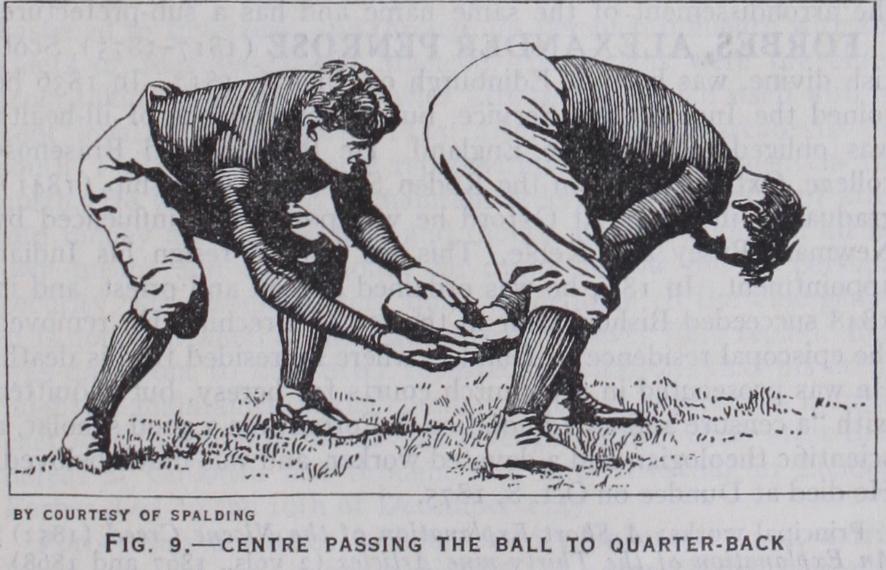
The "huddle," which is being extensively used, enables the players to hear the signals easily without the opponents hearing them. Thus, it is only necessary for the quarter-back to call the actual play number, as 21 in the above example. Any other play number may be given in the same way. See Spalding Official Foot ball Guide. (F. H. Y.)