
MILLING PROCESSES Milling processes may be conveniently divided into two stages, (I) the cleaning and conditioning of wheat and (2) the separa tion of husk from kernel. Stated in these terms, milling may appear to be a simple process; actually it is a complicated one and, although modern milling developments have been in the direc tion of simplification, the diagram or flow sheet of a large modern mill would probably be unintelligible except to those trained in the technics of milling. From the economic or technical point of view the amount added by milling to the value of the raw material is the measure of the merit of the work involved.
Ascending currents of air capable of precise regulation are passed through descending showers of wheat, and carry away particles which by reason of their shape or compactness of particle can be so separated. Wheat is scoured and brushed in various ways. One well-known machine consists essentially of a cylinder, clothed on its inner side with emery ; beaters revolving on a shaft serve the double purpose of scouring the wheat against the emery surface and of passing it through the length of the cylinder.
Conditioning is an English term; in the United States a some what similar operation is called tempering. Essentially it means that the physical condition of any given wheat is adjusted so that optimum separations of husk from kernel can be made. Sometimes water is added; sometimes it is abstracted. Adjust ments must be made to suit the wheat under treatment, the con ditions as to atmosphere and milling machinery subsequently used, and the flours to be produced. The factors employed are water, time and temperature. The methods of conditioning are still in the process of evolution. The results obtained by condi tioning are mainly or wholly physical.
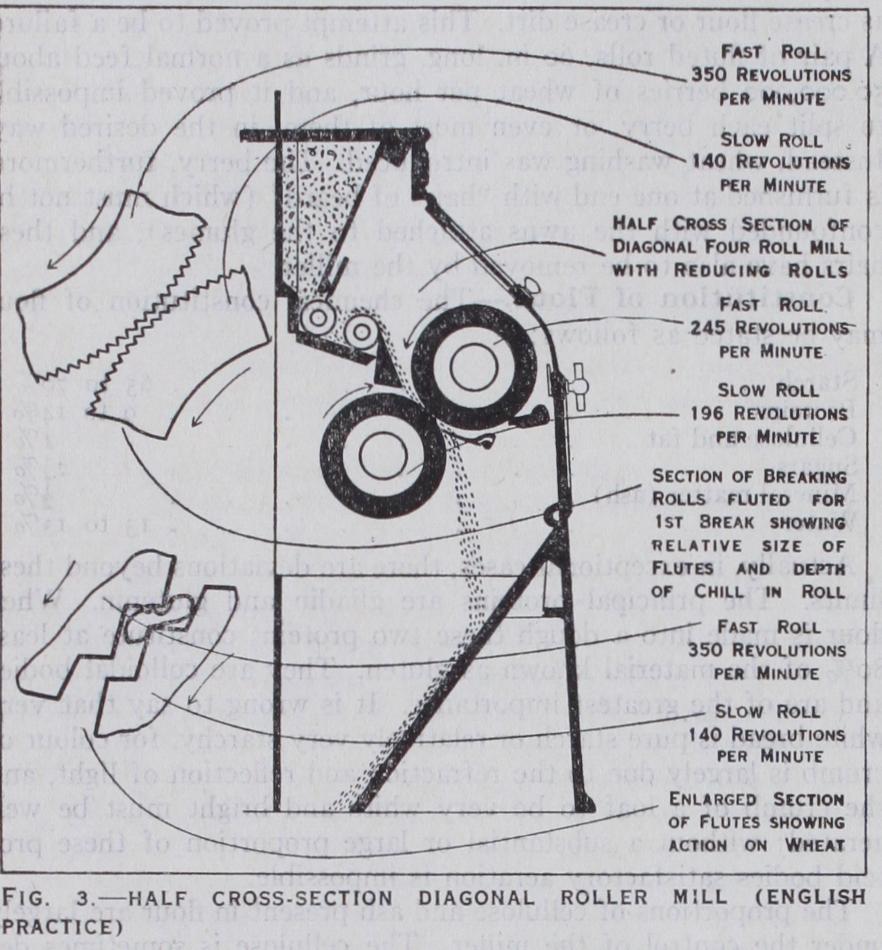
A pair of cylindrical rollers, running at the point of contact in the same direction, nip and grind their feed at one point only in their circumferences. But a release of endosperm particles from the branny husk, and not mere crushing, being the object desired, the two rolls forming a pair are made to revolve at differ ent speeds. This differential varies with the stage of milling. Furthermore, to effect optimum separations of husk from kernel it is necessary to obtain during the earlier stages of actual milling the endosperm particles in granular form. To effect this the rolls used in those stages are corrugated. The number and shape of these corrugations or flutes involve complicated technical points. The numbers range from 9 to 26 per in. of the roll's circum ference. Still further to improve the separations the flutes are cut at varying angles in relation to the rolls' axes.
In conformity with the principle of gradual reduction, no at tempt is made to obtain finished bran at one grinding; on the contrary, the wheat is broken down on the roller mills, known as the breaks, gradually by successive stages. These now number three, four or five; occasionally in some parts of the world six are used. Generally, millers aim to make as little flour as possible on the breaks, but some is made. The commercial article known as bran is separated from the stock, leaving the last break. The breaks as a stage of the milling process yield as finished products flour equalling from 8% to 18% of the original cleaned wheat and bran equalling from to of it. The remainder exists at that stage as granular products, known as middlings and semolina. These contain particles of pure endosperm, particles of pure husk and other particles consisting of endosperm with husk attached. The means of separating these constituents will be described in a succeeding paragraph.
Ultimately, to resolve these intermediate products into fin ished flour and finished husk (known commercially in Great Britain as offals and in North America as feed) further grinding by rolls is required. These are known technically as reduction rolls or reductions, and generally have either smooth surfaces or very fine flutes ranging from 7o to 120 per in. of the roll's circumference. The speed and differential are adjusted to the work to be done, but the principle of gradual reduction is em ployed at these stages also. The central idea of such grinding is a release of endosperm particles from husk. In the case of par ticles consisting of endosperm only, it is desirable to reduce them in size by grinding. In no case should granular particles, how ever fine, be merely crushed.