
OCCIDENTAL FLOWER PAIN 1 !N U In the West, as has been said, the earliest painted flowers are only to be found as symbols or as decoration. The blue water-lily of the Nile, symbolizing a full harvest, is constantly found in the painted decoration of the Egyptians. Flowers repeatedly appear in the religious paintings of the Renaissance. The lily, emblem of purity, is painted in almost every picture of the Annunciation and of the Madonna. In Roman times garlands and festoons of flowers were painted as decorations. Fine examples, in excellent preser vation, are those painted in fresco on the walls of the house of Livia on the Palatine. Crivelli and Mantegna continually in their pictures echo much of this festive decorative floral and fruit painting of the Romans. Flowers form a part in many of the pictures by Botticelli, and though generally introduced for their symbolism, or decoration, they show close observation of growing flowers and a delight in painting flowers for their own beauty, and are rapidly assuming an objective, or realistic character. They slightly suggest those found in some of the paintings of the late Ming period in China. Botticelli died in 1515, and this century witnessed an unprecedented interest in flowers and gar dens. The Italians and Dutch both developed the making of gardens to a fine art. Merchants brought new and beautiful flowers from every corner of the earth to enrich them. In Holland this collecting of rare flowers became the fashion, and collectors of both Italy and Holland employed artists to paint them.
From 1550 to 1650 numerous painters in Italy, Spain and the Netherlands painted flower pictures for the beauty of the flowers themselves. Many of them attained great reputations, and a few were great masters. They exercised an influence that was imme diately felt throughout Europe, and which has continued even to the present day. Jan Breughel (1568-1625) is generally acclaimed as one of the first to develop this manner of painting to a fine art, and, since he introduced flowers as decorative elements in religious painting something in the manner of the early painters of the Italian Renaissance, and later painted flower pictures, he may be considered as the most important link in the chain which leads to the highest point of flower painting in the West. Caravaggio (1569-1609), an Italian, as a young man made many paintings of flowers and fruit while in Rome. He did much to advance solidity and light and shade in painting, and his influence was felt both in Spanish and Dutch painting. From then on this feeling for light and shade and third-dimension was a markedly noticeable addi tion to painting. This phase, observed with greatest understand ing, was almost scientifically accurate, and showed direct obser vation and study from nature. Daniel Seghers (159o-1661) painted in something of the same manner as Breughel, whose pupil he was. He, too, used flowers in conjunction with religious subjects, but they seem rather to be painted as offerings to the Madonna and saints than as garlands of enrichment. As paintings of flowers, they are very beautiful, with much of the charm of their form, looseness and grace of growth, and delicacy of texture. Individual flowers are masterpieces of close observation and painted with feeling for and knowledge of the flowers them selves.
The painting of garlands and festoons as accompanying decora tions to other subject matter led in turn to separate flower paint ings. Jan D. van Heem (1606-1684) developed this phase of flower painting to an amazing degree. His technique was masterly. His composition, colours, arrangements, lighting and feeling for the forms of flowers, which he generally painted against a simple dark background, produced a most finished and unified result. As an objective painter, he advanced flower painting to a point far in advance of what had gone before. He has seldom been surpassed. He achieved a great and deserved reputation, and is one of the real masters of this art. His influence was unmistakable, not only among the Dutch and Flemish painters, but throughout Europe. Almost simultaneously, we find groups of artists paint ing flower pictures in various countries, much in the manner of de Heem. In Italy, there were many, the most noted among which were : Giovanni Battista Ruoppoli (1600—S9) ; Mario Nuzi da Fiori (1603-73) (a pupil of Cavaliere Tommaso Salini's [157o 1625], who was a contemporary of the Italian Caravaggio and the Flemish painter Jan Breughel, and who is claimed by Lanzi to have been "the first that composed vases and flowers accompany ing them, with beautiful groups of foliage") ; and the Roman, Michelangelo de Campidoglio (1610-7o). In Spain, various mem bers of the Arellano family painted in the van Heem and Cara vaggio manner, the most famous being Juan de Arellano (1614 1672) whose flower paintings, generally painted in pairs, are greatly prized throughout Spain.
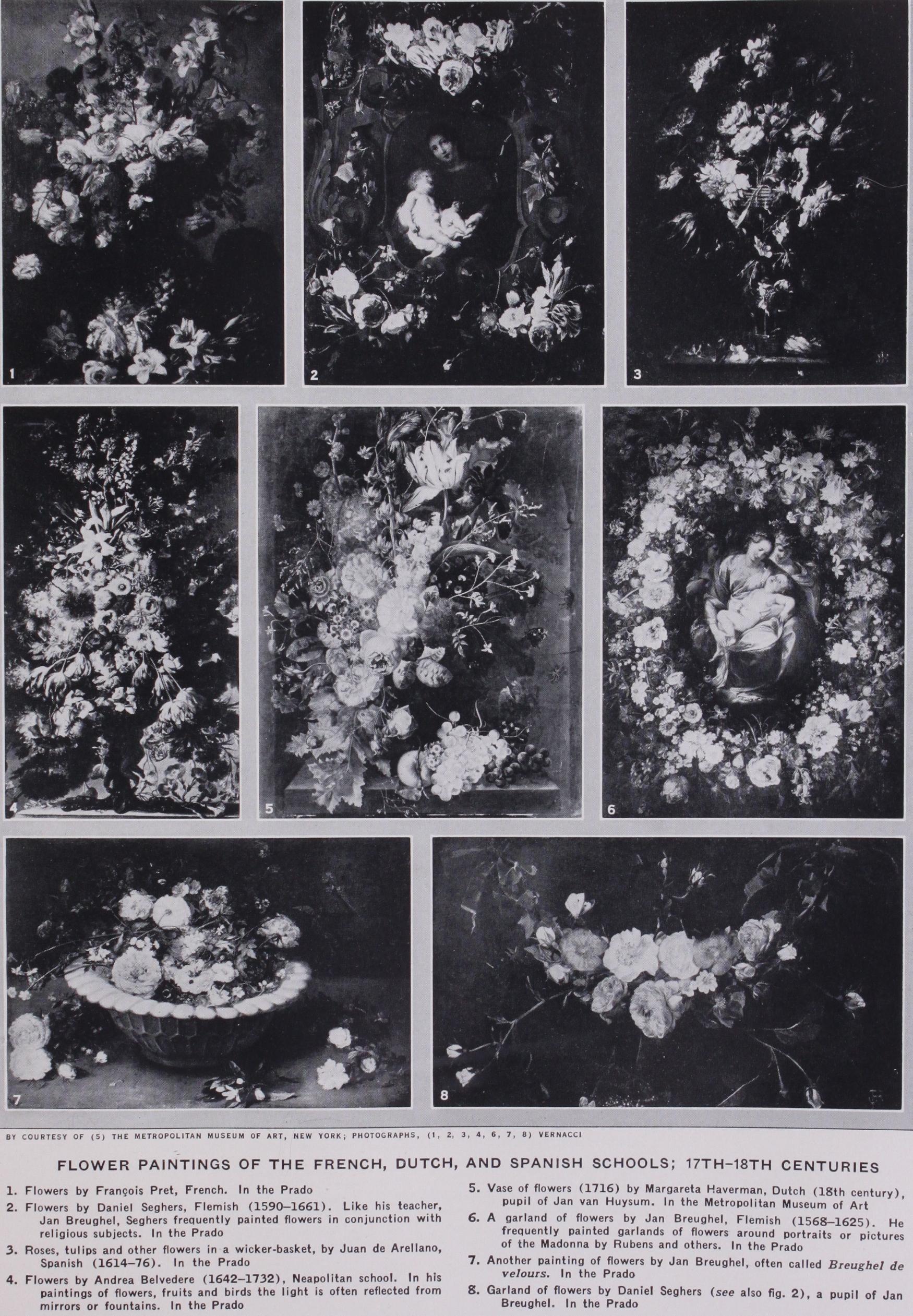
Later a German, Abraham Mignon (1639-1697), pupil of de Heem's, who worked in Holland, made for himself a reputation second only to his master. He, in addition to painting grouped flowers and fruit, painted growing flowers but with little of their rhythmic beauty of growth and no sense of their envelopment by air and light. Andrea Belvedere (1646-1732), a Neapolitan, is another painter, of this later time, with something of the Dutch tradition, much of Ruoppoli and something of Juan de Arellano's. Like him his flower paintings are often in pairs. His pictures are crowded but there is much, as in Arellano's, of the easy free growth of the flowers. The crowning point of this kind of flower painting was reached by Jan Van Huysum (1682-1749), who painted well into the 18th century. His flowers are masterly in the drawing of their exquisite and beautiful forms, superb in their third-dimensional quality, and in their delicate and gracious con tours. His combinations of colour, his contrasting of light flowers against dark and his design of the wealth of blossoms portrayed, produced gorgeous decorative effects and place him without ques tion as one of the greatest masters of flower painting. Yet his paintings lack a feeling for the living flower and do not possess that quality of growth so superbly grasped by the artists of the East. They lack, too, the beauty of transmitted light and trans lucent colour that gives so much of the ethereal quality to flowers. These qualities were to come later in the painting of the French school of the 19th century. However, in his time his pictures were unequalled for exquisiteness and grace of form, and were master pieces of faultless finish. Rachel Ruysch (1664-17 5o) painted in a similar manner and is by some critics considered his equal. Van Huysun's influence was considerable ; and flower pictures in his manner continued to be painted on into the 19th century. They are not as sumptuous, have not the same perfected finish and have not usually the same beauty of form. Often they have an increased harshness.
In France there is an evidence of greater concern for the living character of the flower, a sense of its lightness and delicacy, or, its heaviness, on its stem—a sense for the frailness of flowers that makes Huysum's seem almost moulded from thin metal. Such a painter as Laurent Melaine (1i45-1809) gives evidence of this, as does Francois Pret, of whom there seems to be no existing biography or even dates, but, whose robust and richly painted flowerpiece in the Prado, places him as a master, and moves the art of flower painting a step forward. It is in France, in the second part of the 19th century that flower painting reveals a new and glowing character. The changes brought about in paint ing by the French painters of this time are well known. The naturalistic trend of Courbet ; Manet's aesthetic interest in colour and his admiration of Japanese art, tending to rich vivid masses of pure colour; Monet's interest in light, and colour in light—all these had their influence on flower painting.
France produced, adding these new phases to those of the Dutch school, a group of flower painters that is unsurpassed. In the dec ade between 1830 and 184o were born Edouard Manet (183 2 83), Antoine Vollon (1833-1900), Fantin-Latour (1836-1904) and Claude Monet (184o-1926). Manet and Monet were the real influences for added characteristics of painting, but Fantin-Latour was the great painter of flowers. In Manet's flower painting rich arrangement of colour in a bright and surrounding light gives a sumptuous quality. His flowers are painted with great gusto, fresh ness and luminosity. His influence is perhaps stronger on the painters of flowers of to-day than that of any other painter; but Monet's influence has been of an unmeasurable quantity also. He made the world see colour in light, pure colour of a vibrating, iridescent quality. In his pictures he has perhaps painted flowers rather more as a medium by which to express this feeling for pure colour in light and in space than because of the beauty of the flowers in themselves. Latour, on the other hand, understood flowers, their delicacy of form, growth and colour, and painted them for their own great beauty, but, in doing so, combined the qualities of his two great contemporaries. His pictures are beauti ful arrangements of form and colour with all the living vibrating, if passing, qualities of the flower, placed in full light with atmos phere surrounding them, and they mark to the present time the high spot of Western flower painting.
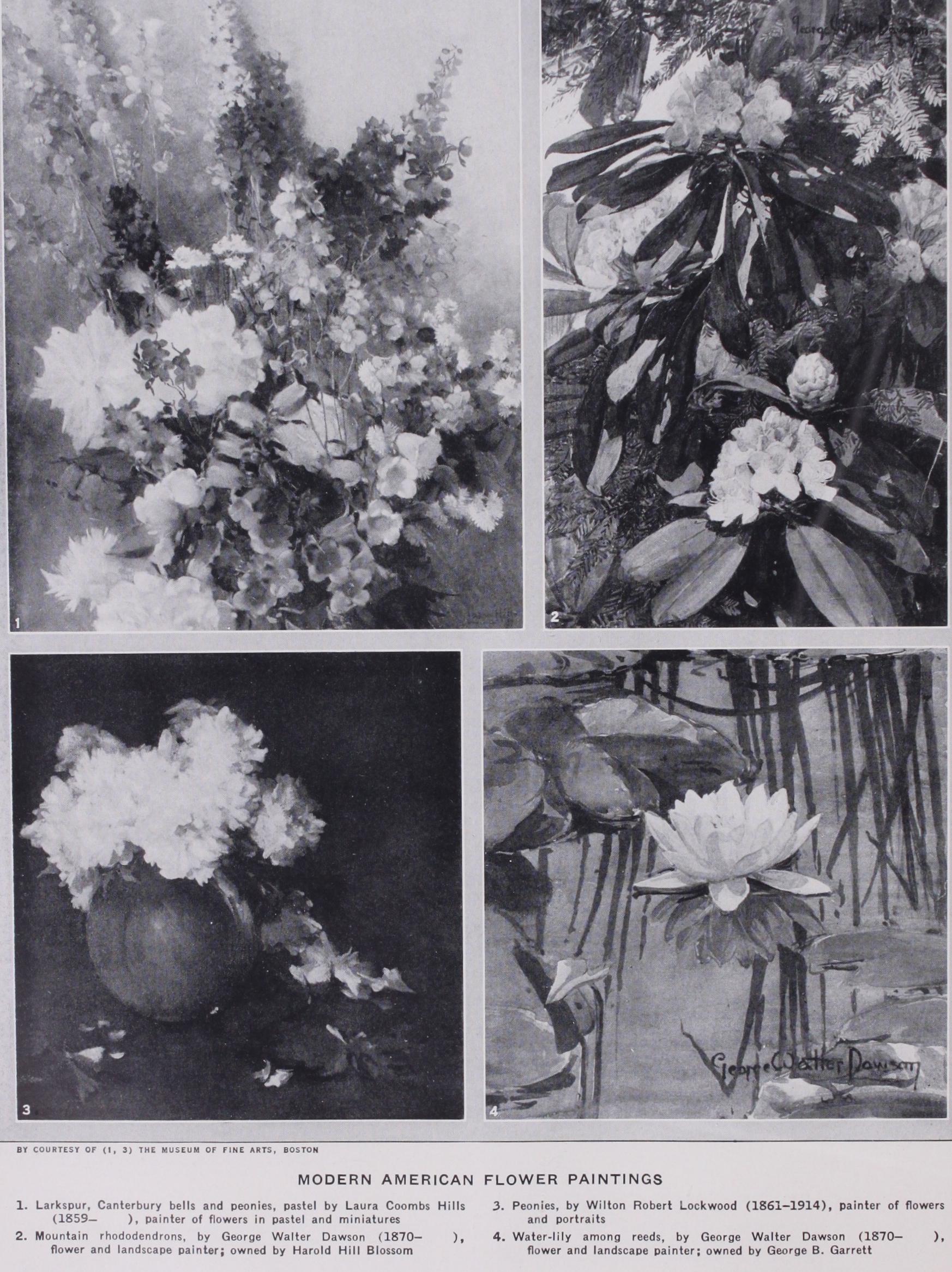
Between the realistic Dutch period and the French impression istic, William Henry Hunt (179o-1864) in England, painting in a method quite his own, produced flower pictures in water colour that, ungracious as they generally are, had much of the exactness of floral structure with a suggestion in colour, that was slightly related to what the French later developed to such a supreme degree. Later still, Francis E. James (1849-192o) developed in water-colour a crisp delightful phase of flower painting. Contem porary with the great French impressionists, John La Farge (183 191 o) in America was a true flower painter, and the forerunner of a number of flower painters in this country. Abbott Thayer, Wilton Lockwood, Maria Oakley Dewing, Charles Demuth and Laura Hills are artists who have found, in flowers, subjects for their paintings, and each has added something to the art. (See also PAINTING; WATER-COLOUR PAINTING.) (G. W. D.)