SEIGNEUR DE 7) , marshal of France and historian, was the son of Robert II. de la Marck, duke of Bouillon, seigneur of Sedan and Fleuranges, whose uncle was William de la Marck, "The Wild Boar of the Ardennes." At the age of ten he was sent to the court of Louis XII., and placed in charge of the count of Angouleme, afterwards King Francis I. He served in Francis's Italian campaigns, and in 1512 the French being driven from Italy, Fleuranges was sent into Flanders to levy a body of 10,000 men, in command of which, under his father, he returned to Italy in 1513, seized Alessandria, but failed to take Novara. In 1515 he distinguished himself at Marignano, where the king knighted him with his own hand. He next took Cremona, and was there called home by the news of his father's illness. In 1519 he was sent into Germany to canvass the electors in favour of Francis I. Fleuranges fought at Pavia (1525), and was taken prisoner with Francis. The emperor, irritated by the defection of his father, Robert II. de la Marck, kept him in prison in Flanders for some years. During this imprisonment he was created marshal of France. In his His toire des choses memorables advenues au regne de Louis XII. et de Francois I., depuis 1499 jusqu'en l'an 1521, written in prison, ed. Lambert 1735, also in the Nouvelle Collection des memoires pour servir a l'histoire de France (edited by J. F. Michaud and J. J. F. Poujoulat, series i. vol. v. Paris, 1836 seq.), he gives many curious and interesting details of the events he had witnessed. He died at Longjumeau in Dec. 1 ; 3 7 .
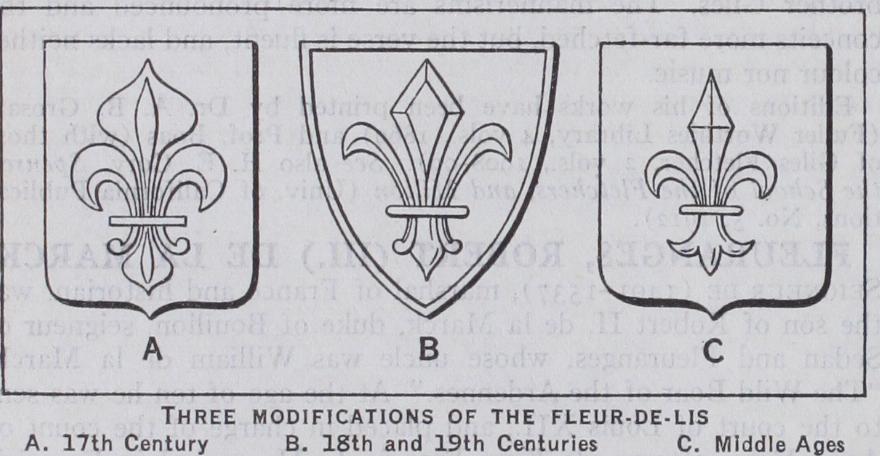
(Fr. "lilyflower"), an heraldic device, very widespread in the armorial bearings of all countries, but more particularly associated with the royal house of France. The con ventional fleur-de-lis, as Lithe says, represents very imperfectly three flowers of the white lily (Lilium) joined together, the central one erect, and each of the other two curving outwards. The fleur-de-lis is a common device in ancient decoration, notably in India and in Egypt, where it was the symbol of life and resurrec tion, the attribute of the god Horus. It is common also in Etrus can bronzes. It is uncertain whether the conventional fleur-de-lis was originally meant to represent the lily or white iris—the flower-de-luce of Shakespeare—or an arrowhead, a spear-head, an amulet fastened on date-palms to ward off the evil eye, etc. In Roman and early Gothic architecture the fleur-de-lis is a fre quent sculptured ornament. As early as I120 three fleurs-de-lis were sculptured on the capitals of the Chapelle Saint-Aignan at Paris. The fleur-de-lis was first definitely connected with the French monarchy in an ordonnance of Louis le Jeune (c. 1147), and was first figured on a seal of Philip Augustus in I180. The use of the fleur-de-lis in heraldry dates from the 12th century, soon after which period it became a very common charge in France, England and Germany, where every gentleman of coat armour desired to adorn his shield with a loan from the shield of France, which was at first d'azur, seme de fleurs de lis d'or. In Feb. 1376 Charles V. of France reduced the number of fleurs de-lis to three—in honour of the Trinity—and the kings of France thereafter bore d'azur, d trois fleurs de lis d'or. Tradition soon attributed the origin of the fleur-de-lis to Clovis, the founder of the Frankish monarchy, and explained that it represented the lily given to him by an angel at his baptism. Whatever be the true origin of the fleur-de-lis as a conventional decoration, it is demonstrably far older than the Frankish monarchy, and history does not record the reason of its adoption by the royal house of France, from which it passed into common use as an heraldic charge in most European countries. An order of the Lily, with a fleur-de-lis for badge, was established in the Roman states by Pope Paul III. in 1546; its members were pledged to defend the patrimony of St. Peter against the enemies of the Church. Another order of the Lily was founded by Louis XVIII. in 1816, in memory of the silver fleurs-de-lis which the Comte d'Artois had given to the troops in 1814 as decorations; it was abolished by the revolution of 183o.