FOUNTAIN, a term applied equally to simple arrangements for letting water gush into an ornamental basin and to more elabo rate ones by which water is mechanically forced into high jets, to the ornamental receptacle and to the jet of water itself. A very early extant example is preserved in the carved Babylonian basin (c. 300o B.c.) found at Tello, the ancient Lagash, and Layard mentions an Assyrian fountain, found by him in a gorge of the river Gomel, which consists of a series of basins cut in the solid rock and descending in steps to the stream. (A. H. Layard, Dis coveries Among . . . Ruins of Nineveh and Babylon, p. 182, 1853.) The water had originally been led from one to the other by small conduits, the lowest of which was ornamented by two rampant lions in relief.
Greek.—During the Aegean civilization, as in later Hellenic Greece, springs were frequently considered sacred and shrines were built round them, the water often emerging into artificial basins. In historic Greece, such fountains, more highly developed, with cut stone openings and marble basins, were common, and both literary references and excavated remains abound. Fre quently the fountain proper was surrounded by a wall and oc casionally small rooms, used for shrines or for ex-voto offerings, stood near by. Some were surrounded by columns, as at Lerna. Groves were sometimes planted in connection with the fountain shrines. The city of Corinth was particularly noted for its foun tains, the most famous being that dedicated to the nymph Pirene, whose tears, in bewailing her sons, slain by Artemis, were claimed by myth as the origin of the spring.
In Roman civilization water was distributed from each terminal reservoir, or castellurn, not only to baths and to large houses, but also to many public fountains from which the poorer people drew their supply. In many cases these fountains, usually at street corners, were decorated with human, animal or grotesque heads, from whose mouths the water issued. Several such public fountains have been uncovered at Pompeii. A charac teristic example, standing on a street corner near the house of Pansa, consists of a rectangular basin on the edge of the curb with a small carved pedestal rising behind it and a small sinkage at the front of the basin, which acted as an overflow. In addition to these small public fountains, great monumental structures known as nymphaea (see NYMPHAEUM) were constructed for purely decorative purposes. These structures, like the Greek foun tains, were considered shrines to nymphs, and often took the shape of an exedra (q.v.) covered by a half dome, and in Roman imperial times were richly decorated. A good example exists near the agora at Ephesus. Fountains were much used as garden decorations by the Romans. Three forms are found. In the first the water gushes from a statue or mass into a basin, and from that trickles down into lower and wider basins. The second resembles a miniature nymphaeum and consists of a decorative niche contain ing the fountain proper. Two charming examples of this. type have been found in Pompeii with the niches decorated by mosaics, predominantly blue, and ornamented with bands of small sea shells. The third type is that known to-day as the jet d' eau in which water under a considerable head or pressure, is led to a small vertical orifice from which it spouts high in the air. Wall paintings from Pompeii and in the Museo Belle Terme at Rome show the type clearly.
Mediaeval.—During the earlier middle ages, although occa sional architectural treatments of natural springs are found, foun tains elsewhere passed out of use ; wells furnished the greater part of the necessary water. From the 12th century, however, public fountains began to reappear, and the spring fountains re ceived a more highly developed architectural treatment. The usual form of the latter consisted of a large basin reached by a descending stairway and covered over with a vault, sometimes enclosed and sometimes supported only on piers. At Poitiers, the Fontaine Joubert
century, restored 1597) was originally of this type. Other crude examples are common in Brittany. The public fountains of the mediaeval towns usually had a polygonal or circular basin, occasionally lobed, in the centre of which rose a column or pier carrying a series of spouts. The architectural details are of infinite variety. From the simple hexagonal vase and column of the lath century fountain at Provins to the elabo rate richness of the i 5th century fountains of south Germany, every kind of Gothic detail is found. Particularly noteworthy is the Schone Brunnen at Nuremburg (1385-96), distinguished by its high, rich, Gothic spirelet, with many statues, and the iron railing which surrounds it.
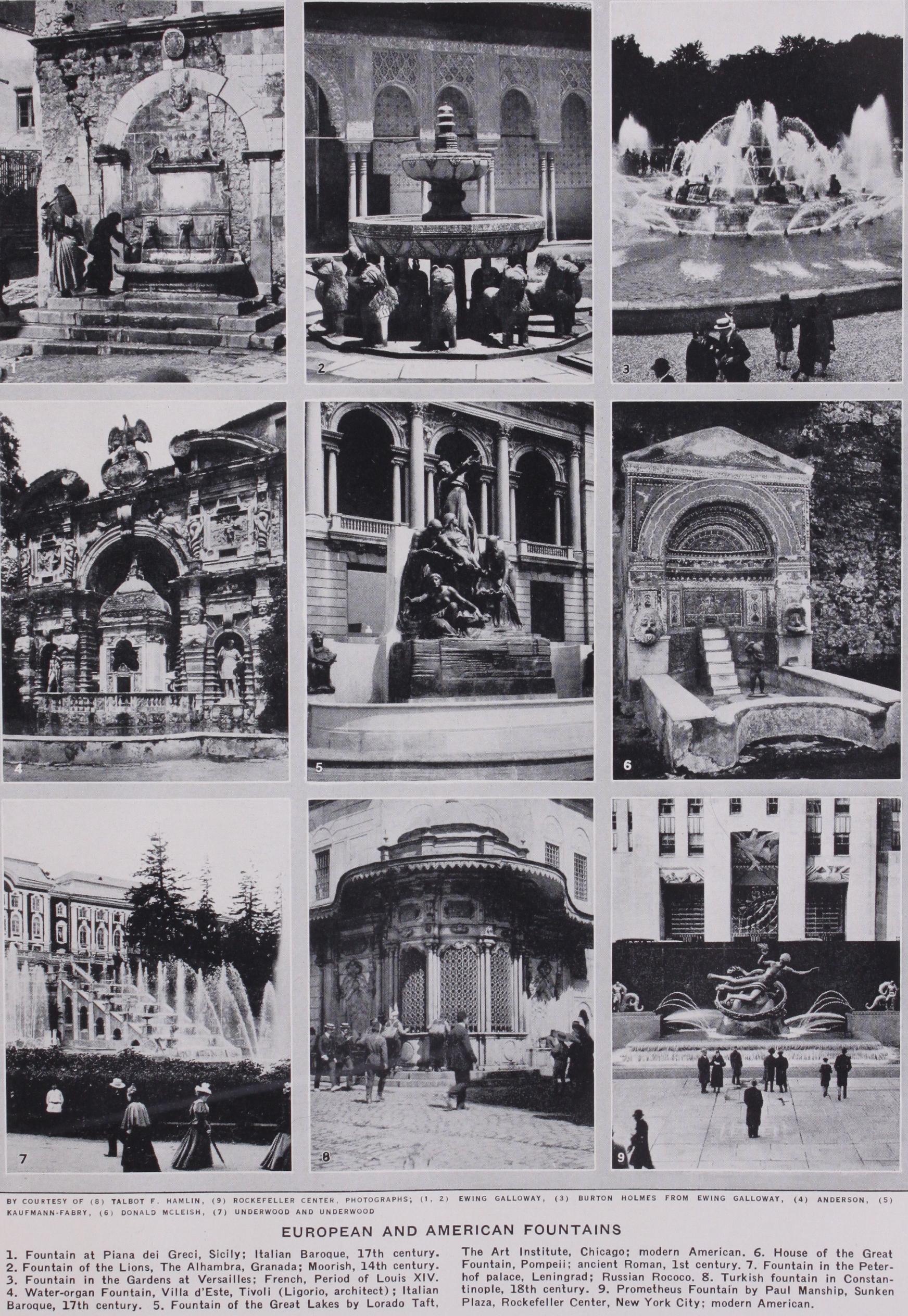
With the coming of the early Renaissance in Italy, a new phase of fountain design, in which sculpture played an ever increasing part, began. The earlier examples consist, usually, of a series of basins, frequently circular, one above the other, the smallest at the top, the whole crowned by the fountain figure, from which the water spouts. Later the complexity of basin and water treatment was increased and many figures, instead of one, were sometimes used, as in Bernini's famous fountain in the Piazza di Navona in Rome, where Tritons and river gods decorate a mass of rustic masonry in the centre. Equally well known are the fountains that he added to the piazza in front of S. Peter's, as simple as the former is complex. In each of these a single enormous vertical jet of water falls into a simple upper basin and from that into a larger lower basin. The same Baroque period saw the addition of monumental fountains more allied to the Roman nvmphaea, in which the water was hardly more than an incident in a vast architectural composition. Such are the Aqua Paola and the fountain of Trevi, both at Rome, the former, by Fontana and Della Porta (c. i600) and the latter built in the i8th century from designs probably by Bernini. In addition to these public fountains, the Baroque period in Italy produced an enormous number of villa fountains of all types, frequently of the most fantastic design, like the water organ of the Villa d' Este, Tivoli, controlled by elaborate mechanical devices so as to play only when certain pavement stones were stepped on, etc., as in the small terrace fountains of the same villa.
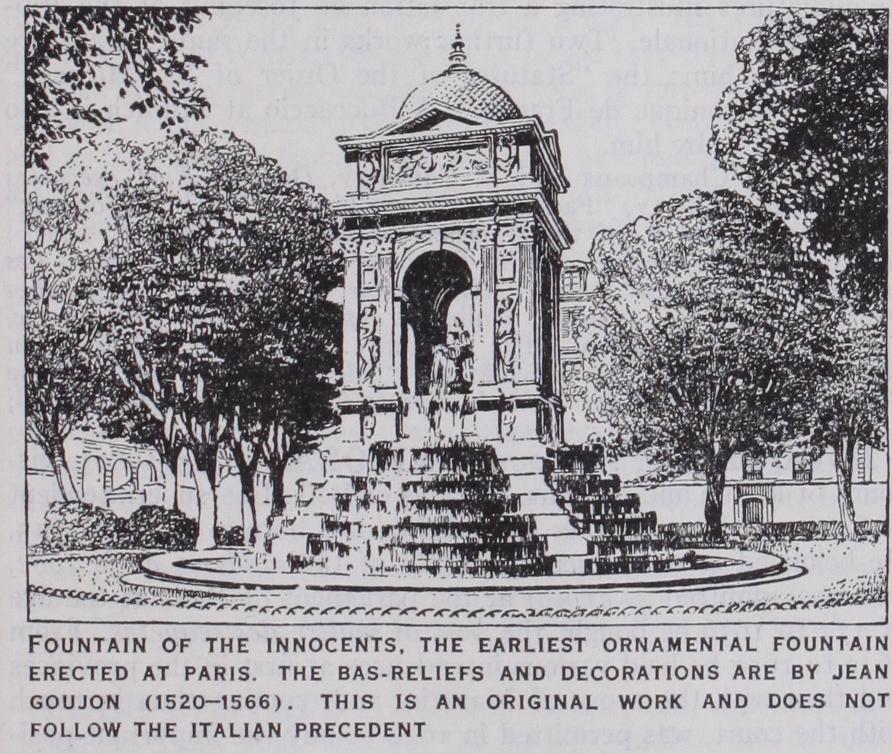
French fountains often follow Italian precedent, although the Fontaine des Innocents, in Paris, by Jean Goujoun (early 16th century) is an original work of much charm, but in general, city fountains of north and west Europe are merely variations of types already set in Rome. Characteristically naive and fantastic in its use of sculpture is the famous little fountain in Brussels known as the Mannikin, by Duquesnoy, 1619, upon which Louis XV. is supposed to have conferred the Cross of St. Louis. A remarkable example of the architectural niche type is the lovely Medici fountain in the Luxembourg Gardens in Paris, by de Brosse, early in the 17th century. The great group of fountains at Versailles, with its magnificent combination of jets of water and sculpture is only a fantastic development on an enormous scale of ideas originally developed in the Italian Baroque villas.
T h e foun tains of Muslim countries are of great interest and beauty. They usually take the form of small square buildings, richly decorated, on the sides of which are the spouts and basins, but simpler forms of great beauty in which the spout and basin are merely enclosed within a graceful niche exist.
In modern times the practical necessity of foun tains has largely disappeared. Horse troughs and small drink ing fountains are, however, still plentiful in most cities. In gen eral, these are of the simplest design, and the most recent are of the so-called bubbling type, in which the water is drunk directly from the jet without a cup. For decorative and monumental use, however, fountains are more common than ever. In the smaller types modern sculpture has found one of its most congenial outlets. A magnificent ex ample of the modern monumental fountain is the Buckingham Memorial Fountain at Chicago (19a 7) by Jacques Lambert, of Paris, and Bennet, Parsons and Frost, of Chicago. (T. F. H.)
