
FRENCH LITERATURE. Literature proper began to be cultivated in France, in the vernacular, during the loth and 11th centuries. The earliest writings are cantilenae, or songs in the vulgar language (e.g., on St. Eulalia), a Life of St. Leger and a Life of St. Alexis (perhaps about 1050), but the first real monu ment of French Literature is the Chanson de Roland, which re mains the greatest achievement of that literature until the Renais sance. The Chanson de Roland is the masterpiece of a flourishing type of epic poetry, the chansons de geste, of which we possess about 1 oo specimens.
Chansons de geste.-These deal with subjects of traditional French history. The line generally used is of ten syllables, and in later poems of 12 ; there is a regular caesura. The lines are arranged in laisses or tirades of very irregular numbers. The earlier poems are assonanced, only the vowel sound of the last syllables being identical. Later the poems are rhymed in a regular manner. In subject matter there are three chief groups: one deal ing with Charlemagne, one with Doon of Mayence, one with Garin de Monglane. There are other groups, not so numerous, on the Lorrainers, on the crusades, etc.
The earliest versions alone of the various poems would amount to over 300,000 lines. The successive development of the chansons de geste may be illustrated by the fortunes of Huon de Bordeaux, one of the most lively, varied and romantic of the older epics, and one which is interesting from the use made of it by Shakespeare, Wieland and Weber. In the oldest form now extant, though even this is probably not the original, Huon consists of over 1o,000 lines. A subsequent version contains Ii,000 more, and lastly, in the 14th century, a later poet has amplified the legend to the extent of 30,000 lines. When this point had been reached Huon began to be turned into prose being, with many of its fellows, pub lished and republished during the subsequent centuries, and re taining, in popular forms and garbs, the favour of the country districts and of the school children of France to the present day. But the best period of the chanson de geste was the 11th and 12th centuries. The Chanson de Roland is the earliest we possess and belongs in its present form to the early 12th century. Two classes of persons are chiefly associated with the chansons de geste. There was the trouvere who composed them, and the jongleur who carried them about in manuscript or in his memory from castle to castle and sang them intermixing frequent appeals to his audience for silence, declarations of the novelty and the strict copyright character of the chanson, revilings of rival minstrels and fre quent requests for money in plain words. Not a few of the manu scripts which we now possess appear to have been actually used by the jongleurs. But the names of the authors are known only in very few cases, the names of copyists, continuators and mere owners of manuscripts having often been mistaken for them.
With the romances to which we have already referred Chretien's poems complete the earlier forms of the Arthurian story, and supply the matter of it as it is best known to English readers in Malory's book. Nor does that book, though far later than the original forms, convey a very false impression of the characteristics of the older romances. Indeed, the Arthurian knight, his character and adventures, are so much better known than the heroes of the Carlovingian chansons that there is less need to dwell upon them. The romances had, as has been already pointed out, great influence upon their rivals, and their compara tive fertility of invention, the much larger number of their dramatis personae, and the greater variety of interests to which they appealed, sufficiently explain their increased popularity. The ordinary attractions of poetry are also more largely present in them than in the chansons; there is more description, more life, and less of the mere chronicle. They have been accused of relaxing morality, and there is perhaps some truth in the charge. But the change is after all one rather of manners than of morals, and what is lost in simplicity is gained in refinement and the beginnings of a sense of literary form.
Alexander is made in many respects a prototype of Charle magne. He is regularly knighted, he has peers, he holds tourna ments, he has relations with Arthur, and comes in contact with fairies, he takes flights in the air, dives in the sea and so forth. There is perhaps more avowed imagination in these classical stories than in either of the other divisions of French epic poetry. Some of their authors even confess to the practice of fiction, while the trouveres of the chansons invariably assert the historical char acter of their facts and personages, and the authors of the Arthu rian romances at least start from facts vouched for, partly by national tradition, partly by the authority of religion and the church. The classical romances, however, are important in two different ways. In the first place, they connect the early litera ture of France, however loosely, and with links of however dubi ous authenticity, with the great history and literature of the past. They show a certain amount of scholarship in their authors, and in their hearers they show a capacity for taking an interest in subjects which are not merely those directly connected with the village or the tribe. The chansons de geste had shown the creative power and independent character of French literature. There is, at least about the earlier ones, nothing borrowed, traditional or scholarly. They smack of the soil, and they rank France among the very few countries which, in this matter of indigenous growth, have yielded more than folksongs and fireside tales. The Arthu rian romances, less independent in origin, exhibit a wider range of view, a greater knowledge of human nature, and a more extensive command of the sources of poetical and romantic interest. The classical epics superadd the only ingredient necessary to an accom plished literature—i.e., the knowledge of what has been done by other peoples and other literatures already, and the readiness to take advantage of the materials thus supplied.
The special period of fabliau composition appears to have been the r2th and r3th centuries. It signifies on the one side the growth of a lighter and more sportive spirit than had yet prevailed, on another the rise in importance of other and lower orders of men than the priest and the noble, on yet another the consciousness on the part of these lower orders of the defects of the two priv ileged classes, and of the shortcomings of the system of polity under which these privileged classes enjoyed their privileges. There is, however, in the fabliau proper not so very much of direct satire, this being indeed excluded by the definition given above, and by the thoroughly artistic spirit in which that definition is observed. The fabliaux are so numerous and so various that it is difficult to select any as specially representative. We may, how ever, mention, both as good examples and as interesting from their subsequent history, Le Vain Pal f roi, treated in English by Leigh Hunt and by Peacock ; Le Vilain Mire, the original con sciously or unconsciously followed in Le Medecin malgre lui; Le Roi d'Angleterre et le jongleur d'Eli; La Tfiouce pantie; Le Sot Chevalier, an indecorous but extremely amusing story ; Les deux bordeors ribaus, a dialogue between two jongleurs of great literary interest, containing allusions to the chansons de geste and ro mances most in vogue ; and Le vilain qui conquist paradis par plait.
The French poems which we possess on the subject amount in all to nearly roo,000 lines, independently of mere variations, but including the different versions of Renart le Contrefait. The sep arate branches are the work of different authors, hardly any of whom are known, and, but for their community of subject and to some extent of treatment, might be regarded as separate poems. The history of Renart, his victories over Isengrim the wolf, Bruin the bear, and his other unfortunate rivals, his family affection, his outwittings of King Noble the Lion and all the rest, are too well known to need fresh description here. It is perhaps in the subsequent poems, though they are far less known and much less amusing, that the hold which the idea of Renart had obtained on the mind of northern France, and the ingenious uses to which it was put, are best shown. The first of these is Le Couronnement de Renart, a poem of between 3,00o and 4,000 lines, attributed, on no grounds whatever, to the poetess Marie de France, and describ ing how the hero by his ingenuity got himself crowned king. This poem already shows signs of direct moral application and general izing. These are still more apparent in Renart le Nouvel, a com position of some 8,000 lines, finished in the year 1288 by the Fleming Jacquemart Gelee. Here the personification, of which, in noticing the Roman de la rose, we shall soon have to give extended mention, becomes evident. Instead of or at least beside the lively personal Renart who used to steal sausages, set Isengrim fishing with his tail, or made use of Chanticleer's comb for a purpose for which it was certainly never intended, we have Renardie, an ab straction of guile and hypocrisy, triumphantly prevailing over other and better qualities. Lastly, as the Roman de la rose of Wil liam of Lorris is paralleled by Renart le Nouvel, so its continu ation by Jean de Meung is paralleled by the great miscellany of Renart le Contrefait, which, even in its existing versions, extends to fully 50,000 lines. Here we have, besides floods of miscella neous erudition and discourse, political argument of the most direct and important kind. The wrongs of the lower orders are bitterly urged.
The earliest song literature is mainly sentimental in character. The collectors divide it under the two heads of romances and pas tourelles, the former being usually the celebration of the loves of a noble knight and maiden, and recounting how Belle Doette or Eglantine or Oriour sat at her windows or in the tourney gallery, or embroidering silk and samite in her chamber, with her thoughts on Gerard or Guy or Henry,—the latter somewhat monotonous but naïve and often picturesque recitals, very often in the first person, of the meeting of an errant knight or minstrel with a shep herdess, and his cavalier but not always successful wooing. With these, some of which date from the 12th century, may be con trasted, at the other end of the mediaeval period, the more varied and popular collection dating in their present form from the 15th century, and published in 1875 by Gaston Paris. In both alike, making allowance for the difference of their age and the state of the language, may be noticed a charming lyrical faculty and great skill in the elaboration of light and suitable metres. Es pecially remarkable is the abundance of refrains of an admirably melodious kind. It is said that more than 500 of these exist.
Among the lyric writers of these four centuries whose names are known may be mentioned Audefroi le Bastard (12th century), the author of the charming song of Belle Idoine, and others no way inferior, Quesnes de Bethune, the ancestor of Sully, whose song-writing inclines to a satirical cast in many instances, the Vidame de Chartres, Charles d'Anjou, King John of Brienne, the chatelain de Coucy, Gace Brusle, Colin Muset, while not a few writers mentioned elsewhere—Guyot de Provins, Adam de la Halle, Jean Bodel and others—were also lyrists. But none of them, except perhaps Audefroi, can compare with Thibaut IV. (1201 53) , who united by his possessions and ancestry a connection with the north and the south, and who employed the methods of both districts but used the language of the north only. Thibaut was supposed to be the lover of Blanche of Castille, the mother of St. Louis, and a great deal of his verse is concerned with his love for her. But while knights and nobles were thus employing lyric poetry in courtly and sentimental verse, lyric forms were being freely employed by others, both of high and low birth, for more general purposes. Blanche and Thibaut themselves came in for contemporary lampoons, and both at this time and in the times immediately following, a cloud of writers composed light verse, sometimes of a lyric, sometimes of a narrative kind, and some times in a mixture of both. By far the most remarkable of these is Rutebeuf.
Rutebeuf is among the earliest French writers who tell us their personal history and make personal appeals. But he does not confine himself to these. He discusses the history of his times, he composes pious poetry too, and in at least one poem takes care to distinguish between the church which he venerates and the cor rupt churchmen whom he lampoons. Besides Rutebeuf the most characteristic figure of his class and time (about the middle of the 13th century) is Adam de la Halle, commonly called the Hunchback of Arras. The earlier poems of Adam are of a senti mental character, the later ones satirical and somewhat ill-tem pered. Such, for instance, is his invective against his native city. But his chief importance consists in his jeux, the Jeu de la f euillee, the Jeu de Robin et Marion, dramatic compositions which led the way to the regular dramatic form. Indeed the general tend ency of 13th century is to satire, fable and farce, even more than to serious or sentimental poetry. We should perhaps except the lais, the chief of which are known under the name of Marie de France. These lays are exclusively Breton in origin, though not in application, and the term seems originally to have had refer ence rather to the music to which they were sung than to the manner or matter of the pieces. The subjects of the lais are indifferently taken from the Arthurian cycle, from ancient story, and from popular tradition, and, at any rate in Marie's hands, they give occasion for some passionate, and in the modern sense really romantic, poetry. The most famous of all is the Lay of the Honeysuckle, traditionally assigned to Sir Tristram.
But this serious and discontented spirit betrays itself also in compositions which are not parodies or travesties in form. One of the latest, if not absolutely the latest (for Cuvelier's still later Clironique de Du Guesclin is only a most interesting imita tion of the chanson form adapted to recent events), of the chan sons de geste is Baudouin de Sebourc, one of the members of the great romance or cycle of romances dealing with the crusades, and entitled Le Chevalier an Cygne. Baudouin de Sebourc dates from the early years of the 14th century. It is strictly a chanson de geste in form, and also in the general run of its incidents. The hero is dispossessed of his inheritance by the agency of traitors, fights his battle with the world and its injustice, and at last prevails over his enemy Gaufrois, who has succeeded in obtaining the king dom of Friesland and almost that of France. Gaufrois has as his assistants two personages who were very popular in the poetry of the time,—viz. the Devil, and Money. These two sinister figures pervade the fabliaux, tales and fantastic literature generally of the time. The abuse of usury at the time, and the exactions of the Jews and Lombards, were severely felt, and Money itself, as per sonified, figures largely in the popular literature.
In the 14th century the influence of the Roman de la rose helped to render moral verse frequent and popular. The same century, moreover, which witnessed these developments of well-intentioned if not always judicious erudition witnessed also a considerable change in lyrical poetry. Hitherto such poetry had chiefly been composed in the melodious but unconstrained forms of the romance and the pastourelle. In the i4th century the writers of northern France subjected themselves to severer rules. In this age arose the forms which for so long a time were to occupy French singers—the ballade, the rondeau, the rondel, the triolet, the chant royal and others. These received considerable altera tions as time went on. We possess not a few Artes poeticae, such as that of Eustache Deschamps at the end of the 14th century and that of Thomas Sibilet in the 16th, giving particulars of them, and these particulars show considerable changes. The ear liest poets who appear to have practised them extensively were born at the close of the i3th and the beginning of the 14th cen turies. Of these Guillaume de Machault (c. 1300-80) is the oldest. He has left us 8o,000 verses. Eustache Deschamps (c. 1340–c. 1410) was nearly as prolific. Froissart the historian was also an agreeable and prolific poet. Less known but not less noteworthy, and perhaps the earliest of all, is Jehan not de Lescurel, whose personality is obscure, and most of whose works are lost, but whose fragments are full of grace. Froissart appears to have had many countrymen in Hainault and Brabant who devoted themselves to the art of versification; and the Livre des cent ballades of the Marshal Boucicault (1366-1421) and his friends—c. 139o—shows that the French gentleman of the i4th century was as apt at the ballade as his Elizabethan peer in Eng land was at the sonnet.
For a long time, however, the mystery and miracle plays re mained the mainstay of theatrical performance, and until the i3th century actors as well as performers were more or less taken from the clergy. It has, indeed, been well pointed out that the offices of the church were themselves dramatic performances, and re quired little more than development at the hands of the mystery writers. The occasional festive outbursts, such as the Feast of Fools, that of the Boy Bishop and the rest, helped on the develop ment. The variety of mysteries and miracles was very great. A single manuscript contains 4o miracles of the Virgin, averaging from 1,200 to 1,5oo lines each, written in octosyllabic couplets, and at least as old as the 14th century, most of them perhaps much earlier. The mysteries proper, or plays taken from the scriptures, are older still. Many of these are exceedingly long. There is a Mystere de l'Ancien Testament, which extends to many volumes, and must have taken weeks to act in its entirety. The Mystere de la Passion, though not quite so long, took several days, and recounts the whole history of the gospels. The best apparently of the authors of these pieces, which are mostly anonymous, were two brothers, Arnoul and Simon Greban (authors of the Actes des apotres, and in the first case of the Passion), c. 1450, while a cer tain Jean Michel (d. 1493) is credited with having continued the Passion from 30,000 lines to 5o,000. But these performances, though they held their ground until the middle of the 16th century and extended their range of subject from sacred to profane his tory—legendary as in the Destruction de Troie, contemporary as in the Siege d'Orleans—were soon rivalled by the more profane performances of the moralities, the farces and the soties. The palmy time of all these three kinds is the 15th century, while the Conf rerie de la Passion itself, the special performers of the sacred drama, only obtained the licence constituting it by an ordinance of Charles VI. in 1402. In order, however, to take in the whole of the mediaeval theatre at a glance, we may anticipate a little. The Confraternity was not itself the author or performer of the profaner kind of dramatic performance. This latter was due to two other bodies, the clerks of the Bazoche and the Enfans sans Souci. As the Confraternity was chiefly composed of trades men and persons very similar to Peter Quince and his associates, so the clerks of the Bazoche were members of the legal profession of Paris, and the Enfans sans Souci were mostly young men of family. The morality was the special property of the first, the sotie of the second. But as the moralities were sometimes decid edly tedious plays, though by no means brief, they were varied by the introduction of farces, of which the jeux already men tioned were the early germ, and of which L'Avocat Patelin, dated by some about 1465 and certainly about 200 years subsequent to Adam de la Halle, is the most famous example.
The morality was the natural result on the stage of the immense literary popularity of allegory in the Roman de la rose and its imitations. The sotie was directly satirical, and only assumed the guise of folly as a stalking-horse for shooting wit. It was more Aristophanic than any other modern form of comedy, and like its predecessor, it perished as a result of its political application. Encouraged for a moment as a political engine at the beginning of the 16th century, it was soon absolutely forbidden and put down, and had to give place in one direction to the lampoon and the prose pamphlet, in another to forms of comic satire more general and vague in their scope. The farce, on the other hand, having neither moral purpose nor political intention, was a purer work of art, enjoyed a wider range of subject, and was in no danger of any permanent extinction. Farcical interludes were interpolated in the mysteries themselves ; short farces introduced and rendered palatable the moralities, while the sotie was itself but a variety of farce, and all the kinds were sometimes combined in a sort of tetralogy. It was a short composition, Soo verses being considered sufficient, while the morality might run to at least 1,000 verses, the miracle play to nearly double that number, and the mystery to some 40,000 or 50,000.
Of the pieces represented one only, that of Maitre Patelin, is now much known; but many are almost equally amusing. Patelin itself has an immense number of versions and editions. Other farces are too numerous to attempt to classify; they bear, however, in their subjects, as in their manner, a remarkable re semblance to the fabliaux, their source. Conjugal disagreements, the unpleasantness of mothers-in-law, the shifty or, in the earlier stages, clumsy valet and chambermaid, the mishaps of too loosely given ecclesiastics, the abuses of relics and pardons, the extortion, violence, and sometimes cowardice of the seigneur and the sol diery, the corruption of justice, its delays and its pompous ap paratus, supply the subjects. The treatment is rather narrative than dramatic in most cases, as might be e5pected, but makes up by the liveliness of the dialogue for the deficiency of elaborately planned action and interest. All these forms, it will be observed, are directly or indirectly comic. Tragedy in the middle ages is represented only by the religious drama, except for a brief period towards the decline of that form, when the "profane" mysteries referred to above came to be represented. These were, however, rather "histories," in the Elizabethan sense, than tragedies proper.
The rhymed chronicles of Philippe Mousket and Guillaume Guiart belong to the next half-century ; and in prose the most remarkable works are the Chronique de Reims, a well written history, having the interesting characteristics of taking the lay and popular side, and the great compilation edited (in the modern sense) by Baudouin d'Avesnes (1213-89). Joinville (1224? 1317 ), whose special subject is the Life of St. Louis, is far more modern than even the half-century which separates him from Villehardouin would lead us to suppose. There is nothing of the knight-errant about him personally, notwithstanding his devotion to his hero. He is an admirable writer, but far less simple than Villehardouin ; the good King Louis tries in vain to make him share his own rather high-flown devotion. Joinville is shrewd, practical, has political ideas and antiquarian curiosity, and his descriptions are often very creditable pieces of deliberate literature.
What Villehardouin is to the 12th and Joinville to the 13th century, so Jean Froissart (1337-1410 is to the 14th. His pic ture is the most famous as it is the most varied of the three, but it has special drawbacks as well as special merits. Society is still to him all knights and ladies, tournaments, skirmishes and feasts. He depicts these, not like Joinville, still less like Villehardouin, as a sharer in them, but with the facile and picturesque pen of a sympathizing literary onlooker. As the comparison of the Con quete de Constantinople with a chanson de geste is inevitable, so is that of Froissart's Chronique with a roman d'aventures.
To Francois Villon (1431-63?), as to other great single writers, no attempt can be made to do justice in this place. His remark able life and character especially lie outside our subject. But he is universally recognized as the most important single figure of French literature before the Renaissance. His work is very strange in form, the undoubtedly genuine part of it consisting merely of two compositions, known as the great and little Testa ment, written in stanzas of eight lines of eight syllables each, with lyrical compositions in ballade and rondeau form interspersed. Nothing in old French literature can compare with the best of these, such as the "Ballade des dames du temps jadis," the "Bal lade pour sa mere," "La Grosse Margot," "Les Regrets de la belle Heaulmiere," and others; while the whole composition is full of poetical traits of the most extraordinary vigour, picturesqueness and pathos. Towards the end of the century the poetical produc tion of the time became very large. The artificial measures al ready alluded to, and others far more artificial and infinitely less beautiful, were largely practised. The typical poet of the end of the 15th century is Guillaume Cretin (d. 1525), who distin guished himself by writing verses with punning rhymes, verses ending with double or treble repetitions of the same sound, and many other tasteless absurdities, in which, as Pasquier remarks, "il perdit toute la grace et la liberte de la composition." The other favourite direction of the poetry of the time was a vein of allegor ical moralizing drawn from the Roman de la rose through the medium of Chartier and Christine, which produced "Castles of Love," "Temples of Honour," and such like. The combination of these drifts in verse-writing produced a school known in lit erary history, from a happy phrase of the satirist Coquillart (v. inf.), as the "Grands Rhetoriqueurs." The most remarkable representative of purely light poetry out side the theatre is Guillaume Coquillart (1450--151o), a lawyer of Champagne, who resided for the greater part of his life in Reims. This city, like others, suffered from the pitiless tyranny of Louis XI. The beginnings of the standing army which Charles VII. had started were extremely unpopular, and the use to which his son put them by no means removed this unpopularity. Co quillart described the military man of the period in his Monologue du gendarme casee. Again, when the king entertained the idea of unifying the taxes and laws of the different provinces, Coquillart, who was named commissioner for this purpose, wrote on the occasion a satire called Les Droits nouveaux.
Froissart had been followed as a chronicler by Enguerrand de Monstrelet (c. 1390-1453) and by the historiographers of the Burgundian court, Chastelain, whose interesting Chronique de Jacques de Lalaing is much the most attractive part of his work, and Olivier de la Marche. The memoir and chronicle writers, who were to be of so much importance in French literature, also begin to be numerous at this period. Juvenal des Ursins (1388 , author of the Chronique scandaleuse, may be mentioned as presenting the characteristic of minute observation and record which has distinguished the class ever since. Jean Lemaire de Beiges (1473–c. 1525) was historiographer to Louis XII. and wrote Illustrations des Gaules. But Comines 0445-5509) is no imitator of Froissart or of any one else. The last of the quartette of great French mediaeval historians, he does not yield to any of his three predecessors in originality or merit, but he is very different from them. He fully represents the mania of the time for statecraft, and his book has long ranked with that of Machia velli as a manual of the art, though he has not the absolutely non moral character of the Italian. His memoirs, considered merely as literature, show a style well suited to their purport—not, in deed, brilliant or picturesque, but clear, terse and thoroughly well suited to the expression of the acuteness, observation and common sense of their author.
The best prose of the century, and almost the earliest which deserves the title of a satisfactory literary medium, was employed for the telling of romances in miniature. The Cent Nouvelles Nou velles is undoubtedly the first work of prose belles-lettres in French, and the first, moreover, of a long and most remarkable class of literary work in which French writers may challenge all comers with the certainty of victory—the short prose tale of a comic character. The subjects of the Cent Nouvelles Nouvelles are by no means new. They are simply the old themes of the fabliaux treated in the old way. The novelty is in the application of prose to such a purpose, and in the crispness, the fluency and the elegance of the prose used. These tales have been attributed to Antoine de la Salle (1398-1461), who, if this attribution and certain others be correct, must be allowed to be one of the most original and fertile authors of early French literature. La Salle's one acknowledged work is the story of Petit Jehan de Saintre, a short romance exhibiting great command of character and abundance of delicate draughtsmanship. To this not only the authorship, part-authorship or editorship of the Cent Nouvelles Nouvelles has been added ; the still more famous and important work of Patelin has been assigned by respectable, though of course conjecturing, authority to the same paternity. The generosity of critics towards La Salle has not even stopped here. A fourth mas terpiece of the period, Les Quinze Joies de mariage, has also been assigned to him.
THE 16TH CENTURYThe16TH CENTURY In no country was the literary result of the Renaissance more striking and more manifold than in France. The double effect of the study of antiquity and the religious movement produced an outburst of literary developments of the most diverse kinds, which even the fierce and sanguinary civil dissensions of the Re formation did not succeed in checking. While the Renaissance in Italy had mainly exhausted its effects by the middle of the 16th century, while in Germany those effects only paved the way for a national literature, and did not themselves greatly contribute thereto, while in England it was not till the extreme end of the period that a great literature was forthcoming—in France almost the whole century was marked by the production of capital works in every branch of literary effort. Not even the 17th century, and certainly not the 18th, can show such a group of prose writers and poets as is formed by Calvin, St. Francis de Sales, Montaigne, du Vair, Bodin, d'Aubigne, the authors of the Satire Menippee, Mon luc, Brantome, Pasquier, Rabelais, des Periers, Herberay des Es sarts, Amyot, Garnier, Marot, Ronsard and the rest of the "Pleiade," and finally Regnier. These great writers are not merely remarkable for the vigour and originality of their thoughts, the freshness, variety and grace of their fancy, the abundance of their learning and the solidity of their arguments in the cases where argument is required. Their great merit is the creation of a lan guage and a style able to give expression to these great gifts.
The first note of the new literature was sounded by Clement Marot . The son of an older poet, Jehan des Mares called Marot (1463-1523), Clement at first wrote, like his father's contemporaries, allegorical and mythological poetry, afterwards collected in a volume with a charming title, L' Adolescence clemen tine. It was not till he was nearly 3o years old that his work be came really remarkable. From that time forward till his death he was much involved in the troubles and persecutions of the Hugue not party to which he belonged; nor was the protection of Mar guerite d'Angouleme, the chief patroness of Huguenots and men of letters, always efficient. But his troubles, so far from harming, helped his literary faculties; and his epistles, epigrams, blasons (descendants of the mediaeval dits), and coq-d-Vane became re markable for their easy and polished style, their light and grace ful wit, and a certain elegance which had not as yet been even at tempted in any modern tongue.
Around Marot arose a whole school of disciples and imitators, such as Victor Brodeau (1470?-154o), the great authority on rondeaux, Maurice Sceve, a fertile author of blasons, Salel, Mar guerite herself (1492-1549), of whom more hereafter, and Mellin de Saint Gelais (1491-1558). But the inventive vigour of the age was so great that one school had hardly become popular before another pushed it from its stool, and even of the Marotists just mentioned Sceve and Salel are often regarded as chief and mem ber respectively of a Lyonnese coterie, intermediate between the schools of Marot and of Ronsard, containing other members of repute such as Antoine Heroet and Charles Fontaine and claiming Louise Labe (v. inf.) herself.
The effort of the "Pleiade" proper was continued and shared by a considerable number of minor poets, some of them, as has been already noted, belonging to different groups and schools. Olivier de Magny (d. 1560) and Louise Labe (b. 1526) were poets and lovers, the lady deserving far the higher rank in literature. There is more depth of passion in the writings of "La Belle Cor diere," as this Lyonnese poetess was called, than in almost any of her contemporaries. Jacques Tahureau (1527-55) scarcely de serves to be called a minor poet. There is less than the usual hyperbole in the contemporary comparison of him to Catullus, and he reminds an Englishman of the school represented nearly a century later by Carew, Randolph and Suckling. The title of a part of his poem—Mignardises amoureuses de l'admiree—is char acteristic both of the style and of the time. Jean Doublet (c. 1528–c. 1580), Amadis Jamyn (c. 1530-85), and Jean de la Taille (154o-1608) deserve mention at least as poets, but two other writers require a longer allusion. Guillaume de Salluste, seigneur du Bartas whom Sylvester's translation, Mil ton's imitation, and the copious citations of Southey's Doctor, have made known if not familiar in England, was partly a disciple and partly a rival of Ronsard. His poem of Judith was eclipsed by his better-known La Divine Sepmaine or epic of the Creation. Theodore Agrippa d'Aubigne (1552-1630), like du Bartas, was a Calvinist. His genius was of a more varied character. He wrote sonnets and odes as became a Ronsardist, but his chief poetical work is the satirical poem of Les Tragiques, in which the author brands the factions, corruptions and persecutions of the time; and in which there are to be found alexandrines of a strength, vigour and original cadence hardly to be discovered elsewhere, save in Corneille and Victor Hugo. Towards the end of the cen tury, Philippe Desportes (1546-1606) and Jean Bertaut (1552 1611), with much enfeebled strength, but with a certain grace, continue the Ronsardizing tradition. Among their contemporaries must be noticed Jean Passerat (1534-1602), a writer of much wit and vigour and rather resembling Marot than Ronsard, and Vauquelin de la Fresnaye (1536-1607), the author of a valuable Ars poetica and of the first French satires which actually bear that title. Jean le Houx (fl. c. 160o) continued, rewrote or in vented the vaux de vire, commonly known as the work of Olivier Basselin.
The nephew of Desportes, Mathurin Regnier marks the end, and at the same time perhaps the climax, of the poetry of the century. A descendant at once of the older Gallic spirit of Villon and Marot, in virtue of his consummate acuteness, terseness and wit, of the school of Ronsard by his erudition, his command of language, and his scholarship, Regnier is perhaps the best representative of French poetry at the critical time when it had got together all its materials, had lost none of its native vigour and force, and had not yet submitted to the cramping and numbing rules and restrictions which the next century introduced.
Robert Garnier is the first tragedian who deserves a place not too far below Rotrou, Corneille, Racine, Voltaire and Hugo, and who may be placed in the same class with them. He chose his subjects indifferently from classical, sacred and mediaeval literature. Sedecie, a play dealing with the capture of Jerusalem by Nebuchadrezzar, is held to be his masterpiece, and Bradamante deserves notice because it is the first tragicomedy of merit in French, and because the famous confidant here makes his first appearance. Garnier's successor, Antoine de Monchretien or Montchrestien (c. 1576-1621), set the example of dramatizing contemporary subjects. His masterpiece is L'Ecossaise, the first of many dramas on the fate of Mary, queen of Scots. While tragedy thus clings closely to antique models, comedy, as might be expected in the country of the fabliaux, is more independent. Italy had already a comic school of some originality, and the French farce was too vigorous and lively a production to permit of its being entirely overlooked. The first comic writer of great merit was Pierre Larivey (c. 1550–c. 1612), an Italian by descent.
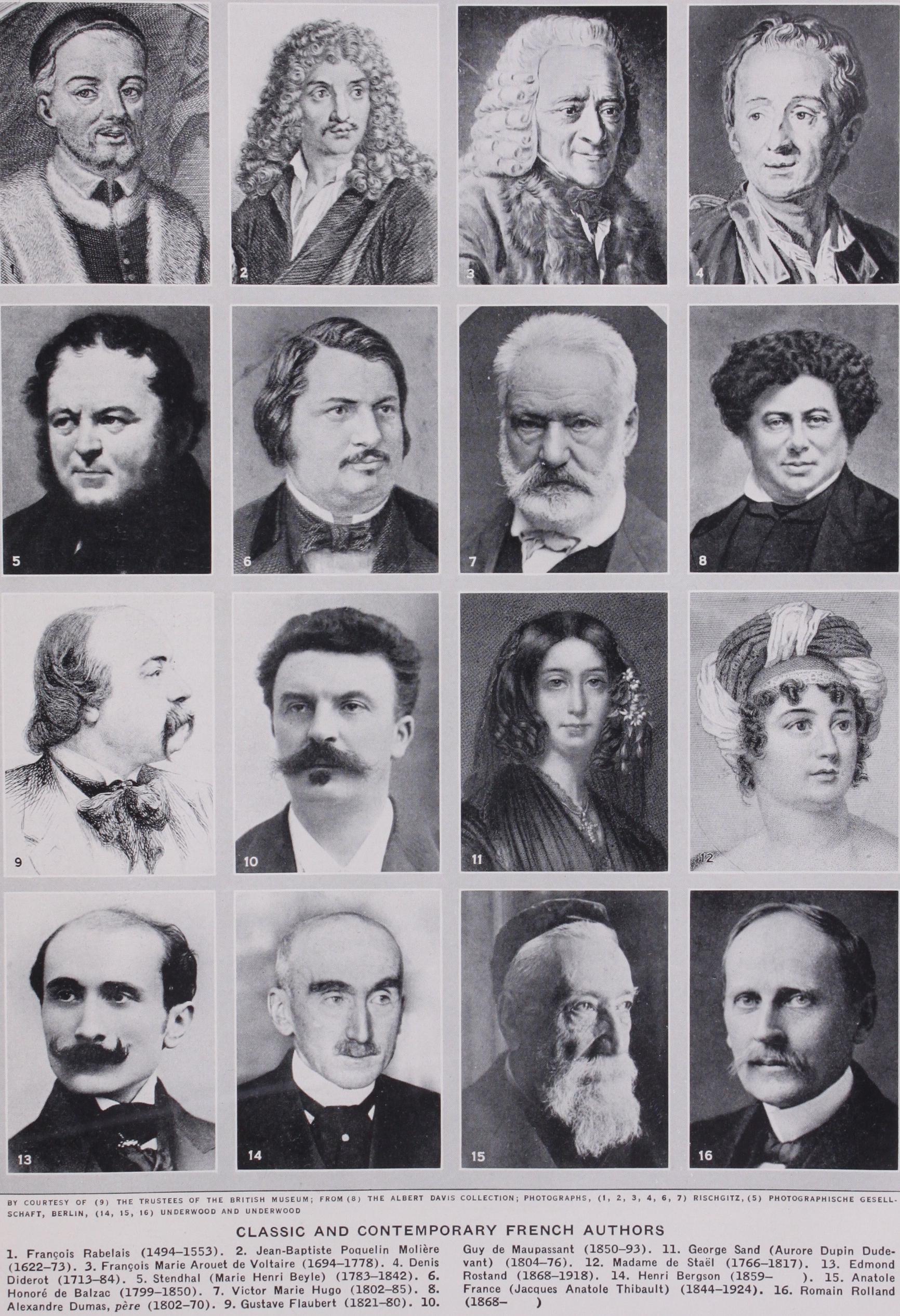
In 1558 appeared two works of high literary and social interest. These are the Heptameron of the queen of Navarre, and the Contes et joyeux devis of Bonaventure des Periers (c. Des Periers, who was a courtier of Marguerite's, has sometimes been thought to have had a good deal to do with the first-named work as well as with the second, and was also the author of a curious Lucianic satire, strongly sceptical in cast, the Cymbalum mundi. Indeed, not merely the queen's prose works, but also the poems gracefully entitled Les Marguerites de la Marguerite, are often attributed to the literary men whom the sister of Francis I. gathered round her. However this may be, some single influence of power enough to give unity and distinctness of savour evidently presided over the composition of the Heptameron. Composed as it is on the model of Boccaccio, its tone and character are entirely different, and few works have a more individual charm. The Tales of des Periers are shorter, simpler and more homely; there is more wit in them and less refinement.
There are four collections of memoirs concerning this time which far exceed all others in interest and importance. The turbu lent dispositions of the time, the loose dependence of the nobles and even the smaller gentry on any single or central authority, the rapid changes of political situations, and the singularly active appetite, both for pleasure and for business, for learning and for war, which distinguished the French gentleman of the i 6th cen tury, place the memoirs of Francois de Lanoue (1531-91), Blaise de Mon [t] luc (1503-77), Agrippa d'Aubigne and Pierre de Bourdeille[s] Brantome (154o-1614) almost at the head of the literature of their class. The name of Brantome is known to all who have the least tincture of French literature, and the works of the others are not inferior in interest, and perhaps superior in spirit and conception, to the Dames Galantes, the Grands Capitaines and the Hommes illustres. The commentaries of Montluc, which Henri IV. is said to have called the soldier's Bible, are exclusively military and deal with affairs only. Montluc was governor in Guienne, where he repressed the savage Huguenots of the south with a savagery worse than their own. He was, however, a partisan of order, not of Catholicism. He hanged and shot both parties with impartiality, and refused to have anything to do with the massacre of St. Bartholomew. Though he was a man of no learn ing, his style is excellent, being vivid, flexible and straightforward. Lanoue, who was a moderate in politics, has left his principles reflected in his memoirs. D'Aubigne gives the extreme Huguenot side as opposed to the royalist partisanship of Montluc and the via media of Lanoue. Brantome, on the other hand, is quite free from any political or religious prepossessions, and, indeed, troubles himself very little about any such matters. He is the shrewd and somewhat cynical observer, moving through the crowd and taking note of its ways, its outward appearance, its heroisms and its follies. It is really difficult to say whether the recital of a noble deed of arms or the telling of a scandalous story about a court lady gave him the most pleasure, and impossible to say which he did best. Certainly he had ample material for both exercises in the history of his time.
In 1558 appeared two works of high literary and social interest. These are the He ptameron of the queen of Navarre, and the Contes et joyeux devis of Bonaventure des Periers (c. Des Periers, who was a courtier of Marguerite's, has sometimes been thought to have had a good deal to do with the first-named work as well as with the second, and was also the author of a curious Lucianic satire, strongly sceptical in cast, the Cymbalum mundi. Indeed, not merely the queen's prose works, but also the poems gracefully entitled Les Marguerites de la Marguerite, are often attributed to the literary men whom the sister of Francis I. gathered round her. However this may be, some single influence of power enough to give unity and distinctness of savour evidently presided over the composition of the Heptameron. Composed as it is on the model of Boccaccio, its tone and character are entirely different, and few works have a more individual charm. The Tales of des Periers are shorter, simpler and more homely; there is more wit in them and less refinement.
There are four collections of memoirs concerning this time which far exceed all others in interest and importance. The turbu lent dispositions of the time, the loose dependence of the nobles and even the smaller gentry on any single or central authority, the rapid changes of political situations, and the singularly active appetite, both for pleasure and for business, for learning and for war, which distinguished the French gentleman of the 16th cen tury, place the memoirs of Francois de Lanoue (1531-91), Blaise de Mon [t] luc (1503-77), Agrippa d'Aubigne and Pierre de Bourdeille[s] Brantome (154o-1614) almost at the head of the literature of their class. The name of Brantome is known to all who have the least tincture of French literature, and the works of the others are not inferior in interest, and perhaps superior in spirit and conception, to the Dames Galantes, the Grands Capitaines and the Hommes illustres. The commentaries of Montluc, which Henri IV. is said to have called the soldier's Bible, are exclusively military and deal with affairs only. Montluc was governor in Guienne, where he repressed the savage Huguenots of the south with a savagery worse than their own. He was, however, a partisan of order, not of Catholicism. He hanged and shot both parties with impartiality, and refused to have anything to do with the massacre of St. Bartholomew. Though he was a man of no learn ing, his style is excellent, being vivid, flexible and straightforward. Lanoue, who was a moderate in politics, has left his principles reflected in his memoirs. D'Aubigne gives the extreme Huguenot side as opposed to the royalist partisanship of Montluc and the via media of Lanoue. Brantome, on the other hand, is quite free from any political or religious prepossessions, and, indeed, troubles himself very little about any such matters. He is the shrewd and somewhat cynical observer, moving through the crowd and taking note of its ways, its outward appearance, its heroisms and its follies. It is really difficult to say whether the recital of a noble deed of arms or the telling of a scandalous story about a court lady gave him the most pleasure, and impossible to say which he did best. Certainly he had ample material for both exercises in the history of his time.
The literature of doubt was to receive its principal accession in the famous essays of Michel Eyquem, seigneur de Montaigne . It would be a mistake to imagine the existence of any sceptical propaganda in this charming and popular book. Its principle is not scepticism but egotism ; and, the author being profoundly sceptical, this quality automatically rather than inten tionally appears. It expresses the mental attitude of the latter part of the century as completely as Rabelais expresses the mental attitude of the early part. There is considerably less vigour and life in this attitude. Inquiry and protest have given way to a placid conviction that there is not much to be found out, and that it does not much matter; the erudition though abundant is less indiscriminate, and is taken in and given out with less gusto; exuberant drollery has given way to quiet irony ; and though neither business nor pleasure is decried, both are regarded rather as useful pastimes incident to the life of a man than with the eager appetite of the Renaissance. From the purely literary point of view, the style is remarkable for its absence of pedantry in construction, and yet for its rich vocabulary and picturesque brilliancy.
The greatest political writer of the age is Jean Bodin (153o- 96), whose Republique is founded partly on speculative considera tions like the political theories of the ancients, and partly on an extended historical inquiry. Bodin, like most lawyers who have taken the royalist side, is for unlimited monarchy, but notwith standing this, he condemns religious persecution and discourages slavery. In his speculations on the connection between forms of government and natural causes, he serves as a link between Aris totle and Montesquieu. On the other hand, the causes which we have mentioned made a large number of writers adopt opposite conclusions. Etienne de la Bootie (153o-63), the friend of Mon taigne's youth, composed the Contre un or Discours de la servi tude volontaire, a protest against the monarchical theory. The foremost work against the League was the famous Satire Menip pee from a literary point of view°one of the most remark able of political books. The Menippee was the work of no single author, but was due, it is said, to the collaboration of five, Pierre Leroi, who has the credit of the idea, Jacques Gillot, Flo rent Chretien, Nicholas Rapin (1541-96) and Pierre Pithou with some assistance in verse from Passerat and Gilles Durand. The book is a kind of burlesque report of the meeting of the states-general, called for the purpose of supporting the views of the League in 1593. It gives an account of the proces sion of opening, and then we have the supposed speeches of the principal characters—the duc de Mayenne, the papal legate, the rector of the university (a ferocious Leaguer) and others. But by far the most remarkable is that attributed to Claude d'Aubray, the leader of the Tiers Etat, and said to be written by Pithou, in which all the evils of the time and the malpractices of the leaders of the League are exposed and branded. The satire is extraordi narily bitter and yet perfectly good-humoured.
On the other hand, Claude Fauchet (153o-16o1) in two anti quarian works, Antiquites gauloises et f rancoises and L'Origine de la langue et de la poesie francaise, displays a remarkable critical faculty in sweeping away the fables which had encumbered his tory. Fauchet had the (for his time) wonderful habit of con sulting manuscripts, and we owe to him literary notices of many of the trouveres. At the same time Francois Grude, sieur de la Croix du Maine (1552-92), and Antoine Duverdier i600) founded the study of bibliography in France. Pasquier's Recherches carries out the principles of Fauchet independently, and besides treating the history of the past in a true critical spirit, supplies us with voluminous and invaluable information on con temporary politics and literature. He has, moreover, the merit which Fauchet had not, of being an excellent writer. Henri Es tienne [Stephanus] (1528-98) also deserves notice in this place, both for certain treatises on the French language, full of critical crotchets, and also for his curious Apologie pour Herodote. The famous potter, Bernard Palissy (1510-90), was not much less skilful as a fashioner of words than as a fashioner of pots, and his description of the difficulties of his experiments in enamelling, which lasted 16 years, is well known. The great surgeon Ambrose Pare (c. 1510-9o) was also a writer, and his descriptions of his military experiences at Turin, Metz and elsewhere have all the charm of the 16th-century memoir. The only other writers who require special mention are Oliver de Serres (1539-1619), who composed, under the title of Theatre d'agriculture, a complete treatise on the various operations of rural economy, and Jacques du Fouilloux (1521-8o), who wrote on hunting (La Venerie). Both became extremely popular and were frequently reprinted.
THE 17TH CENTURYThe17TH CENTURY We come now to the shaping of a literary doctrine that was to last for two centuries, and to determine, not merely the language and complexion, but also the form of French verse during the whole of that time. The tradition of respect for Malherbe, an elder and more gifted Boileau, was at one time all-powerful in France, and, notwithstanding the Romantic movement, is still strong. In rejecting a large number of the importations of the Ronsardists, he certainly did good service. But it is difficult to avoid ascribing in great measure to his influence the origin of the chief faults of modern French poetry, and modern French in gen eral, as compared with the older language. He pronounced against "poetic diction," as such, forbade the overlapping (enjambement) of verse, insisted that the middle pause should be of sense as well as sound, and that rhyme must satisfy eye as well as ear. The very influences which he despised and proscribed produced in him much tolerable and some admirable verse, though he is not to be named as a poet with Regnier, who had the courage, the sense and the good taste to oppose and ridicule his innovations. Of Mal herbe's school, Honorat de Bueil, marquis de Racan (1589-167o), and Francois de Maynard (1582-1646) were the most remarkable.
But the vigour, not to say the licence, of the 16th century could not thus die all at once. In Theophile de Viau (1591-1626) the early years of the 17th century had their Villon. The later poet was almost as unfortunate as the earlier, and almost as disrepu table, but he had a great share of poetical and not a small one of critical power. Racan and Theophile were followed in the sec ond quarter of the century by two schools which sufficiently well represented the tendencies of each. The first was that of Vincent Voiture (1598-1648), Isaac de Benserade (1612-91), and other poets such as Claude de Maleville (1597-1647), author of La Belle Matineuse, who were connected more or less with the fa mous literary coterie of the Hotel de Rambouillet. Theophile was less worthily succeeded by a class, it can hardly be called a school, of poets, some of whom, like Gerard Saint-Amant 166o), wrote drinking songs of merit and other light pieces; oth ers, like Paul Scarron (1610-6o) and Sarrasin (1603? 4? 1654), devoted themselves rather to burlesque of serious verse. Most of the great dramatic authors of the time also wrote mis cellaneous poetry, and there was even an epic school of the most singular kind, in ridiculing and discrediting which Boileau did un doubtedly good service. The Pucelle of Jean Chapelain 1674), the unfortunate author who was deliberately trained and educated for a poet, who enjoyed for some time a sort of dicta torship in French literature on the strength of his forthcoming work, and at whom from the day of its publication every critic of French literature has agreed to laugh, was the most famous and perhaps the worst of these. But Georges de Scudery (160'– 67) wrote an Alaric, the Pere le Moyne (1602-71) a Saint Louis, Jean Desmarets de Saint-Sorlin (1595-1676), a dramatist and critic of some note, a Clovis, and Saint-Amant a Moise, which were not much better. The Precieuses of the Hotel Rambouillet, with all their absurdities, encouraged if they did not produce good literary work. In their society there is no doubt that a great reformation of manners took place, if not of morals, and that the tendency to literature elegant and polished, yet not destitute of vigour, which marks the 17th century, was largely developed side by side with much scandal-mongering and anecdotage. The Guir lande de Julie, in which most of the poets of the time celebrated Julie d'Angennes, daughter of the marquise de Rambouillet, is perhaps the best of all such albums, and Voiture, the typical poet of the coterie, was certainly the best writer of vers de society who is known to us. The poetical war which arose between the Uranistes, the followers of Voiture, and the Jobistes, those of Benserade, produced reams of sonnets, epigrams and similar verses. This habit of occasional versification long continued. It led as a less important consequence to the rhymed Gazettes of Jean Loret (d. 1665), which recount in octosyllabic verse of a light and lively kind the festivals and court events of the early years of Louis XIV. It led also to perhaps the most remarkable non-dramatic poetry of the century, the Contes and Fables of Jean de la Fontaine (1621-95) . No French writer is better known than la Fontaine, and there is no need to dilate on his merits. It has been well said that he completes Moliere, and that the two to gether give something to French literature which no other litera ture possesses. La Fontaine continues the tradition of the writers of fabliaux, in the language and with the manners of his own century.
All the writers we have mentioned belong more or less to the first half of the century, and so do Valentin Conrart (1603-75), Antoine Furetiere (1626-88), Chapelle (Claude Emmanuel) l'Huillier (1626-86), and others not worth special mention. The latter half of the century is far less productive, and the poetical quality of its production is even lower than the quantity. In it Boileau (1636-1711) is the chief poetical figure. Next to him can only be mentioned Madame Deshoulieres (1638-94), Guillaume de Brebeuf (1618-61), translator of Lucan, and Philippe Quin ault (1635-88), the composer of opera libretti. Boileau's satire, where it has much merit, is usually borrowed direct from Horace. He had a certain faculty as a critic of the slashing order and might have profitably used it if he had written in prose. But of his poetry it must be said, not so much that it is bad, as that it is not, in strictness, poetry at all, and the same is generally true of all those who followed him. Yet his importance is enormous. He elaborated, in the clearest possible manner of expression, those ideals of classicism, which are the soul of his period, and on which lived much greater poets than himself. What he con demned has disappeared, and we reap the profit of his activities without always realizing the great necessity there was for them.
The fertility of France at this moment in dramatic authors was immense; nearly 10o are enumerated in the first quarter of the century. The early plays of Pierre Corneille (1606-84) showed all the faults of his contemporaries combined with merits to which none of them except Rotrou, and Rotrou himself only in part, could lay claim. His first play was Melite, a comedy, and in Clitandre, a tragedy, he soon produced what may perhaps be not inconveniently taken as the typical piece of the school of Hardy. A full account of Corneille may be found elsewhere. It is suf ficient to say here that his importance in French literature is quite as great in the way of influence and example as in the way of in tellectual excellence. The Cid and the Menteur are respectively the first examples of French tragedy and comedy which can be called modern.
Beginning with mere farces of the Italian type, and passing from these to comedies still of an Italian character, it was in Les Precieuses ridicules, acted in 1659, that Moliere (1622-73), in the words of a spectator, hit at last on "la bonne comedie." The next 15 years comprise the whole of his best known work, the finest achievement of a certain class of comedy that any literature has produced. The tragic masterpieces of Racine were not far from coinciding with the comic masterpieces of Moliere, for, with the exception of the remarkable aftergrowth of Esther and Athalie, they were produced chiefly between 1667 and 1677. Both Racine and Moliere are writers who require separate mention.
The French Academy was founded unofficially by Conrart in 1629, received official standing six years later, and continued the tradition of Malherbe in attempting constantly to school and cor rect, as the phrase went, the somewhat disorderly instincts of the early French stage. Even the Cid was formally censured for ir regularity by it.
Among the immediate successors and later contemporaries of the three great dramatists we do not find any who deserve high rank as tragedians, though there are some whose comedies are more than competent. It is at least significant that the restric tions imposed by the academic theory on the comic drama were far less severe than those which tragedy had to undergo. Only Thomas Corneille (1625-1709), the inheritor of an older tradition and of a great name, deserves to be excepted from the condemna tion to be passed on the lesser tragedians of this period. He was unfortunate in possessing his brother's name, and in being, like him, too voluminous in his compositions; but Camma, Ariane, Le Comte d'Essex, are not tragedies to be despised. On the other hand, the names of Jean de Campistron (1656-1723) and Nicolas Pradon (1632-98) mainly serve to point injurious comparisons; Joseph Francois Duche (1668-1704) and Antoine La Fosse 1708) are of still less importance, and Quinault's tragedies are chiefly remarkable because he had the good sense to give up writ ing them and to take to opera. The general excellence of French comedy, on the other hand, was sufficiently vindicated. Besides the splendid sum of Moliere's work, the two great tragedians had each, in Le Menteur and Les Plaideurs, set a capital example to their successors, which was fairly followed. David Augustin de Brueys (164o-1723) and Jean Palaprat (1650-1721) brought out once more the ever new Avocat Patelin besides the capital Gron deur. Quinault and Campistron wrote fair comedies. Florent Carton Dancourt (1661-1726), Charles Riviere Dufresny (c. 1654-1724), Edmond Boursault (1638-1701), were all comic writers of considerable merit. But the chief comic dramatist of the latter period of the 17th century was Jean Francois Regnard whose Joueur and Lagataire are comedies almost of the first rank.
The form which the prose tale took at this period was that of the fairy story. Perrault (1628-1703) and Madame d'Aulnoy (d. 1705) composed specimens of this kind which have never ceased to be popular since. Hamilton (1646-172o), the author of the well-known Memoires du Comte de Gramont, wrote similar stories of extraordinary merit in style and ingenuity. There is yet a third class of prose writing which deserves to be mentioned. It also may probably be traced to Spanish influence, to the picaresque romances which the 16th and 17th centuries produced in Spain in large numbers. The most remarkable example of this is the Roman comique of the burlesque writer Scarron. The Roman bourgeois of Antoine Furetiere (1619-88) also deserves mention as a collec tion of pictures of the life of the time, arranged in the most desultory manner, but drawn with great vividness, observation and skill. A remarkable writer who had great influence on Moliere has also to be mentioned in this connection rather than in any other. This is Cyrano de Bergerac (1619-55), who, besides com posing doubtful comedies and tragedies, writing political pam phlets, and exercising the task of literary criticism in objecting to Scarron's burlesques, produced in his Histoires comiques des etats et empires de la lune et du soleil, half romantic and half satirical compositions.
One other work, and in literary influence perhaps the most remarkable of its kind in the century, remains. Madame de Lafayette, Marie de la Vergne (1634-92), the friend of La Rochefoucauld and of Madame de Sevigne, though she did not exactly anticipate the modern novel, showed the way to it in her stories, the principal of which are Zaide and still more La Princesse de Cleves. The latter, though a long way from Manon Lescaut, Clarissa, or Tom Jones, is a longer way still from Polexandre or the Arcadia. The novel becomes in it no longer a more or less fic titious chronicle, but an attempt at least at the display of charac ter. La Princesse de Cleves has never been one of the works wide ly popular out of their own country, nor perhaps does it deserve such popularity, for it has more grace than strength; but as an original effort in an important direction its historical value is considerable. But with this exception, the art of fictitious prose composition, except on a small scale, is certainly not one in which the century excelled, nor are any of the masterpieces which it produced to be ranked in this class.
From this time memoirs and memoir writers were ever multi plying. The queen of them all is Madame de Sevigne (1626-96), on whom, as on most of the great and better-known writers whom we have had and shall have to mention, it is impossible here to dwell at length. The last half of the century produced crowds of similar but inferior writers. The memoirs of Roger de Bussy Rabutin (1618-93) (author of a kind of scandalous chronicle called Histoire amoureuse des Gaules) and of Madame de Main tenon (1635-1719) perhaps deserve notice above the others. Memoir-writing became the occupation not so much of persons who made history, as was the case from Comines to Retz, as of those who, having culture, leisure and opportunity of observation, devoted themselves to the task of recording the deeds of others. The efforts of Balzac and the Academy supplied a suitable language and style, and the increasing tendency towards epigrammatic moralizing, which reached its acme in La Rochefoucauld (1663-80) and La Bruyere (1639-96), added in most cases point and attractiveness to their writings.
Yet, for all this, philosophy hardly flourished in France. It was too intimately connected with theological and ecclesiastical ques tions, and especially with Jansenism, to escape suspicion and persecution. Descartes himself was for much of his life an exile in Holland and Sweden ; and though the unquestionable orthodoxy of Malebranche, the strongly religious cast of his works, and the remoteness of the abstruse region in which he sojourned from that of the controversies of the day, protected him, other followers of Descartes were not so fortunate. Holland, indeed, became a kind of city of refuge for students of philosophy, though even in Holland itself they were by no means entirely safe from perse cution. By far the most remarkable of French philosophical sojourners in the Netherlands was Pierre Bayle (1647-1706), a name not perhaps of the first rank in respect of literary value, but certainly of the first as regards literary influence. Bayle, after oscillating between the two confessions, nominally remained a Protestant in religion. In philosophy he in the same manner oscillated between Descartes and Gassendi, finally resting in an equally nominal Cartesianism. Bayle was, in fact, both in philo sophy and in religion, merely a sceptic. His style is hardly to be called good, being diffuse and often inelegant. But his great dic tionary, though one of the most heterogeneous and unmethod ical of compositions, exercised an enormous influence. It may be called the Bible of the i8th century, and contains in the germ ali the desultory philosophy, the ill-ordered scepticism, and the critical but negatively critical acuteness of the Auf klarung.
Jansenius himself, though a Dutchman by birth, passed much time in France, and it was in France that he found most disciples. These disciples consisted in the first place of the members of the society of Port Royal des Champs, a coterie after the fashion of the time, but one which devoted itself not to sonnets or madrigals but to devotional exercises, study and the teaching of youth. This coterie early adopted the Cartesian philosophy, and the Port Royal Logic was the most remarkable popular hand-book of that school. In theology they adopted Jansenism, and were in conse quence soon at daggers drawn with the Jesuits, according to the polemical habits of the time. The most distinguished champions on the Jansenist side were Jean Duvergier de Hauranne, abbe de St. Cyran (1581-1643), and Antoine Arnauld (156o-1619), but by far the most important literary results of the quarrel were the famous Provinciales of Pascal, or, to give them their proper title, Lettres &rites a un provincial. Their literary importance consists, not merely in their grace of style, but in the application to serious discussion of the peculiarly polished and quiet irony of which Pascal is the greatest master the world has ever seen. Pascal set the example of combining the use of the most terribly effective weapons with good humour, good breeding and a polished style. The example was largely followed, and the manner of Voltaire and his followers in the i8th century owes at least as much to Pascal as their method and matter do to Bayle. The Jansenists, attacked and persecuted by the civil power, which the Jesuits had contrived to interest, were finally suppressed. But the Provinciales had given them an unapproachable superiority in matter of argument and literature. Their other literary works were inferior, though still remarkable. Antoine Arnauld (the younger, often called "the great") (1612-94) and Pierre Nicole (1625-95) managed their native language with vigour if not exactly with grace.
While Bossuet made himself chiefly remarkable in his sermons and in his writings by an almost Hebraic grandeur and rudeness, the more special characteristics of Christianity, largely alloyed with a Greek and Platonic spirit, displayed themselves in Fenelon. In pure literature he is not less remarkable than in theology, politics and morals. His practice in matters of style was admi rable, as the universally known Talemaque sufficiently shows to those who know nothing else of his writing. But his taste, both in its correctness and its audacity, is perhaps more admirable still. Despite Malherbe, Balzac, Boileau and the traditions of nearly a century, he dared to speak favourably of Ronsard, and plainly expressed his opinion that the practice of his own con temporaries and predecessors had cramped and impoverished the French language quite as much as they had polished or purified it.
The two Protestant ministers whom we have mentioned, though inferior to their rivals, yet deserve honourable mention among the ecclesiastical writers of the period. Claude engaged in a contro versy with Bossuet, in which victory is claimed for the invincible eagle of Meaux. Saurin, by far the greater preacher of the two, long continued to occupy, and indeed still occupies, in the libraries of French Protestants, the position given to Bossuet and Massillon on the other side.
There arose only a little later a very different group of moral ists, whose writings have been as widely read, and who have had as great a practical and literary influence as perhaps any other class of authors. The earliest to be born and the last to die of these was Charles de Saint-Denis, seigneur de Saint-Evremond (1613-1703). Saint-Evremond was long known rather as a con versational wit, some of whose good things were handed about in manuscript, or surreptitiously printed in foreign lands, than as a writer, and this is still to a certain extent his reputation. He was at least as cynical as his still better known contemporary La Rochefoucauld, if not more so, and he had less intellectual force and less nobility of character. But his wit was very great, and he set the example of the brilliant societies of the next century.
In direct literary value, however, no comparison can be made between Saint-Evremond and the author of the Sentences et max imes morales. Francois, duc de la Rochefoucauld (1613-80), has other literary claims besides those of this famous book. His Memoires were very favourably judged by his contemporaries, and they are still held to deserve no little praise even among the nu merous and excellent works of the kind which that are of memoir writers produced. But while the Memoires thus invite compari son, the Maximes et sentences stand alone. Even allowing that the mere publication of detached reflections in terse language was not absolutely new, it had never been carried, perhaps has never since been carried, to such a perfection. Beside La Rochef oucauld all other writers are diffuse, vacillating, unfinished, rough. Not only is there in him never a word too much, but there is never a word too little. The thought is always fully expressed, not com pressed. Frequently as the metaphor of minting or stamping coin has been applied to the art of managing words, it has never been applied so appropriately as to the maxims of La Rochef oucauld. The form of them is almost beyond praise, and its excellencies, combined with their immense and enduring popularity, have had a very considerable share in influencing the character of subse quent French literature. Of hardly less importance in this respect, though of considerably less intellectual and literary individuality, was the translator of Theophrastus and the author of the Carac teres, Jean de la Bruyere (1645-96), but though frequently epi grammatic, he did not aim at the same incredible terseness as the author of the Maximes.
The famous quarrel between the Ancients and the Moderns, of Italian origin, was mainly started in France by Charles Perrault (1628-1703), who thereby rendered much less service to litera ture than by his charming fairy tales. The opposite side was taken by Boileau, and the fight was afterwards revived by Antoine Houdar[d, t] de la Motte (1672-1731), a writer of little learning but much talent in various ways, and by the celebrated Madame Dacier, Anne Lef evre (1654-1720). The discussion was con ducted, as is well known, without very much knowledge or judg ment among the disputants on the one side or on the other. But at this very time there were in France students and scholars of the most profound erudition. Fleury is only the last and the most popular of a race of omnivorous and untiring scholars, whose labours have ever since, until the modern fashion of first-hand investigations came in, furnished the bulk of historical and scholar ly references and quotations. To this century belong le Nain de Tillemont (1637-98), whose enormous Histoire des empereurs and Memoires pour servir d l'histoire ecclesiastique served Gibbon and a hundred others as quarry; Charles Dufresne, seigneur de Du cange (1614-88), whose well-known glossary was only one of numerous productions; Jean Mabillon (1632-1707), one of the most voluminous of the voluminous Benedictines; and Bernard de Montfaucon