
FROST, water in the atmosphere, which is crystallized by freezing upon exposed objects. Under the broader and more pop ular conception of frost, the phenomenon also includes the me chanical effects produced by the freezing of the juices of plants, of the water in the soil, in rocks, etc. Frost is a phenomenon most common in the polar regions and during the winter months. But frosts of a milder nature are also quite common, during cold, clear nights in spring and autumn, in temperate regions, and some times extend over thousands of square miles, doing great damage by freezing the juices of plants, vegetables, etc. When frosts of this character occur, hoar-frost crystals collect upon the earth and vegetation. The frost crystals, themselves, however, do no dam age. It is the freezing of the juices of plants, etc., that injures them. The condition that precedes and favours hoar-frost forma tion is a cooling of the air near the earth's surface. This may be brought about by seasonal changes in temperature and by radia tion of heat from the earth during calm, clear nights. Other fac tors that tend to favour frosts are the cooling of objects by the evaporation of moisture from them, and in mountain regions the descent of cold air into the valleys.
Hoar-frost, like snow, occurs in two distinct states, the crystal line and the granular. Hoar-frost is not, as some suppose, frozen dew. Granular hoar-frost may properly be termed fog or cloud f rost, as it is produced by the collection and freezing of fog drops upon vegetation, etc. It occurs most frequently upon mountain tops, because clouds often enshroud them. In zero weather, fog drops form in the air around all open springs and streams, and collect and freeze upon near-by objects. Hoar-frost of this char acter is usually of a subcrystalline character, due to colloidal crystallization. It occurs during both windy and calm weather. Its forms assume columnar, needle-like or fernlike shapes, some times of considerable size and great beauty. On mountain tops, the cloud-frost crystals of ten grow outward, mainly in a windward direction, and form lovely fernlike or fluted creations, that im part wondrous beauty to the mountain tops. True crystalline hoar frost crystals, like the crystalline varieties of snow crystals, form direct from the invisible water vapour in the air. Winds and clouds, and overhanging objects that shield the earth, retard or prevent frosts of this character in the open. Such crystals assume many beautiful and varied forms. Like the snow crystals, most of them can be grouped into one of two classes, those that assume columnar forms, and those that assume tabular forms. In general, the crystals of these respective classes do not form together on a given night, but one or the other will greatly pre dominate. Columnar shapes usually form the bulk of the hoar frost crystals during the so-called destructive frosts of spring and autumn. The columns are usually hexagonal in form, are hollow, or have cavities projecting downward from their upper ends, and vary more or less in size, slenderness, etc.
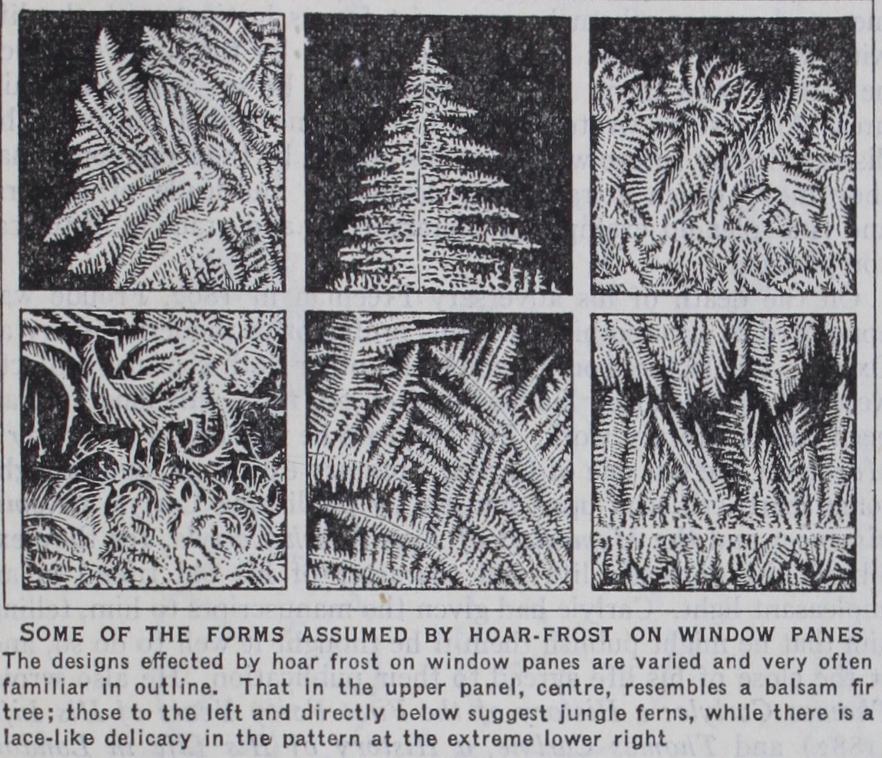
Tabular hoar-frost crystals are most common to the winter months, and to lower temperatures. They form in open branching or in close solid platelike figures, and vary in size, outline, thick ness, etc. The individual crystals of tabular frost resemble in some degree similar types of tabular snow crystals. But unlike them, and as a result of their being forced to grow outward in segmental fashion from some support, they rarely assume the per fect symmetry of many of the snow crystals. Copious frosts of this description coat the trees and other objects with glittering hosts of butterflylike or fernlike crystals, giving them a white frosted appearance, and thus convert forested regions into the semblance of fairyland. In the winter time, when ice covers pond and river, beautiful clusters or rosettes of fernlike or jewel-like frost collect upon the surface of the ice. Among the rarer of the frost forms are those which assume the funnel or cubical form.
The most varied and beautiful of all the frost forms, however, occur during zero weather, upon the window-panes of buildings. The more delicate and varied effects are due to a crystallization of the moisture in the air of a room, upon dry glass in cold un heated rooms. The bolder and larger so-called window-frost effects, however, that form in warm moist rooms, are really win dow-ice crystallization, as they form upon wet window-panes, and crystallize within the thin film of fluid water that often covers such panes. Window-frost and window-ice assume a bewildering vari ety of designs, some of them in the semblance of castles, tropical forest effects, starry firmaments, trees, ferns, corals, stars, etc. Some of the designs, as those that form within tiny scratches or strictions in the glass, are repeated from time to time. Others have a much more obscure origin. The temperature and degree of humidity of the air, the varying thickness of the glass, the dust, etc., on it, the tiny air currents and eddies that flow over it, the presence or absence of other closely lying frost crystals, each doubtless tends to determine or modify the shape, size, and form of the frost crystals forming on windows. When considered in its broader aspects, frost plays an important role, both beneficent and otherwise, in nature's plan. Its destructive effects, when early or late frosts occur and injure crops and vegetation, are well known. Various devices are now used to lessen or prevent frost damage, such as tentlike coverings, oil heaters and smudge pans, etc. The beneficent services of frost are very important. It acts as an erosive agent, in tearing down mountains, and converting rocks into soil. This is accomplished by means of the expansive action of water when it freezes within crevices of the rocks, thus rending them asunder and helping to pulverize them into soil.
(W. A. BEN.)