
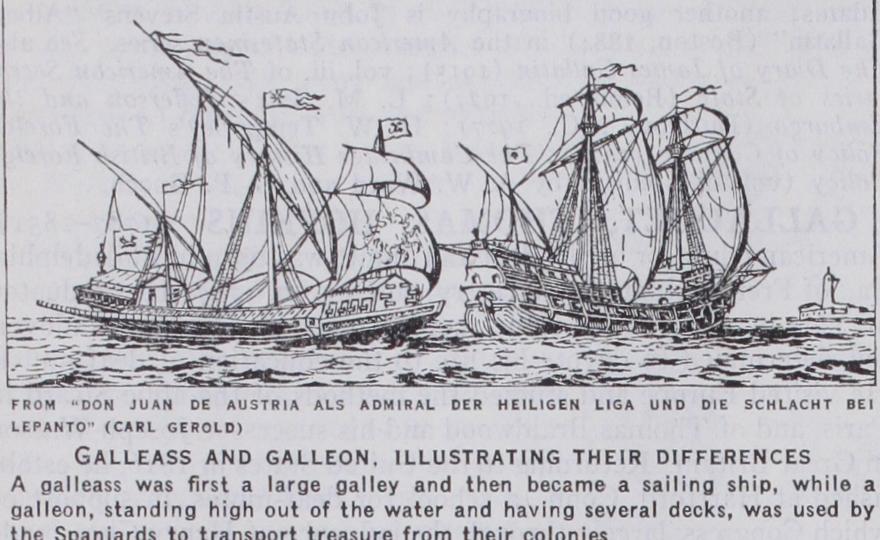
GALLEY, a long single or half-decked vessel of war, with low free-board, propelled primarily by oars or sweeps, but also having masts for sails. The word is used generally to refer to the ancient war vessels of Greece and Rome of various types, whose chief propelling power was the oar or sweep, but its more specific application is to the mediaeval war vessel which survived in the navies of the Mediterranean sea-powers after the general adoption of the larger many-decked ship of war, propelled solely by sail-power. Lepanto (15 71) was the last great naval battle in which the galley played the principal part. It became the custom among the Mediterranean powers to sentence condemned criminals to row in the war galleys of the state. Traces of this in France can be found as early as 1532, but the first legislative enactment is in the Ordonnance d'Orleans of 1561. In 1564 Charles IX. forbade the sentencing of prisoners to the galleys for less than ten years. The galley-slaves were branded with the letters GAL. At the end of the reign of Louis XIV. the use of the galley for war purposes had practically ceased, but the corps of the galleys was not incorporated with the navy till 1748. The headquarters of the galleys and of the convict rowers (galeriens) was at Marseilles. The majority of these latter were brought to Toulon, the others were sent to Rochefort and Brest, where they were used for work in the arsenal. At Toulon the convicts remained in chains on the galleys, which were moored as hulks in the harbour. Shore prisons were, however, provided for them, known as bagnes, baths, a name given to such penal establishments first by the Italians (bagno), and said to have been derived from the prison at Constantinople situated close by or attached to the great baths there. The name galerien was still given to all convicts, though the galleys had been abandoned, and it was not till the French Revo lution that the hated name with all it signified was changed to forcat. In Spain galera is still used for a criminal condemned to penal servitude. (See also SHIP) The word "galley" is also applied to an oblong receptacle or tray, usually of brass, but sometimes of wood or zinc, having upright sides and used to hold type which has been set. Galleys vary in width and length depending upon the use to which they are put. One form, known as a slice galley, has a sliding bottom. The word is also used elliptically for a proof from type on a galley (in full a galley proof).
A vivid account of the life of galley-slaves in France is given in Jean Marteilhes's Memoirs of a Protestant, translated by Oliver Goldsmith (new edition, 1895), which describes the experiences of one of the Huguenots who suffered after the revocation of the edict of Nantes.