
MODERN SIEGE WARFARE The sieges of Belfort in 1871 and of Plevna in 1877 had shown the great strength of extemporized field works and the value of an active defence, but regular siege methods had altered little since the days of Vauban. In 188o, however, the invention of high explosive shell introduced an important factor into the methods of attack. By the close of the 19th century the range of guns, and the power of their projectiles, had so increased that it was thought that by a heavy bombardment resistance would be paralysed, and the way made open for an attack delivered by great numbers and provided with special appliances for crossing ob stacles. Imbued with these ideas, the Japanese in 1904 assaulted Port Arthur. In spite of the fire of the new I1in. siege howitzers, which were used in the second and third attacks, all three assaults failed. It was found impossible to rush even semi-permanent works, or well prepared field defences, and a return had to be made to the old forms of methodical attack by means of parallels and saps and mines.
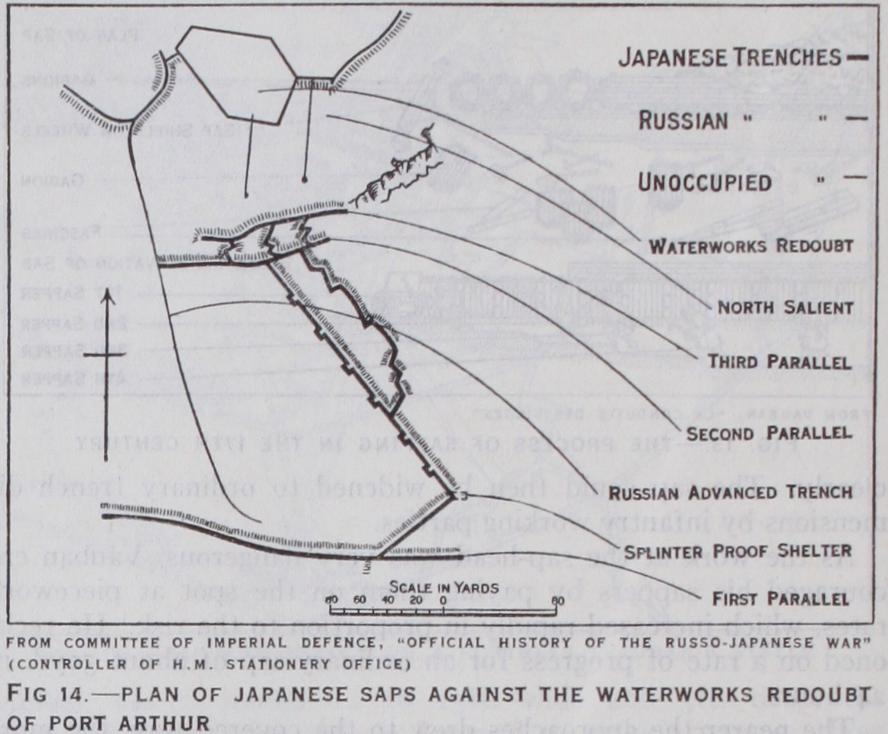
A typical example of the methods of approach by sap and the formation of parallels is shown in fig. 14 which illustrates the Japanese attack on the waterworks redoubt of Port Arthur. The first parallel was formed about 3ooyd. from the redoubt by ex tending a portion of an advanced Russian trench to the right and left. Taking advantage of the ground, the first sap was commenced right handed for 65yd. A left turn was then made to bring the sap just clear of the left of the redoubt. This portion was tra versed to prevent the sap from being enfiladed from a Russian trench to the east. About iooyd. from the redoubt, a second paral lel was formed, and, from here, three zigzag saps were driven forward, their heads being joined to form the third parallel within assaulting distance of the redoubt.
Seven-inch mortars were also used which fired a 144 lb. canis ter up to 150 yards.
The introduction of various forms of efficient trench mortar,and the "1o6" or instantaneous fuse, enabled wire that could be seen to be destroyed, but in ex tended areas and where hidden from direct observation, wire and M.G.'s formed the chief obstacles. Smoke was found a useful adjunct for blinding machine guns, and "Bangalore torpedoes," or long tubes of explosives, thrust under the wire entanglements and detonated, were used to form lanes through the obstacles. Great progress was also made in mining methods and the efficiency of close combat weapons improved. Hand grenades and trench mortars were standardized and manufactured in large quantities. Stokes mortars, handy and portable, which enabled a rapid rate of fire to be turned, from a short distance, on to a work, were in vented, and a new and deadly, though in the long run not a very efficient, close range weapon, the flame thrower, which could throw a flaming jet 8o to rooyd., was introduced.
But up to 1917 artillery remained the chief weapon of the be siegers' armoury. The thoroughly prepared attack on the very strong Messines Ridge position in June 1917 may be said to be the culminating act of the regular siege operations. In addition to the 20 mines containing a million pounds of explosives which were detonated under the German lines, three and a half million rounds of artillery ammunition were fired during the ten days' bombard ment prior to the assault. The increase in depth of defensive positions, the dispersion of machine guns in concrete pill-boxes, and the introduction of tanks, put an end to siege warfare methods of attack. The conduct of a siege places a very heavy strain on the administration and transportation services. To enable men to live, without undue casualties from sickness, in the forward trenches, careful and detailed arrangements have to be made. The provision of hot food, warm clothing, drying rooms, rest billets, baths and laundries behind the lines, the extension and improvement of com munications to carry the vast quantities of ammunition and engi neer stores of every kind, requires an elaborate organization; and without this organization the pressure required for a modern siege cannot be maintained. As an example of the weights that have to be dealt with, one British army in the assault of the Hindenburg Line in Sept. 1918 expended 52,500 tons of ammunition in one day.
(E. H. K.)