
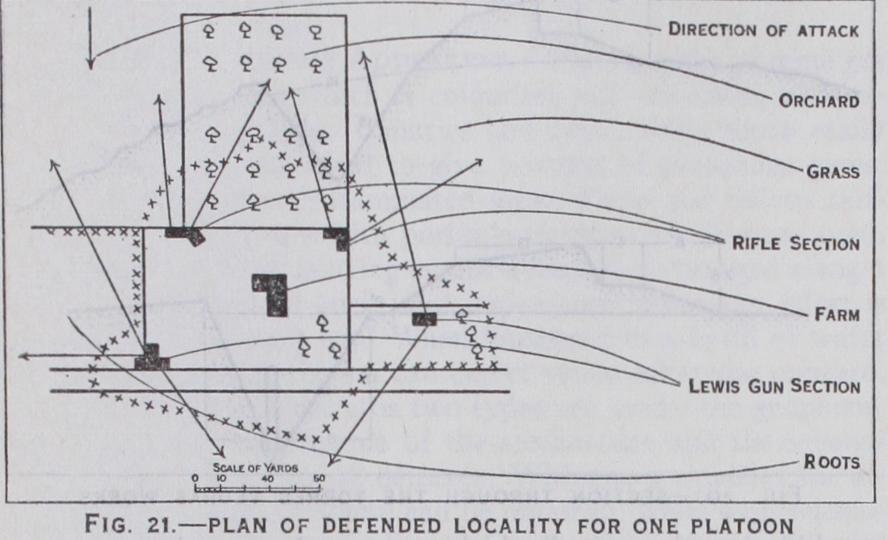
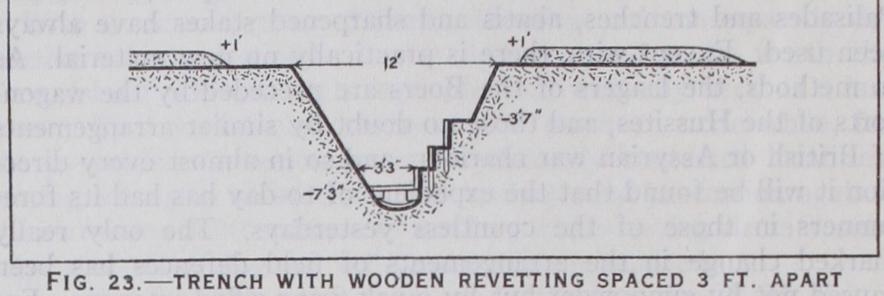
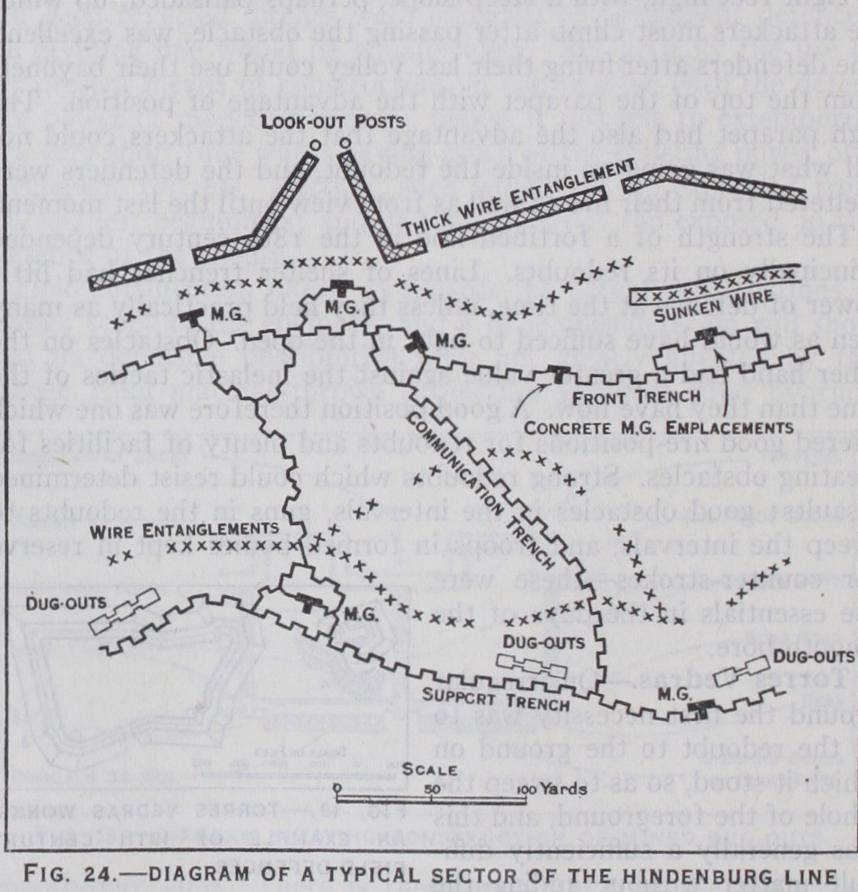
PRINCIPLES OF MODERN FIELD DEFENCES While the basic principle of hitting the enemy without being hit oneself remains unchanged, the increased efficiency of artillery and small arms and the introduction of tanks have considerably affected the design of field fortification. In early times command and an unclimbable obstacle were necessary; now observation, concealment and tank obstacles are required. The defender by skilful use of the ground, reinforced by the artificial aid of field works, can hold out against a greatly superior enemy, but protec tion is required against tanks, rifle and machine gun fire. Also, when time is available, against heavy high explosive shell, air bombs and gas. Field fortification varies from "hasty" defences made on the battlefield to "deliberate" work on rear defences. Machine guns, anti-tank guns and artillery form the framework of a defensive position. To use them to the best advantage, good observation is necessary, and as field defences seldom have suf ficient strength to protect them against heavy shells, concealment is essential. A continuous trench held throughout its length is a weak line lacking in strength and depth. Important tactical local ities, supporting one another and flanked by the fire of machine guns and artillery, are therefore held by complete infantry units. These "defended localities" are sited where possible to be proof against tank attack. They are organized as a system of "defended posts" consisting of short lengths of fire trench, dispersed in the best fire positions, and each capable of holding a section of in fantry (seven men) see fig. In order to prevent these defended posts and localities from being easily recognized on aeroplane photographs, to provide inter-communication, and to afford the intermediate fire positions required in fog or darkness, they are later connected by trenches.
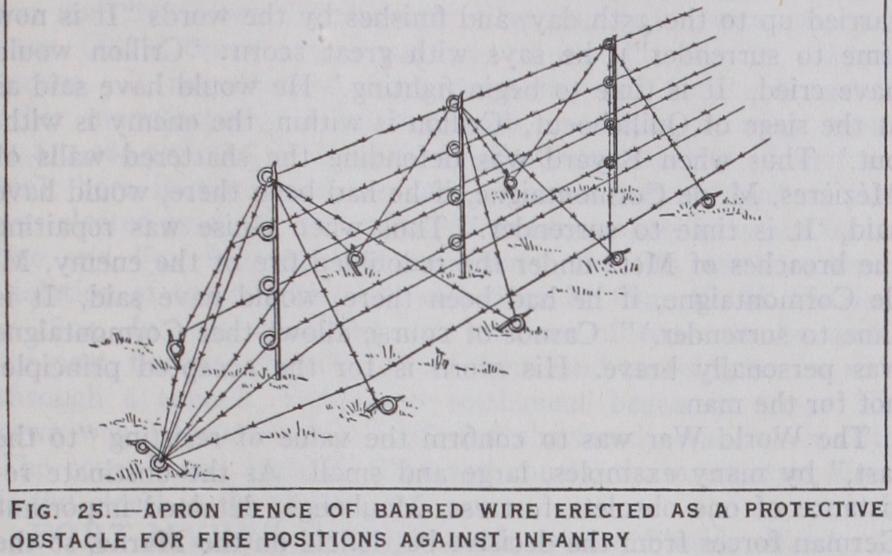
Against tanks, since artificial obstacles take considerable time and labour to erect, the greatest use is made of existing ones such as woods, marshes, waterways, steep banks, cuttings, etc. In restricted approaches, such as the entrances to villages, vertical steel girders set in concrete blocks, or "elephant pits" 8f t. deep and 1 oft. wide, lightly covered with timber and earth, are effec tive. For longer fronts a V-shaped ditch with a five foot vertical revetted face nearest the defenders will stop tanks until battered by artillery. Tank mines, however, form the best obstacles. These consist of light portable mines laid just below the surface of the ground, or may be improvised with shells with percussion fuses as shown in fig. 26.
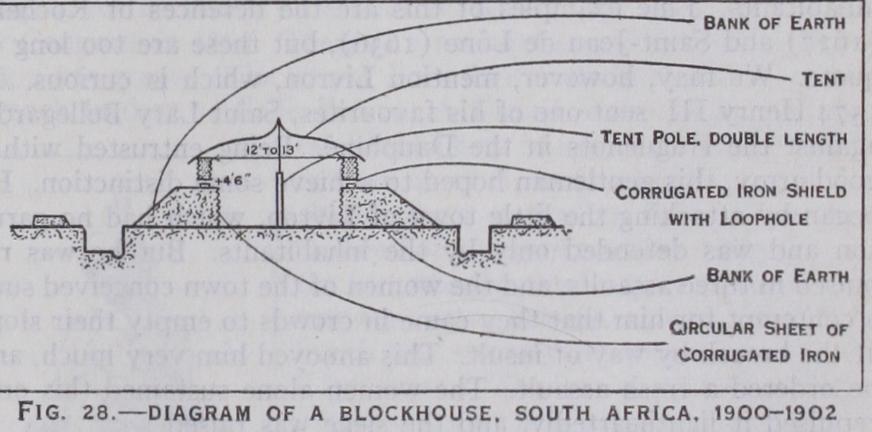
For the defence of small posts, blockhouses are frequently used. These vary from the log stockades of the Red Indian wars, stone sangars for hill pickets on the north-west frontier of India, corrugated iron and shingle blockhouses (see fig. 28) in South Africa, to the concrete "pill-box" of 1916-18. With the advent of mechanized forces, these will again be used to contain an anti tank gun for the protection of areas liable to attack by armoured fighting vehicles. (E. H. K.) In tracing the history of the science of fortification and in outlining the practice of our own time it has been necessary to dwell chiefly on the material means of defence and attack. The human element has had to be almost ignored. But here comes in the paradox, that the material means are after all the least impor tant element of defence, for the best defences recorded in history owed little to the builder's art. The splendid defence in 1667 of Candia; whose enceinte, of early Italian design, was already obso lete, but whose capture cost the Turks ioo,000 men; the three years' defence of Ostend in 16o1; the holding of Arcot by Clive, are instances that present themselves to the memory at once. The very weight of the odds against them sometimes calls out the best qualities of the defenders; and the man when at his best is worth many times more than the rampart behind which he fights. But it would be a poor dependence deliberately to make a place weak in order to evoke these qualities. One cannot be sure that the garrison will rise to the occasion, and the weakness of the place has very often been found an excuse for giving it up with little or no resistance. Very much depends on the governor. Hence the French saying, "tant vaut 1'homme, tant vaut la place." Among modern men we think of Todleben (not governor, but the soul of the defence) at Sevastopol, Fenwick Williams at Kars, Denfert Rochereau at Belfort and Osman Pasha at Plevna. The sieges of the 16th and i7th centuries offer many instances in which the event turned absolutely on the personal qualities of the governor; in some cases distinguished by courage, skill and foresight, in others by incapacity, cowardice or treachery. The reader is re ferred to Carnot's Defense des places fortes for a most interest ing summary of such cases, one or two of which are quoted below.
In 1645 the young governor of the royal post at Bletchingdon House was entertaining a party of ladies from Oxford, when Cromwell appeared and summoned him to surrender. The attack ing force had no firearm more powerful than a carbine, but the governor, overawed by Cromwell's personality, yielded. Charles I., who was usually merciful to his officers, caused this governor to be shot. A defence of another kind was that of Quilleboeuf in 1S92. Henry IV. had occupied it and ordered it to be fortified. Before the works had been well begun, Mayenne sent 5,00o men to retake it. Bellegarde undertook its defence, with 115 soldiers, 45 gentlemen and a few inhabitants. He had ammunition but not much provisions. With these forces and a line of defence a league in length, he sustained a siege, beat off an assault on the 17th day and was relieved immediately afterwards. The relieving forces were astonished to find that he had been defending not a fortified town but a village, with a ditch which, in the places where it had begun, measured no more than four feet wide and deep.
Sometimes the ardour of defence inspired the whole body of the inhabitants. Fine examples of this are the defences of Rochelle (1627) and Saint-Jean de Lone (1636), but these are too long to quote. We may, however, mention Livron, which is curious. In 1574 Henry III. sent one of his favourites, Saint Lary Bellegarde, against the Huguenots in the Dauphine. Being entrusted with a good army, this gentleman hoped to achieve some distinction. He began by attacking the little town of Livron, which had no garri son and was defended only by the inhabitants. But he was re pulsed in three assaults, and the women of the town conceived such a contempt for him that they came in crowds to empty their slops at the breach by way of insult. This annoyed him very much, and he ordered a fresh assault. The women alone sustained this one, repulsed it lightheartedly, and the siege was raised.
Arcot.—The history of siege warfare has more in it of human interest than any other branch of military history. It is full of the personal element, of the nobility of human endurance and of dramatic surprises. And more than any battles in the open field, it shows the great results of the courage of men fighting at bay. Think of Clive at Arcot. With four officers, 120 Europeans and 200 sepoys, with two i8-pounders and eight lighter guns, he held the fort against 15o Europeans and some 1 o.000 native troops. "The fort" (says Orme) "seemed little capable of sustaining the impending siege. Its extent was more than a mile in circumfer ence. The walls were in many places ruinous ; the rampart too narrow to admit the firing of artillery; the parapet low and slightly built ; several of the towers were decayed, and none of them cap able of receiving more than one piece of cannon ; the ditch was in most places fordable, in others dry and in some choked up," etc. These feeble ramparts were commanded almost everywhere by the enemy's musketry from the houses of the city outside the fort, so that the defenders were hardly able to show themselves without being hit, and much loss was suffered in this way. Yet with his tiny garrison, which numbered about one man for every seven yards of the enclosure, Clive sustained a siege of 5o days, ending with a really severe assault on two large open breaches, which was repulsed, and after which the enemy hastily decamped.
Clive's defence of the breaches, which by all the then accepted rules of war were untenable, brings us to another point which has been already mentioned, namely, that a garrison might honourably make terms when there was an open breach in their main line of defence. This is a question upon which Carnot delivers himself very strongly in endeavouring to impress upon French officers the necessity of defence to the last moment. Speaking of Cormon taigne's imaginary Journal of the Attack of a Fortress (which is carried up to the 35th day, and finishes by the words "It is now time to surrender"), he says with great Scorn: "Crillon would have cried, `It is time to begin fighting.' He would have said as at the siege of Quilleboeuf, `Crillon is within, the enemy is with out.' Thus when Bayard was defending the shattered walls of Mezieres, M. de Cormontaigne, if he had been there, would have said, `It is time to surrender.' Thus when Guise was repairing the breaches of Metz under the redoubled fire of the enemy, M. de Cormontaigne, if he had been there, would have said, `It is time to surrender.' " Carnot of course allows that Cormontaigne was personally brave. His scorn is for the accepted principle, not for the man.
The World War was to confirm the value of resisting "to the last," by many examples, large and small. As the obstinate re sistance of one obsolete fortress, Maubeuge, detained important German forces from the decisive battlefield on the Marne, so the fortitude of the defenders of small posts and localities repeatedly dammed the free flow of the attacker's resources and so helped to prevent a threatened disastrous break-through. Other examples are the German defence of Flesquieres, Nov. 20, 1917, against the British offensive towards Cambrai, and the British resistance in face of the German offensives in March and April 1918.