
PROTECTION OF ADJOINING STRUCTURES When inserting foundations for new buildings the foundations of adjoining structures must not be disturbed. Most laws recog nize the rights of adjoining owners, and impose penalties for damages to existing property. The upper portions of existing structures must be supported by shoring while adjacent excava tions are in progress (see SHORING).
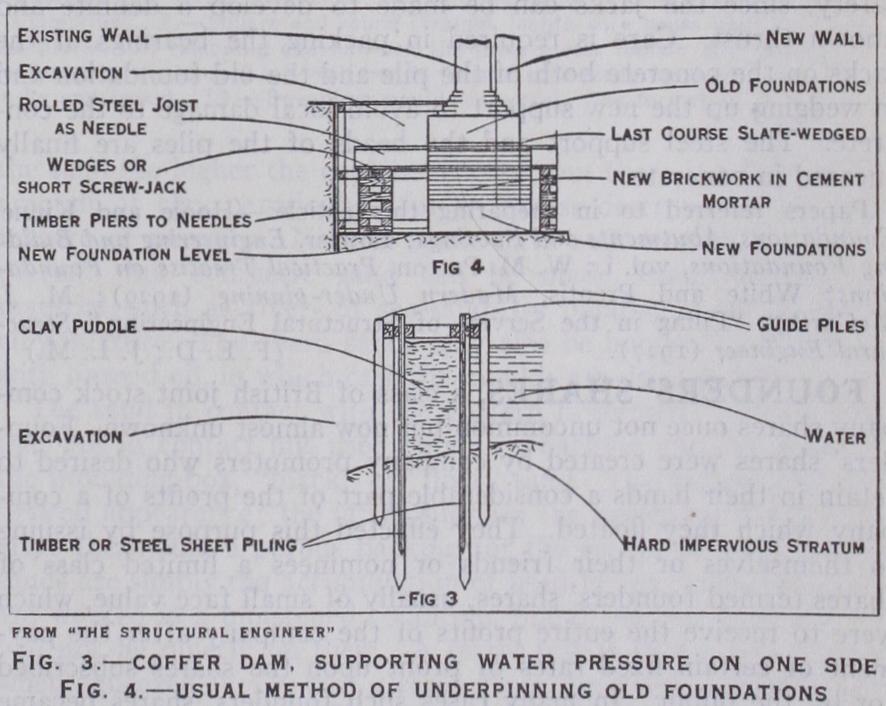
If the new foundations are to be lower, to admit of deeper basements, then the old structure must be re-supported at the lower level. The process of inserting new supports is known as under-pinning.
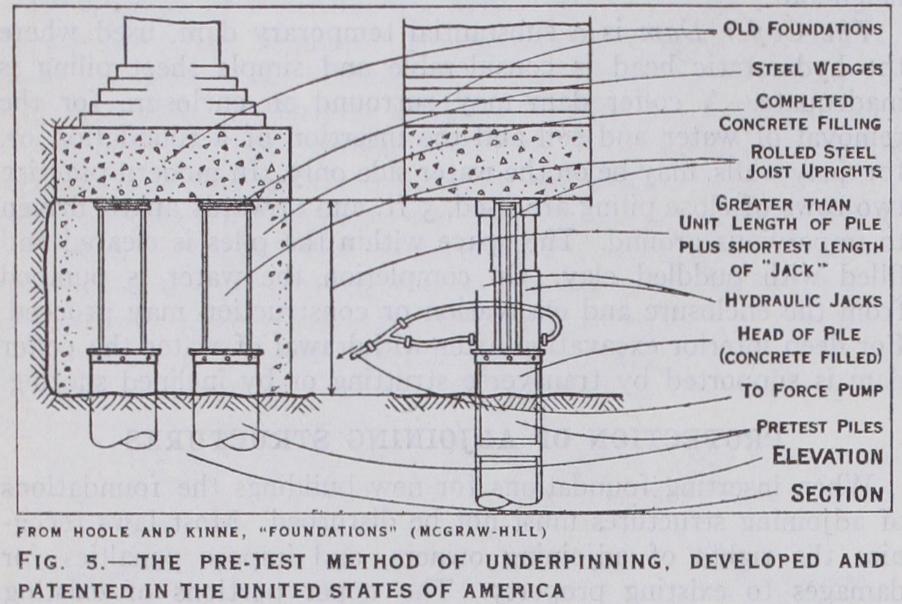
By wedging tight while the pressure is maintained on the pile, a great advantage in supporting power is gained. When the pres sure on such a pile is being increased, a "bulb of pressure" develops in the earth beneath the base of the pile and opposes its further penetration. If the load be released this "bulb" disap pears and will only be re-formed if the pile be once more forced forward into the ground. Hence, if the under-pinning be com pleted while the pile is not under pressure, the full resistance can only be developed by further settlement. The pre-test method eliminates this settlement and may also ensure a known factor of safety, since the jacks can be made to develop a definite and known thrust. Care is required in packing the bearings of the jacks on the concrete both of the pile and the old foundation and in wedging up the new support to avoid local damage to the con crete. The steel support and the heads of the piles are finally encased in concrete.
Papers referred to in preparing this article:—Hoole and Kinne, Foundations, Abutments and Footings; Fowler, Engineering and Build ing Foundations, vol. i. ; W. M. Patton, Practical Treatise on Founda tions; White and Prentis, Modern Under-pinning (1929) ; M. J. McCarthy, "Piling in the Service of Structural Engineering," Struc tural Engineer (1927). (F. E. D.; J. L. M.)