
SMALL FRUITS Black Currants.—Black currants are not suited for growing under the shade of top fruits and are not found often in the mixed plantations. They grow best in open field culture, in soil of light texture, farmed highly. The bushes are planted in rows 6 to 8 ft.
apart. Black currant growing has become a special industry on the sandy soils of East Norfolk. Kent, Worcestershire and Here fordshire are also important centres of production. Varieties such as Biskoop Giant (the earliest), Seabrooks Black, and Goli ath (mid-season) and Baldwin (late) are the main sorts grown. Septembers Black and Davidsons Eight are promising new intro ductions.
The black currant bushes have suffered much in the past from diseases such as Big Bud and Reversion, but in recent years scientific workers have shown that these may be controlled with spring spraying of lime-sulphur. Since these sprayings have been made crops have improved and acreages have extended. The average yield in 1908 fell to the low figure of 9 cwt. per acre, since when it has risen steadily until by 1925 it had reached 16 cwt. per acre. In 1927 the Ministry of Agriculture commenced a scheme whereby young bushes were inspected during the growing season and certificates issued in respect of well-grown bushes true to variety and free from reversion. A register of growers having these certificates was issued to facilitate growers in securing healthy bushes, for that seems to be of paramount importance. The planting of bushes propagated from reverted parents has been shown to be disastrous, for the planter has little or no chance of securing a crop. The total production in England and Wales rose from 5 i ,000 cwt. in 1908 to 188,000 cwt. in 1925; but even that quantity is insufficient, so that about one-third has to be imported. The Strawberry.—The strawberry crop is essentially a crop for open field culture, and especially for production on suitable soils. About 90% of the consumption is produced at home, the mild, temperate and humid climate of Great Britain being favourable to strawberry production and berries of Royal Sover eign, the Duke and Joseph Paxton are of a size and quality not reached in other lands. In 1925 strawberries in England and Wales covered 29,300 ac., having risen from 21,672 ac. in 1913. The Hampshire area, centred at Botley, Fareham and Swan wick, is perhaps the most famous, for here there are over 3,000 ac. planted in close concentration. The holdings vary from one to five acres, though a few growers have large farms. The soil is of a sandy character of easy cultivation, but rather poor and requiring liberal fertilization with stable dung, bone meal and dried blood to yield good crops. The early maturing Royal Sovereign predominates, and few are left for jam purposes. The berries are picked by gangs of pickers into chip baskets, holding at first I lb. and 2 lb. and later in the season 3 lb. and 4 lb. re spectively. From the various stations within this area approxi mately 21 million chip baskets are sent to markets all over Eng land and Wales and as far north as Dundee and Aberdeen.
In Kent the area is now less concentrated, but it has an im portant production; the Kent soil is heavier and more retentive of moisture and larger yields per acre are obtained. On the fertile soils in the Wisbech area, between King's Lynn, March and Spalding, the average to strawberries is nearly four times that of the Hampshire area. The crop here is later and the growers, missing to some extent the consumers' early market, concentrate on big yields, a large proportion of which goes for making jam. In addition to the Royal Sovereign, the heavy crop ping Sir Joseph Paxton, Madame Kooi, and the Laxton are grown. Yields are larger than in Hampshire and growers have been known to pick over two tons to the acre.
In all areas the strawberry plants have suffered from pests and diseases, such as eelworm, red plant and patch. At the request of growers the Ministry of Agriculture caused research investigations to be instituted at the horticultural research station at Long Aston, and in addition a strawberry experimental' station has been established at Botley by the Hampshire county council. The ministry also initiated a scheme of certificates similar to that for black currant growers.
Storage, Grading, Packing and Marketing.—Soft fruits, such as strawberries, currants, gooseberries, raspberries, cherries and plums, are in the main marketed directly they are picked without grading, for there seems a general belief that such fruits will not stand further handling and cannot therefore be graded. Where grading is attempted for strawberries it is usually done by the picker. Some have graded both cherries and plums with suc cess. In these cases the corps are taken to the packing sheds and graded by hand into three grades, the best cherries being packed in one-pound cartons covered with celapane paper and marketed in crates holding eight cartons. The best grade plums have been packed in chip baskets of four pounds and marketed in crates holding four baskets.
French growers specially grade their plums for the English market, and pack into small neat wooden boxes, sometimes separ ating each plum with white paper. South African plums for the English market are well packed so that each plum rests in its own nest of wood wool in flat boxes, being sold by the dozen and not by the pound.
Such well graded produce is doing much to create an impression in favour of grading, all the hardy fruits unless graded and packed in a recognized market package fetching low prices. Quicker work is made by using machinery to group certain fruits according to size, after they have been sorted into different grades by hand and the cull fruits removed. Some fruit growers have established their own grading rooms, but a beginning, too, has been made in establishing public fruit packing stations on lines com parable, though smaller, to those found in the fruit districts of the United States. The first public company was incorporated in 1924 as British Fruit Packing Co., with a packing house at East Peckham, Kent. This company undertook to provide boxes and paper, to grade, pack and sell at a fixed charge all fruit delivered to the station. The grower was relieved of the labour of grading and packing and of the task of selling; he shared the goodwill attaching to the company's label and had the fruit dealt with by skilled people. In 1925 the company handled 6o,000 bushels of apples. In 1926 the business was transferred to East Farleigh (Kent) and a branch opened at Faversham (Kent).
The fruit growers of Cottenham (Cambridge) combined and opened a packing station in 1925; similarly equipped with grad ing and packing machinery, mostly imported from the United States. The business was conducted on co-operative lines and in consequence the society has enjoyed a loan from the Ministry of Agriculture for the purchase of the machinery. During the year 1925 over io,000 bushels were handled. The failure of the apple crop in Cambridge in 1926 and 1927 prevented the station from reopening. Nevertheless, these and other British packing stations are too few in number to handle the apple and pear crops, to say nothing of the other fruits.
The Canadian fruit areas of importance are three : (a) Nova Scotia, (b) Ontario and (c) British Columbia. The Nova Scotia area is the oldest ; the British Columbia area the youngest ; that of Ontario by far the most important.
Fruit Growing in Nova Scotia.—The fruit growing industry, mainly apples, of Nova Scotia is concentrated in the narrow An napolis valley which runs almost down to the Bay of Fundy. The soil is rich, light and of an alluvial nature; the rainfall is heavy and the district well drained by four rivers. The climate is cold, with snow in winter; the summers are moderately hot with bright sunshine.
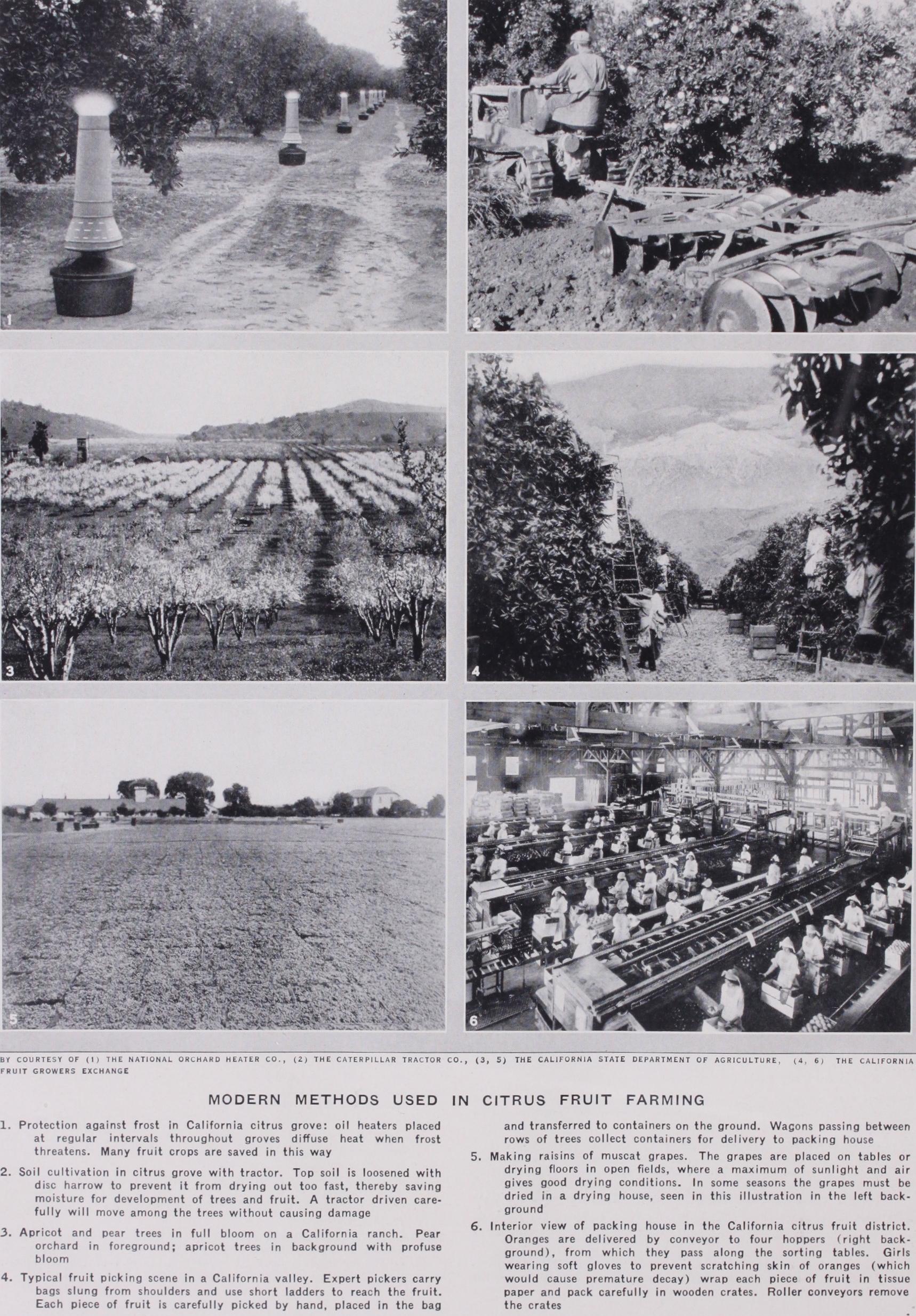
There is great similarity in the plan of the orchards, half standards being planted widely in rotas fully 4o ft. apart. Some orchards are 8o to ioo years old, though the majority would be from 20 to 3o years and a few are quite young. Grass orchards are not favoured, and all but the backward growers keep the land well cultivated with disc harrows from spring until July 1, when seed of clover, vetches, rape, millet or buckwheat is sown to produce a green crop for ploughing in to provide soil humus.
The district is by no means free of pests, and in old neglected trees scab, and scabby blotch, the codling moth, brown tail moth and aphis can be found. It is said that most growers spray three or four times and the best five or six—using lime-sulphur, Bor deaux mixture, arsenate of lime and nicotine.
The fruit after picking is taken into the packing stations, where it is graded into Grade 1, Grade 2, Domestic and Grade 3, after which it is packed into wooden barrels each holding 120 lb. The larger growers of from 70-100 ac. have their own packing houses, but the majority adopt a co-operative method of packing and selling and for that purpose have formed a number of societies or companies each of which owns one or more packing houses. Throughout the Annapolis valley there must be over 1 oo of these packing houses.
Forty of the fruit packing companies have carried co-operation a stage further by combining to form a central trading organiza tion registered as the United Fruit companies of Nova Scotia. This company acts as a selling agency for all its subsidiary com panies and has sales which exceed 400,000 barrels of apples annually. The total production of apples is estimated at 1,400,000 barrels, of which at least two-thirds is annually exported to Great Britain. The chief varieties grown are the Baldwin, Blenheim, Gravenstein (early), Golden Russet, Kings and Ribston. Cherries, strawberries, pears are also grown in smaller quantities.
The soil is silty, though varying considerably in texture, so that patches of very, light, medium and heavy soils occur frequently and each is cropped in a special way. Orchards of peach trees abound on the light soils; pears, plums and apples on the medium, whilst grapes and currants are found on the heavy. Fields of strawberries and raspberries are common. The Niagara district lying well south has a climate coming under the moderating in fluence of the Great Lakes, so that the day and night temperatures are more even and spring frosts are very rare. All these factors combined are said to give high flavour and piquancy to Ontario grown fruit and to render safe the production of good annual crops.
The apple trees in the orchards follow the English system ; but in culture, cover cropping, manuring with artificials, and spraying to control pests the methods are akin to those practised in Nova Scotia. The grading of the fruit is done in the orchards mostly by hand, for few have yet adopted the packing house system so commonly seen elsewhere. The fruit districts are in close prox imity to populous districts and much is sold for local consumption, leaving but little for export.
The land under the trees is cover cropped to alfalfa (mostly), vetches or sweet clover, for the practice of clean-cultivation has not been successful. The fruit on the trees are much thinned after the June drop and trees are sprayed five or six times to prevent insect pests from doing damage. Under these conditions it is not surprising that high quality clean fruit is produced.
In each centre, Vernon, Kelowna, Penticton, etc., local growers have combined to form fruit companies for the co-operative storing, grading and packing of the fruit ready for marketing. In British Columbia the standard box of 4o lb. is used for apples. None of the packing houses—nor any of the members—are per mitted to sell fruits on the markets, the selling being left to a central agency, the Associated Growers of British Columbia, Ltd.. with headquarters at Vernon. The annual sales of this central agency exceed 3,000,00o boxes of fruit (of which over 2,500,000 are apples) and over 12,000,000 lb. of vegetables. The chief varieties of apples grown are McIntosh Red and Jonathan, Wealthy, Kings, Delicious and some Cox's Orange Pippin.
Enjoying a wide range of soil and climate, it is not surprising that districts can be found in Australia where nearly every kind of fruit may flourish. Large scale production is, however, re stricted to fruits that can be exported under refrigeration, for the main market is Great Britain. In the census for 1926 the main fruits grown and produced were as follows :— Apples are the most important crop not only in production but for export. Tasmania is the oldest fruit growing centre and still has the largest industry. Next in order of importance are Victoria, Western Australia and South Australia. The total value of the Australian fruit crop in 1925 amounted to £6,283,000 and with the grape harvest included it reached a total of f 1 o,000,000.
Growers have copied the orcharding systems of both Great Britain and the United States for apple and pear growing; apricot and peach culture closely resemble that of California. New South Wales, Victoria, and South Australia have taken the lead in irri gation of orchards, utilizing the waters of the Murrumbidgee and the Murray rivers with schemes under Government direction.
Of apples, the principal varieties grown are Sturmer Pippin, Cleopatra, Scarlet Pearmain, Cox's Orange Pippin, Ribston Pippin, Dunn's Seedling and the American Jonathans and Rome Beauty; of pears, Doyenne du Cornice, Josephine, Bon Morceau, Beurre Bosc and Keiffer, etc. The Australian growers, and especially those of Tasmania, have introduced most varieties grown in Eng land and the best of the American kinds, with the inevitable result that too many kinds are grown to market to the best advantage.
To a large extent the grading and packing is modelled on the American system and improvements in the market package are made annually. There now exists a plan for linking up the fruit areas with district packing houses and cold stores working as co-operative concerns. Stage by stage these are coming into opera tion ; but it will be some years before complete standardization is effected. At present the Western Australian apples are packed in bushel cases made of red eucalyptus wood, Tasmania uses white gum wood, while New Zealand uses deal.
In New Zealand the fruit-growing lands are situated in the provinces of Auckland, Hawkes Bay, Nelson, Canterbury and Otugo. The orchards are surrounded with shelter belts of rapid growing Australian wattles, usually three rows, for it is held that one of the first essentials in successful fruit production in New Zealand is adequate shelter to protect the trees when in blossom. The fruits from New Zealand are juicy and well flavoured, much as those grown in England, but the skins are more polished and coloured by the bright sunshine.
The fruit industry of Australia and New Zealand acquire added importance in virtue of its season of harvest synchroniz ing with the lean fruit months of countries in the Northern Hemi sphere. Great Britain, for instance, is able to draw supplies of apples and pears from the Northern Hemisphere from September till April, and from Australia and New Zealand from May till August.
The potential capacity of South Africa for fruit production is fast becoming recognized. Large numbers of trees have been planted, but only a few have reached the production stage. The statistics show the trees of bearing and non-bearing ages :— These figures clearly show that in a few years' time South Africa will rank amongst the great fruit producing countries, whilst its production will resemble that of California, which en joys a summer climate not very dissimilar. Irrigation is practised, particularly for the citrus groves.
Apples of a sort have been grown for generations in all parts of South Africa, especially on the high plateaux of the Transvaal, Free State and Natal, and recently, when the commercial possi bility of production was realized, many commercial orchards were established mainly in the same regions, for apples seem to do better on the high veldt than in the hot plains. The rainfall is mainly in the summer; for the winter is dry, with frost at night. Sunshine at all times is very bright. Some apples are grown in the eastern portion of Cape Province near the sea, where these conditions are reversed.
The peaches, pears, plums and apricots are grown in special areas, of which the district at the back of Cape Town is well known, though some are produced in the Orange Free State and the Transvaal. The pear probably does best. It is the longest in coming into bearing, but has a commercial life twice as long as the peach tree and yields large crops. William Bon Chreticn, Beurre Bosc, Beurre Hardy and Louise Bonne are favourite kinds. Plums and peach trees commence to give a commercial return in about four years, in seven or eight they are in full cropping and have a life of about 20 years.
Oranges are now grown throughout the South African Union and also in Southern Rhodesia, but as yet the trees are young and only yield light crops. In 1907 only 3,00o boxes were exported to the United Kingdom, in 1925 the number had reached 1,000,000 boxes. It is estimated that within the next 15 years South Africa and Southern Rhodesia will be able to send to the United King dom 1o,o0o,000 cases a year. The chief varieties grown are the Washington Navel and Late Valentia, though the Jaffa and the Mediterranean Sweet are being planted. The Late Valentia has proved very suitable for South Africa. The trees grow well and the fruit packs and carries satisfactorily ; it arrives in the United Kingdom during September, October and November. The Wash ington Navel is earlier and reaches the British markets in June, July and August. Orange growing in South Africa is done by the white population helped by native labour. All exported oranges must conform in grade, quality and packing to the Government regulations which define the grades. The future prospects for fruit production in South Africa seem particularly bright.
Oranges ripen at different times in the various countries of pro duction, and so reach the markets at different seasons of the year. Orange: from the West Indies, Palestine and Spain are on sale during the winter months from November to April, those from California in January to July. The South African and Australian crops arrive in Britain from June to November. Oranges from all these places are sent for sale to England; but the Californian crop is marketed mainly in the United States, though a small quantity is exported to Europe. The Spanish oranges differ a good deal, those of the Mediterranean seaboard being the sweeter, whilst the Sevilles, a speciality of the south, are bitter and largely used for making marmalades. These Sevilles are sold during January.
No general organization exists for grading and packing, nor has the Spanish Government passed any laws to compel grading. A few large growers do their own grading and packing, but in general the fruit is taken over by merchants who grade and pack in accordance with their own standards.
The total orange area in Palestine is over 8,000 ac., with exten sive new annual planting being made on the coastal strip near Jaffa. Both Jewish and Arab labour is employed. Camels are used to take the cases of oranges to Jaffa, whence they take 12 to 20 days by ship to reach England. The large oval Jaffa oranges en joy a high reputation.
Orange growing in California is on a large and elaborately organized scale. Washington Navel (maturing from November to May) and Valentia (from May to November) are the two main varieties. Many Tangerines and Mediterranean Sweet have been planted in recent years. In order to protect the maturing fruits against frost, oil pots are used to heat the orchards.
The Californian orange growers are great believers in bud selection. In propagating citrus trees nurserymen now use buds from parent trees with known and satisfactory performance records. These are grafted on the sour orange, which has proved to be the best stock for California.
Government standards of grading and packing are in force in South Africa for all exported fruits. In the West Indies, es pecially in Jamaica, the grape fruit is found wild in many places.
Great Britain draws its supplies from two main areas: the British West Indies with Central America and Colombia to gether supply about 75% of the British imports, the other 25% comes from the Canary islands and Madeira:— Great Britain's Importation of Bananas The banana is easy to grow provided there is sufficient heat and an abundance of water. Suckers planted soon take root and grow into plants which yield fruit in about 18 months, but the plant bears only a single bunch in its life cycle. The Gros Michael is the principal kind grown in Central America and Jamaica. Individual bunches of these vary between so-8o lb. in weight. This banana is large, has a thick skin, and may be marketed in towns far from the centre of production. Unfor tunately it is liable to the Panama disease (Fusarium cubense), which in the past has caused so much loss, especially in the West Indies.
The Canary banana has bunches weighing from 25 to 65 lb., and carrying from 125 to 200 separate fruits. The individual fruits are thin skinned, small and of high class. Owing to the delicacy of the skin of the fruit and the structure of the bunch special precautions in handling, packing and carriage have to be made. The supplies sent to Great Britain from the Canary islands are wrapped in cotton wool and packed in crates to pre vent damage and decay.