
THE ATTACK OF FORTRESSES In considering the history of siegecraft since the introduction of gunpowder, there are three main lines of development to fol low, viz., the gradually increasing power of artillery, the systema tizing of the works of attack and in recent times the change that has been brought about by the effect of modern small-arm fire.
Cannon appear to have been first used in sieges as mortars, to destroy hoardings by throwing round stones and barrels of burn ing composition. Early in the 15th century we find cannon throw ing metal balls, not only against hoardings and battlements, but also to breach the bases of the walls. It was only possible to work the guns very slowly, and archers or crossbowmen were needed in support of them, to drive the defenders from the crenellations or loopholes of the battlements. At that period the artillery was used in place of the mediaeval siege engines and in much the same manner. The guns of the defence were inaccurate and in capable of adequate depression so that the besieger could place his guns close to the walls, with only the protection of a few large gabions filled with earth, set up on the ground on either side of the muzzle.
In the course of the 15th century the power of artillery was largely increased, so that walls and gates were destroyed by it in an astonishingly short time. Three results shortly followed. The guns of the defence having gained equally in effectiveness, greater protection was needed for the attack batteries; bastions and outworks were introduced to keep the besieger at a distance from the inner walls; and the walls were sunk in ditches so that they could only be breached by batteries placed on the edge of the glacis. Early in the i6th century fortresses were being remod elled on these lines, and the difficulties of the attack were at once increased. The tendency of the assailants was still to make for the curtain, which had always been considered the weak point ; but the besiegers now found that they had to bring their guns right up to the edge of the ditch before they could make a breach, and in doing so had to pass over ground which was covered by the converging fire from the faces of the bastions. Towards the end of the century the attack of the curtain was still more delayed and the cross-fire over the ground in front increased by the in troduction of ravelins.
Another weak point about the attack was that after the escarp walls had been strengthened to resist artillery fire as has been described, there was no clear idea as to how they should be breached. The usual process was merely an indiscriminate pound ing from batteries established on the crest of the glacis. Thus there were cases of sieges being abandoned after they had been carried as far as the attempt to breach. It is in no way strange that this want of method should have characterized the attack for two centuries after artillery had begun to assert its power. At the outset many new ideas had to be assimilated. Guns were gradually growing in power ; sieges were conducted under all sorts of conditions, sometimes against mediaeval castles, sometimes against various and widely differing examples of the new fortifi cation; and the military systems of the time were not favourable to the evolution of method. It is the special feature of Vauban's practical genius for siege warfare that he introduced order into this chaos and made the issue of a siege, under normal condi tions, a mere matter of time, usually a very short time.
For this purpose Vauban devised the Places d'armes or lignes paralleles. He tells us that they were first used in 1673 at the siege of Maestricht, where he conducted the attack, and which was captured in 13 days after the opening of the trenches. The object of these parallels was to provide successive positions for the guard of the trenches, where they could be at hand to repel sorties. The latter were most commonly directed against the trenches and batteries, to destroy them and drive out the working parties. The most vulnerable points were the heads of the ap proach trenches. It was necessary, therefore, that the guard of the trenches should be in a position to reach the heads of the approaches more quickly than the besieged could do so from the covered way. This was provided for as follows. The first par allel was usually established at about 600yd. from the place, this being considered the limiting range of action of a sortie. The parallel was a trench 12 to 15ft. wide and 3ft. deep, the excavated earth being thrown forward to make a parapet three or four feet high. In front of the first parallel and close to it were placed the batteries of the "first artillery position." While these batteries were engaged in silencing the enemy's artillery, for which purpose most of them were placed in pro longation of the faces of the fortress so as to enfilade them, the "approach trenches" were being pushed forward. The normal sector of attack included a couple of bastions and the ravelin be tween, with such faces of the fortress as could support them ; and the approach trenches (usually three sets) were directed on the capitals of the bastions and ravelin, advancing in a zigzag so ar ranged that the prolongations of the trenches always fell clear of the fortress and could not be enfiladed.

Fig. 12, taken from Vauban's Attack and Defence of Places, shows clearly the arrangement of trenches and batteries.
After the approach trenches had been carried forward nearly half-way to the most advanced points of the covered way, the "second parallel" was constructed, and again the approach trenches were pushed forward. Midway between the second par allel and the covered way, short branches called demi-parallels were thrown out to either flank of the attacks ; and finally at the foot of the glacis came the third parallel. Thus there was always a secure position for a sufficient guard of the trenches. Upon an alarm the working parties could fall back and the guard would advance. Trenches were either made by common trenchwork, flying trenchwork or sap. In the first two a considerable length of trench was excavated at one time by a large working party extended along the trench: flying trenchwork (formerly known as flying sap) being distinguished from common trenchwork by the use of gabions, by the help of which protection could be more quickly obtained. Both these kinds of trenchwork were com menced at night, the position of the trench having been previously marked out by tape. The "tasks" or quantities of earth to be excavated by each man were so calculated that by daybreak the trench would afford a fair amount of cover. Flying trenchwork was generally used for the second parallel and its approaches, and as far beyond it as possible. In proportion as the attack drew nearer to the covered way, the fire of the defenders' small arms and surviving artillery naturally grew more effective, and it became necessary before reaching the third parallel to have recourse to sap.
Sapping required trained men. It consisted in gradually push ing forward the end of a narrow trench in the desired direction. At the sap-head was a squad of sappers. The leading man excavated a trench one foot six inches wide and deep. To protect the head of the trench he had a shield on wheels, under cover of which he placed the gabions in position one of ter another as the sap-head progressed. Other men following strengthened the para pet with fascines, and increased the trench to a depth of three feet, and a width of two feet six inches to three feet. Fig. 13, taken from Vauban's treatise on the attack, shows the process clearly. The sap could then be widened to ordinary trench di mensions by infantry working parties.
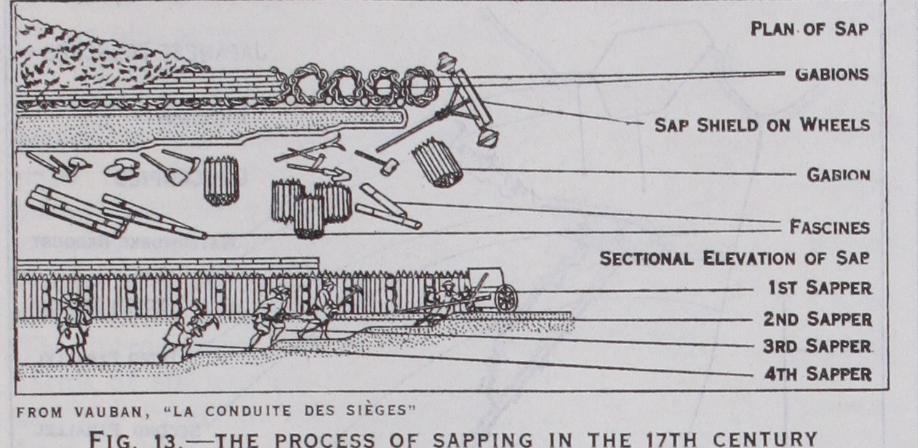
As the work at the sap-head was very dangerous, Vauban en couraged his sappers by paying them on the spot at piecework rates, which increased rapidly in proportion to the risk. He reck oned on a rate of progress for an ordinary sap of about 5oyd. in hours.
The nearer the approaches drew to the covered way, the more oblique became the zigzags, so that little forward progress was made in proportion to the length of the trench. The approaches were then carried straight to the front, by means of the "double sap," which consisted of two single saps worked together with a parapet on each side. To protect these from being enfiladed from the front, traverses had to be left at intervals.
From the third parallel the attack was pushed forward up the glacis by means of the double sap. It was then pushed right and left along the glacis, a little distance from the crest of the covered way. This was called "crowning" the covered way, and on the position thus gained breaching batteries were established in full view of the escarp. While the escarp was being breached, if it was intended to use a wide systematic attack, a mine gallery (see "Military Mining" below) was driven under the covered way and an opening made through the counter-scarp into the ditch. The sap was then pushed across the ditch, and if necessary up to the breach, the defenders' resistance being kept under by mus ketry and artillery fire from the covered way. The ravelin and bastions were thus captured successively.
Vauban showed how to breach the escarp with the least ex penditure of ammunition. This was done by making, with succes sive shots placed close together (as was feasible even then at such short range) horizontal and vertical cuts through the revetment wall. The portion of revetment enclosed by the cuts being thus detached from support was overturned by the pressure of the earth from the rampart. Ricochet fire was also the invention of Vauban. He showed how, in enfilading the face of a work, by using greatly reduced charges a shot could be made to drop over the crest of the parapet and skim along the terreplein, dismount ing guns and killing men as it went.
In comparing the resistance made behind the earthworks of Sevastopol with the recorded defences of permanent works, it is essential to remember that the conditions there were abnormal.
The siege corps was not sufficiently strong to invest the fortress completely, in fact the Russians came nearer to investing the Allies ; the Russians had the preponderance in guns almost throughout ; the Russian force in and about Sevastopol was nu merically superior to that of the Allies. We must add to this that Todleben had been able to get rid of most of his civilian pop ulation, and those who remained were chiefly dockyard workmen, able to give most valuable assistance on the defence works. The circumstances were therefore exceptionally favourable to an active defence. The weak point about the extemporized earthworks, which eventually led to the fall of the place, was the want of good bomb-proof cover near the parapets.