
THE MODERN FUR TRADE Sources of Supply.—It is a mistake to suppose that furs are the product only of cold climates. The fur trade draws its supplies from all over the world, and finds use for those of the tropics as well as for those of the Arctic. But it remains a fact that the more valuable pelts are mostly obtained from those regions where the winter temperature is sufficiently low to ensure the growth of thick and luxuriant fur. Canada and North America generally, northern Europe and Siberia are therefore the most important sources of fur supply, and their production in this kind includes almost all the so-called "fine furs," and the majority of those classed as staple articles.
The principal furs obtained from North America are beaver, musquash, skunk, American opossum, mink, marten, fisher, er mine, silver fox, blue fox, red fox, white fox, cross fox, seal, raccoon, white bear, grizzly bear, wolf, lynx and wolverine. Of these seal, raccoon, musquash, opossum, mink, skunk, beaver and the various kinds of foxes are the most important commercially.
Northern and central Europe and Siberia provide squirrel, Rus sian sable, ermine, red fox, cross fox, white fox, wolf, bear, badger, kolinsky, mink, marmot, fitch, stone marten, baum marten, otter and a certain amount of musquash. The chief contribution of the British Isles to the list of wild fur supplies is moleskin, of which the best grades come from Scotland. The British Isles also pro duce wild rabbit and a few otter, wild cat and stoat. Moleskin is also obtained from Holland, France and parts of Africa.
China supplies marmot, kid, goat, lamb, moufflon, etc. ; and central Asia, Persian lamb and other lambskins. The principal Australian furs are Australian opossum, red fox, wallaby and rab bit. New Zealand also produces opossums and a large number of rabbit skins. The Australian and New Zealand rabbit skin supply is a factor of great and increasing importance in the fur trade.
From South America come nutria, chinchilla (though this fur is scarce) foxes, skunk, chinchilla rats, etc. The fur production of Africa is relatively unimportant in the commercial sense. The skins of various animals of the deer tribe are obtained from there, together with monkey, panther, lion, otter and hyrax. Of the minor fur producing regions, Japan produces a certain amount of mink and flying squirrel; India, red foxes, tiger and some stone marten ; the Balkans, lambskins, fox, martens, etc. ; and Italy and Spain, lambskins.
The seal is the principal marine animal whose fur is used in the fur trade, the best skins being obtained from the north Pacific, and particularly from the coast and islands of Alaska. The Alaskan seal herds are protected by an international convention, and since it has been in force their total has increased from under i oo,000 to over 800,000. Sealskins are also obtained off the Cape of Good Hope and in the north and south Atlantic. Sea otter, another marine animal with a valuable pelt, is rare ; the best specimens live in Alaskan and Canadian waters but are strictly protected.
Collection and Distribution.—Fur skins find their way to the world's markets through two channels. A large number, after being delivered or sold by the trappers to collecting agents, are bought by the representatives of skin merchants in various centres, and pass directly into use. The majority of the world's catch however is consigned to agents or brokers for sale at one or other of the great public fur auctions held periodically in cer tain centres. The most important of these auctions are those at London, Leipzig and New York, while Montreal, St. Louis (the Alaska seal catch is sold here), Paris, Winnipeg, Copenhagen, Seattle, Edmonton, etc., are fur auction centres of secondary im portance. In London, which, from the number and value of the furs sold there, is the chief distributing centre for the world's fur trade, public auctions of skins are held three times a year—in January, April and October—each series lasting from three to four weeks. The offering is made up of (I) fur skins consigned from all parts of the world to about half -a-dozen firms of fur brokers; and (2) the collection of the Hudson's Bay Company. The latter is sold separately by the company, but the other brokers group their collection into sections, including seal skins and Aus tralian furs, Chinese and Japanese furs, and the main catalogue, which comprises furs from North America, Europe, etc., and is the most important part of the sale. Each broker firm sells its own col lection, the order of selling being arranged by lot. The offerings in each section, either in bulk or in sample, are open to inspection in various warehouses several days before the auctions commence, and buying in the sale room is done from the catalogue, no lots or samples being shown there. The same procedure as regards in spection and buying is followed at the other fur auction centres, though selling arrangements may vary. In New York there are three major public fur auctions a year, in addition to minor auc tions each month at certain periods of the year; and this system also prevails at Leipzig. The New York auctions, though they include furs from all parts of the world, are mainly concerned with American skins ; those at Montreal almost entirely so. The Paris and Winnipeg auctions are only of local collections, and at Copenhagen there is annually held a sale of Greenland furs.
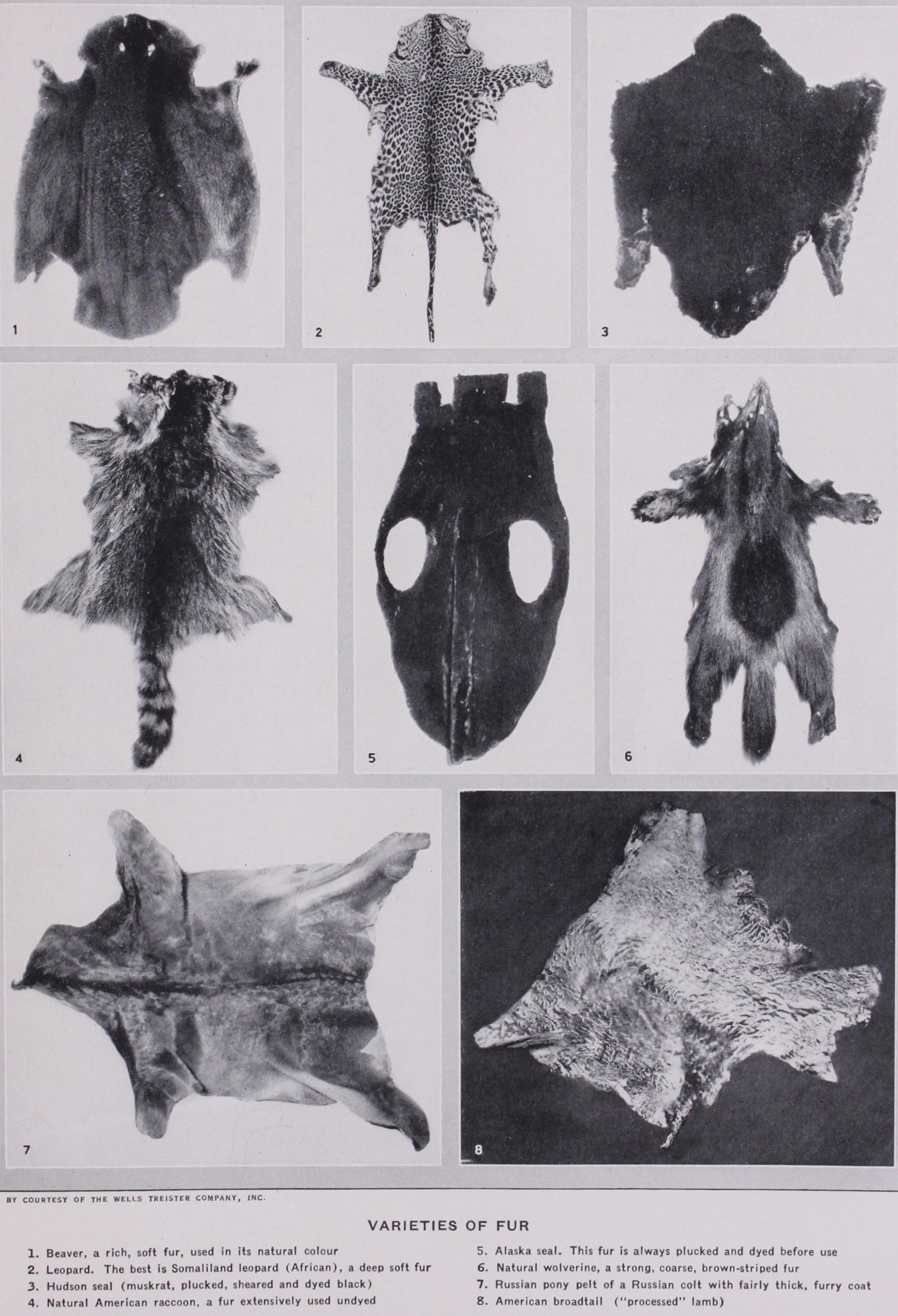
The Leipzig auctions are of especial importance in connection with Russian furs, for which they provide one of the principal markets. Under the Soviet Government in Russia, the export trade in furs is a state monopoly, and in theory the Russian fur catch is collected by certain state trading organizations which pay the trappers an officially fixed price for the skins. This price, however, is seldom the highest obtainable, and a good deal of private trading, with subsequent smuggling of furs over the fron tiers into China and elsewhere, goes on. Nevertheless the greater part of the catch comes eventually into the hands of the appropri ate authority, and whatever proportion of it is deemed surplus to domestic requirements is held for export and sold abroad at a convenient time for the account of the Soviet Government.
Buyers from all parts of the world attend the fur auctions in London and Leipzig, the great majority of them being either skin merchants, fur brokers and commission agents or manufac turing furriers. The fur broker buys and sells on commission terms for his clients, while the skin merchant buys for his own stock the kinds of furs for which he anticipates a demand. Each class of trader is of necessity an expert in raw furs, and the skin merchant can tell not only the exact grade and value of a skin, but often the precise district of its country of origin.
The approximate quantities of certain of the more important furs offered at the London auctions during the year 1927 were as follow: Beaver 51,631, musquash 490,558, red fox 625,198, skunk 1,660,161, Australian opossum 1,677,507, mole 1,961,443, squirrel 3,203,317, fur seals 22,866, American opossum Persian lamb 970,300, marmot 558,486, nutria 31,211, cross fox 17,270, white hare 1,084,590, mink 120,563, Russian ermine 213,708, stone marten 39,347. With these figures may be compared some for 1913, as follows: Red fox 96,395, musquash 3,861,010, Australian opossum 275,600, skunk 863,638, beaver 23,070, fur seal 15,183, mole 1,445,124, squirrel 628,177. Price comparisons have little real significance because fur skins are susceptible of such numer ous variations in quality that a common basis is difficult to find. The following, however, are of interest : the figures given are as a rule the highest price paid for a single skin in the auctions of the year in question: Red fox-1913, £5, 1927, £12.5s.; musquash 1913, 4s.6d., 1927, Australian opossum—I 913, 6s., 1927, 38s.; beaver-1913, f3.8s., 1927, f13; skunk-1913, 35s.6d., 1927, I 2S.
Auctions of Australian and New Zealand rabbit skins are held in London about six times a year, the offerings including both furriers' and hatters' skins. The total export of rabbit skins from Australia during the fiscal year 1925-26 was 15,028,304 lb., valued at £2,880,360, of which 5,117,458 lb. were consigned to the United Kingdom and 9,270,118 lb. to the United States of America. During the calendar year 1912 the total export was 9,856,034 lb., valued at £577,050, the United Kingdom receiving 6,034,532 lb. and the United States 1,842,052 lb. The United States imported in 1927, 22,069,111 lb. of rabbit, hare and coney skins. The total imports and manufactures of fur for 1926 were for The total exports for 1926 were $23,215, and for 1927, $30,892,985.
Fur Dressing and Fur Dyeing.—Briefly, the function of the fur skin dresser is to make the skin suitable for use in the later stages of the trade, the objects aimed at being the creation of a soft, pliable leather; the removal of superfluous matter from the pelt ; and the preservation and enhancement of the natural lustre of the fur. The details of the process vary widely with the nature and condition of the skin treated, but in every instance there are at least four distinct stages, some being comprised of several processes, in the operation. First of all there is the prelim inary cleaning and softening of the pelt ; then "fleshing" (removal of fleshy matter from the skin) and stretching ; then "leathering" (the formation of a leather on the skin, actually a form of tan ning) ; and then a final cleaning. After each stage, and between many of the intermediate processes, the fur is cleaned, a revolving wooden drum containing sawdust or other suitable material being generally used for this. Separate departments of the fur dresser's art are "unhairing" (the removal of guard-hairs where necessary), shaving, etc. ; while the dressing of seal skins is a complicated business presenting features not found in the majority of furs. Though it doubtless originated in a primitive and haphazard manner, modern fur skin dressing is a highly developed scientific process requiring, incidentally, a considerable mechanical equip ment.
Fur dyeing is of great antiquity, but may be said to date its modern development from the latter part of the i9th century. Before that date the dyeing of furs was mainly carried out with vegetable or mineral colouring matters. Since then, however, various chemical compounds known as fur bases have come into general use, and have largely superseded the older materials by reason mainly of the ease with which they can be applied. The use of these synthetic compounds has also enabled fur dyers to produce many new colours on furs, and fresh ones are added every year. This again has led to the adoption by the fur trade of many skins which in their natural colours would be disdained by the public, but which when well dressed and dyed make most attractive furs. Chief among these is rabbit, which, under its trade name of coney, appears in almost innumerable shades, and is one of the most important furs in the world. From the cheap ness of the skin, dyeing in this instance has brought furs within the reach of millions who could not otherwise afford them. Another result of the development of fur dyeing is that the public is enabled to obtain excellent substitutes for furs which are scarce or costly. Thus, marmot is dyed to represent the valuable mink, while dyed musquash is widely used in the place of sealskin. The technical side of fur dyeing is a matter upon which great secrecy is maintained. Each dyer has his own proc esses which are jealously guarded, and though he may achieve the same results as his neighbour it is often by means which are to a large extent different. Leipzig is the chief fur dyeing centre of Europe, a position it owes partly to the skill of its workers, but largely to the success of the German chemists in producing dyestuffs. France and Belgium annually dye millions of imported and domestic rabbit skins, and there is a flourishing fur dyeing industry in London which has long been reputed for the excellence of its dyes on sealskins. The fur dyeing industry of New York, a large and prosperous one, received a great impetus from the cessation of the supply of Leipzig-dyed furs during the war of 1914-18, and has since developed rapidly.
According to the Census of Production for 1924, the total value of the goods made and the work done by the fur trade in Great Britain in that year was £6,562,000, as compared with £1,658,000 in 1907. Of the 1924 figure £5,328,000 represented the selling value of made-up fur goods other than mats and rugs ; alterations and repairs to fur goods accounted for £443,000; while the amount received by fur dressers and dyers for work done for the trade was £521,000. Each of these figures is considerably above that for 1907, the most notable increase being in the amount received for alterations and repairs, which was only £21,000 in the earlier year.