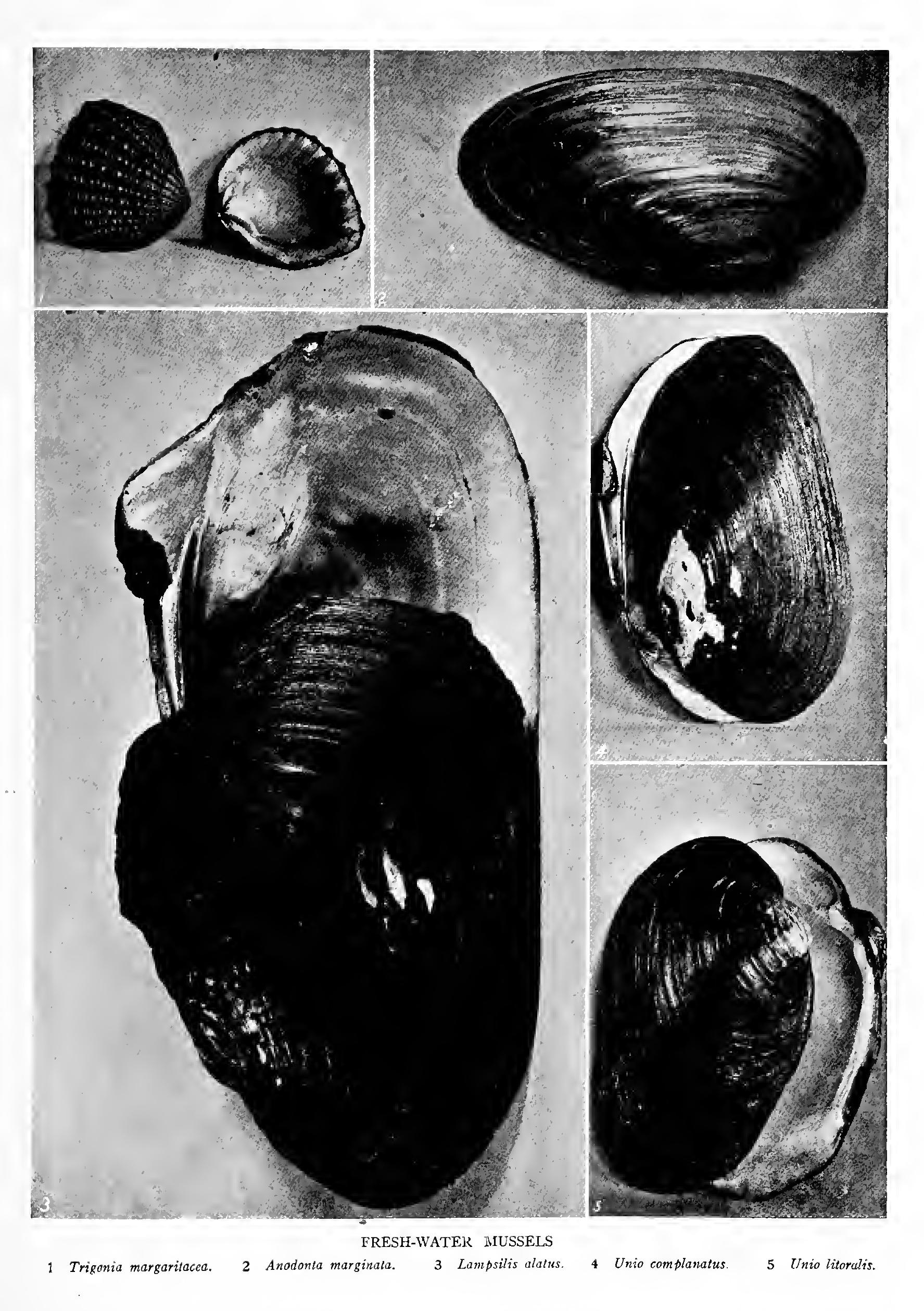
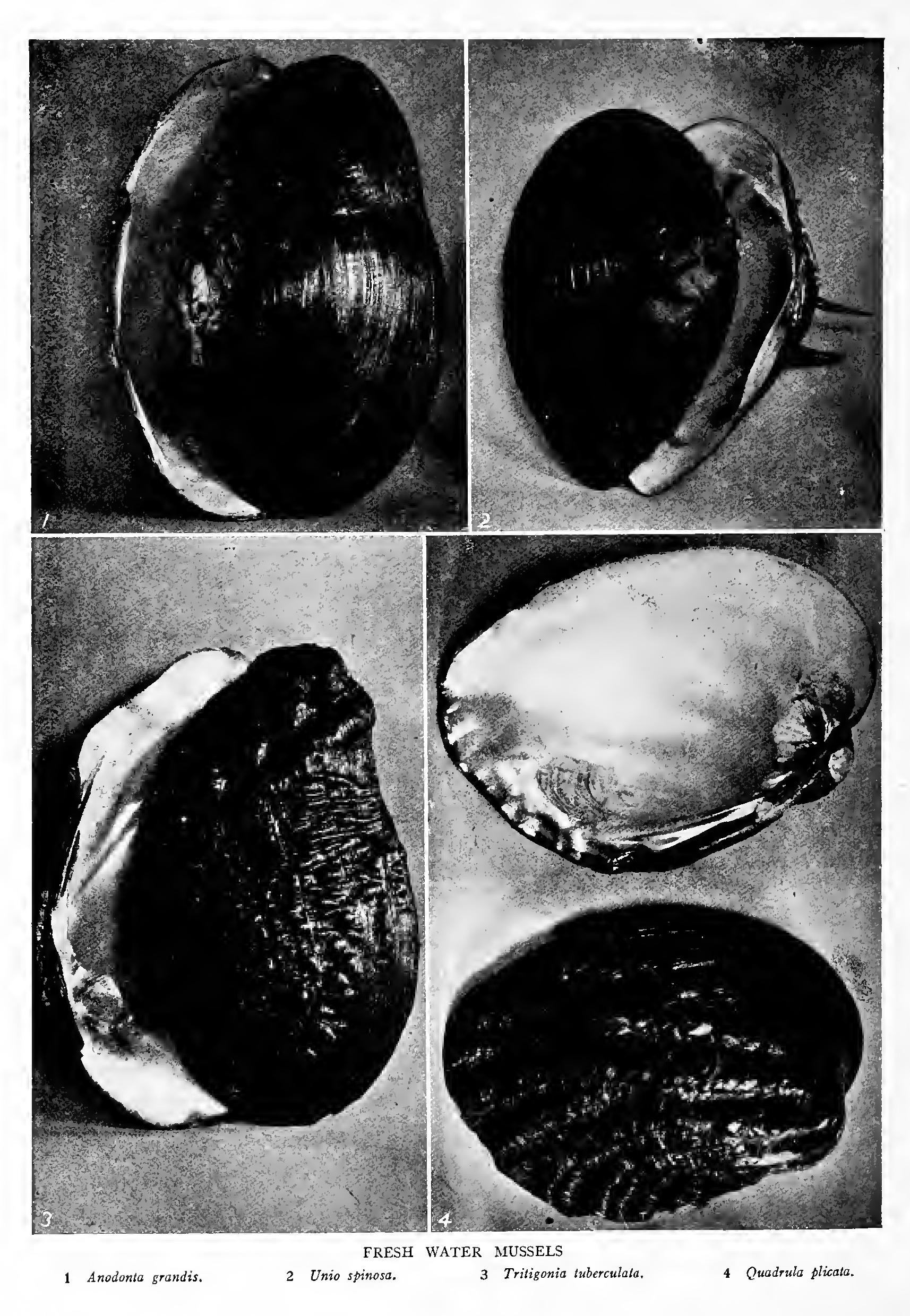
The Pearly Fresh-Water Mussels - Family Unionidae
THE PEARLY FRESH-WATER MUSSELS - FAMILY UNIONIDAE. Shell pearly, with thick periostracum; hinge variable, with or without teeth of schizodont type, all genera show at least vestiges of teeth arranged as pseudo-cardinals and laterals; beaks sculptured usually, often showing remains of nuclear shell, eroded when old, as a rule; pallial line usually sim ple; prismatic border narrow; sculpture variable. Animal with large foot; mantle borders free; gills four, leaf-like, dorsally at tached; labial palpi four, wider than long. Embryo a glochidium, with bivalve shell, developed in the gills of the parent. Sexes united or separate. In higher forms, shell of the female swollen to accommodate the egg pouches, marsupia. Shells of thick pearl used in button-making. Pearls of considerable value are obtained from river clams.
A vast and complex family of fresh-water clams, inhabiting the sandy or muddy bottoms of streams and bodies of still water, Every continent has its own genera; every great drainage basin has its peculiar species. There is much variability within species.
Mr. Charles T. Simpson has published a "Synopsis of the Naiades" in Volume XXI 1., No. 1205, of the Proceedings of the United States National Museum, issued in 190o. Under the name, Naiades he groups the families Mustelidx and Unionidx. The latter only is represented in North America, though it is by no means restricted to this continent. The Mustelidx include eleven genera, in tropical Africa and South America. The Unionidx comprise sixty-one genera, with about one thousand species and eighty-two varieties. Of these over five hundred species and fifty-five varieties belong to North America. Others are distributed over the other continents.
Besides significant differences in the hinge teeth the two 373 The Pearly Fresh-water Mussels grand divisions of the Naiades are based upon differences in the structure and development of the embryo, which widely separate the two families. The young of the Mustelidx'begin with a three segmented body hatched from the egg, the central segment alone having a single shell. The Unionidx hatch from the eggs as creatures with bivalve shells. This universal family trait deserves
some definite description.
The gills of the parent clam are modified to form brood pouches which are swollen with eggs, and retain the young after they are hatched until they reach the stage called glochidium. The young are submerged during this waiting period in a nutri tious mucus in the outer gill of the parent. A bivalve shell, loosely hinged. and joined by a muscular band, contains the soft parts, undifferentiated into organs until the mollusk is six months or a year old. Two strong, inward-pointing, saw-toothed hooks stand at the lips of the gaping valves. A thread-like byssus is coiled between them.
When the mucus is all absorbed the glochidia are discharged from the brood pouch into the water. On suitable bottom they lie on their backs with the byssal cords floating upward. Here each creature perishes unless a fish comes near enough for it to catch hold of with the prehensile cord. The successful indi vidual is not slow to secure his hold by clamping the edge of a scale or a fleshy gill filament of the fish with the two hooks of the bivalve shell. A slimy exudation of the skin of the fish covers the minute clam that is catching a ride on fin or gill or elsewhere. The nutriment absorbed while thus encysted is sufficient to per fect the development of the vital organs. The young clam bursts the cyst, and falls to the bottom, where subsequent growth con sists of gradual increase in size, through feeding upon microscopic organisms from the water.
Genus QUADRULA, Agassiz Shell triangular, or quadrate, solid, swollen, with distinct posterior ridge crossed by' irregular, coarse, concentric ridges, beaks prominent, with deep cavities inside; hinge plate heavy, wide, flattened; teeth ragged, solid, under beaks; laterals double, blade-like in left valve, single in right; epidermis dark, dull, some times feebly rayed; male and female shells alike. Inner gills 374 The Pearly Fresh-water Mussels larger than outer pair; all occupied by marsupia in breeding time, forming smooth pads. Ninety-nine species.