The Pearly Fresh-Water Mussels - Family Unionidae
U. gibbosus,
Barnes, is a mid-continental Unio of wide distribution. The shell is solid, triangularly or elongately ovate, arcuate- when old, gibbous above, rounded in front, pointed or biangulate behind, with a moderate posterior ridge; beaks low, sculptured with a few strong, parallel ridges; epidermis cloth-like, dull; hinge teeth strong, rough; laterals club-shaped, vertically striated or granular; one or more furrows and ridges run parallel to laterals; muscle scars distinct, deep; mantle thin, with thick ened edges; gills large, curved at ventral border. Several varieties are recognised. Length, 3 to 5 inches.
Habitat.— Entire drainage areas of St. Lawrence, Mississippi and Alabama Rivers; also to Guadaloupe River, Texas, and into Florida.
Genus ANODONTA, Lam.
Shell thin, elliptical, often slightly winged posteriorly, in flated; beaks with fine parallel ridges, sometimes looped and nodu lous; hinge toothless, reduced to a curved line; surface smooth, shining; pearl dull. Sexes with shells alike; marsupia filling whole of outer gills.
The Swan Mussel (A. cygnea, Linn.) is spread over Europe and Siberia. Its synonyms are legion, owing to its variability, and the tendency of "new school" conchologists to give slight variations the rank of specific characters.
A. grandis,
Say, is a large and widely distributed American species. 1 t inhabits the entire Mississippi system, the St. Law rence and Red River of the North, Lake Winnipeg, Manitoba, extending to Southeastern Pennsylvania and into Texas.
A. marginata,
Say, is a fragile, elongated Anodonta, with green epidermis, and bluish white lining, found in the St. Law rence drainage.
Genus LAMPSILIS, Raf.
Shell oval or elliptical, usually smooth, without posterior ridge; epidermis shiny, often brilliantly rayed; two hinge teeth 377 The Pearly Fresh-water Mussels with single lateral in right valve, two in left; female shell swollen in posterior ventral region to accommodate marsupia, which occupy the hinder part of outer gills; mantle margins doubled and thickened.
L.
ventricosus, Barnes, with a thin, inflated shell, is the "pocket-book" clam of the button factories. It is the type species of the genus. Its range includes the drainage of the St. Lawrence and Mississippi rivers.
L.
capax, Green, is another "pocket-book," obtained from the lower Ohio River drainage, north to eastern Iowa, south west into Arkansas. It is locally abundant.
L.
alatus, Say, has a strong dorsal wing set off by a ridge that runs backward from the beaks. It is a large species, with dark, cloth-like epidermis, and purple nacre. It inhabits the St. Lawrence and Mississippi river systems, and the Red River of the North. It reaches the Arkansas River.
L.
ligamentinus, Lam., is the "Mouquet," "Mougat," or "Mucket," a fine button shell with silvery, sometimes pinkish, pearl lining.
L.
anodontoides, Lea, is a solid, inflated shell, pointed be hind, with a shiny yellow epidermis and lustrous white or purple nacre. It is the "yellow-back" or "yellow sand shell" used for buttons. It is found throughout the Mississippi and Gulf drainage.
Genus TRITIGONIA, Agassiz Shell solid, elongately rhombic, with strong, irregular pos terior ridge, obliquely truncated behind in the male shell, com pressed and rounded in the female; surface covered with pustules.
T. tuberculata,
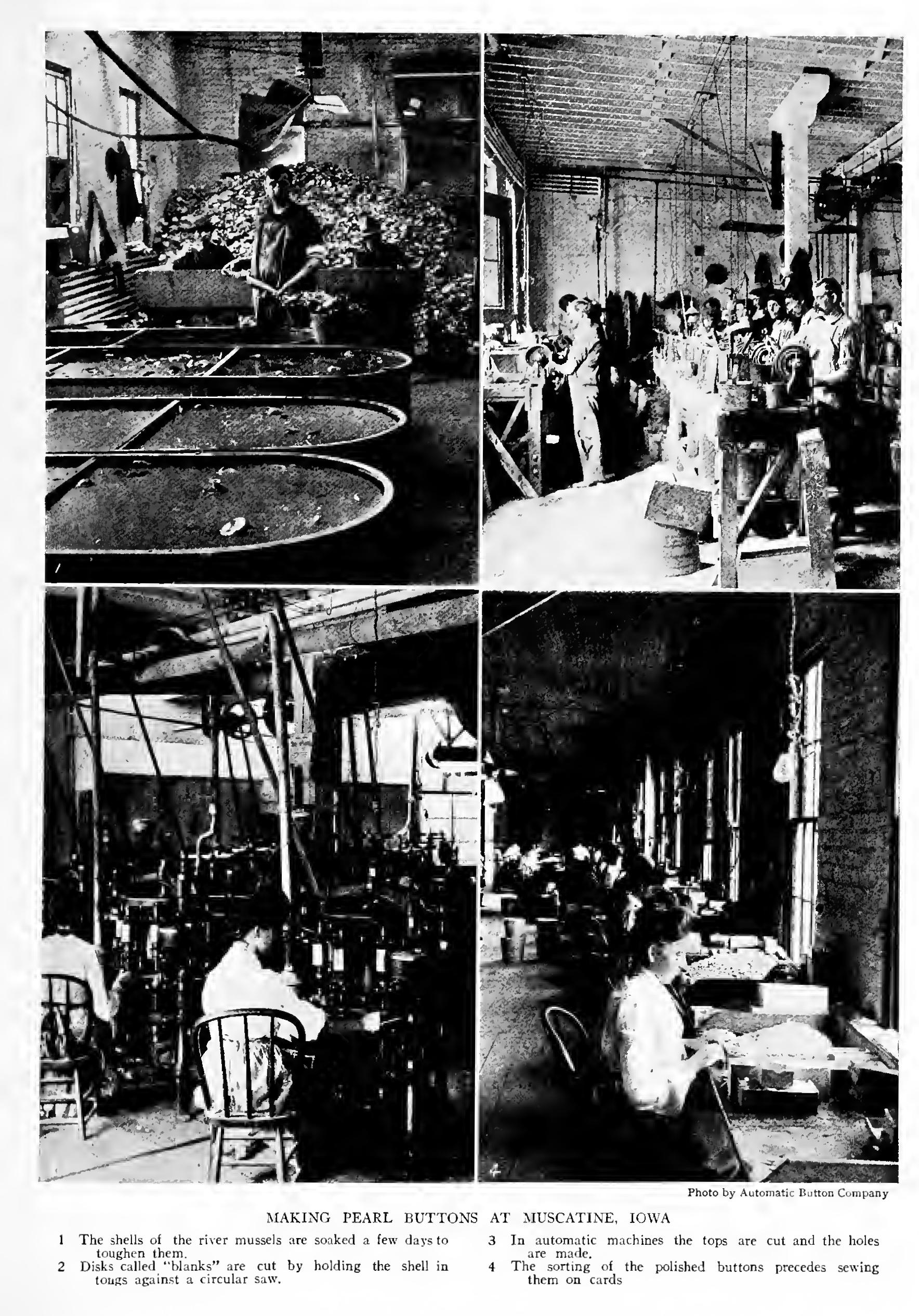
Barnes, is the "deer-horn" or "buck-horn," the largest species that furnishes material for pearl buttons. The average "niggerhead," three or four inches long, cuts four or five "blanks "—disks that are ground down into buttons. A large deerhorn will cut four times as many, though not proportion ately larger.
Habitat — Mississippi drainage and streams flowing to the Gulf from the Alabama River to Central Texas.
378