2 Family Burseraceae
This largest of Northern sumachs is constantly seen on railroad embankments, in fence rows, and along the highways of wooded regions. In the summer its fern-like foliage covers all the ugliness of the most unsightly bank, and lifts among the green its fine clusters of ruddy or pink blossoms. In the fall these are lost sight of amid the glory of the leaves, which turn to all shades of orange and purple and red. For weeks they flame and glow in the soft autumn sunshine, then fade and fall, and the bare antlered branches, like candelabra, hold aloft the pointed red fruit clusters which burn on with gradual abatement to the middle of winter.
The glory of the staghorn sumach's colouring makes it one of the most desirable of ornamental trees for fall and winter colour effects. Its habit of spreading by root suckers makes it objectionable for planting except in situations where the trees can spread unchecked, and the massed effect of the foliage can be enjoyed at some distance. The fern-like leaves are much larger if the plants are cut back severely each spring. For screen and border shrubs this species is very satisfactory.
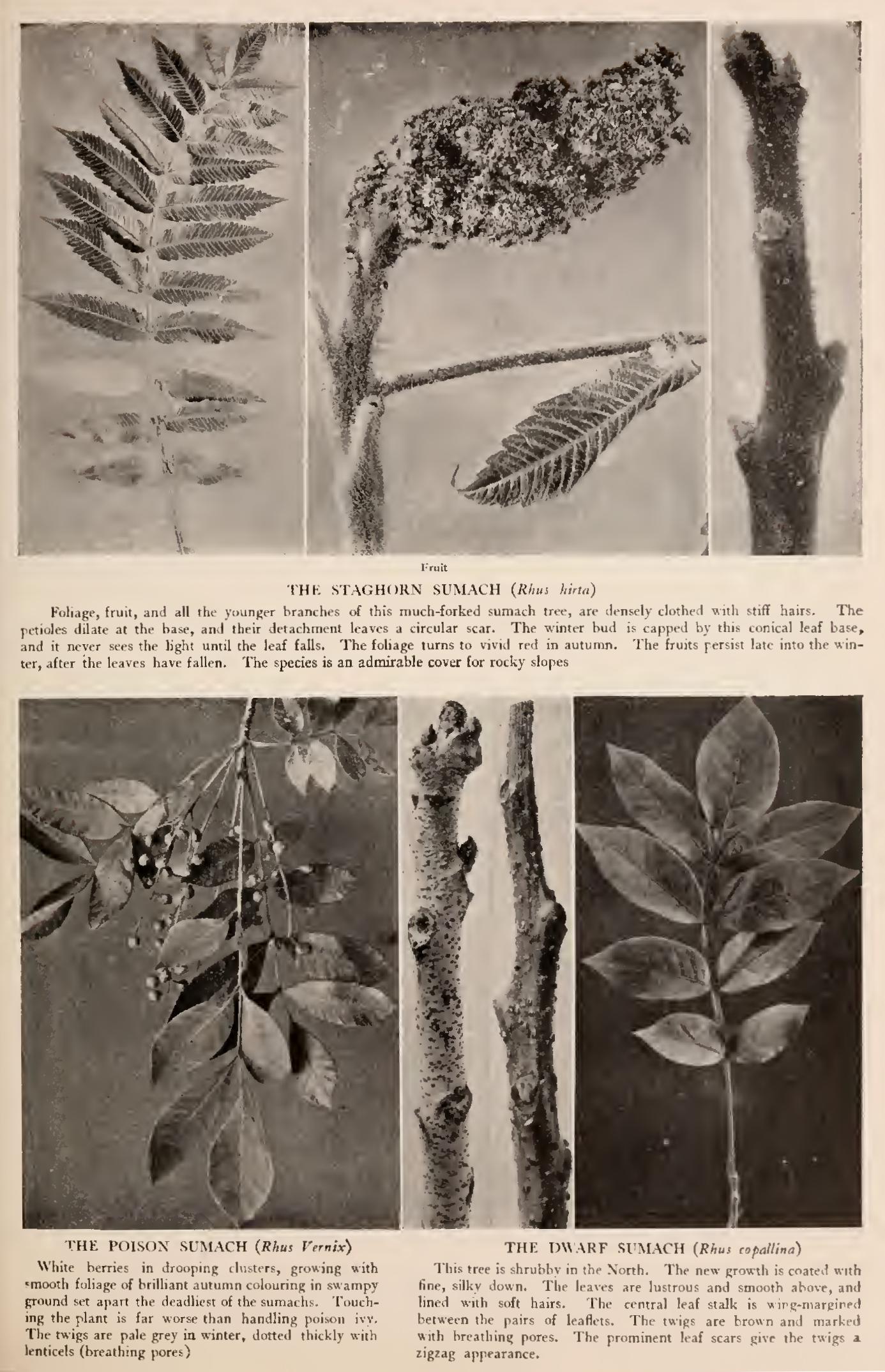
The Dwarf, Black, or Mountain Sumach (Rhus copallina, Linn.), is the soft, velvety species, fully as handsome, if not quite as large, as the preceding one. It grows all over the eastern half of the United States and beyond the Mississippi to the foothills of the Rocky Mountains. Usually a shrub, it rises to 3o feet in height in the mountains of Tennessee and North Carolina. It is the latest of all the sumachs to bloom. Its long pinnate leaves are lined with soft hair, and the central leaf stem is winged on each side between the pairs of leaflets. These are the most beau tiful leaves to be found in the sumach family. They turn in autumn to dark, rich reds.
In the South, the leaves are gathered in summer in considerable quantities, for they are rich in tannin, and when dried and pulver ised, are used for tanning leather. A yellow dyestuff is also extracted from them.
The Poison Sumach (Rhus Vernix, Linn.), "one of the most beautiful, but unfortunately the most poisonous of the sumachs," ranges from New England to Minnesota, south to Georgia, and across to Texas. It is more to be dreaded than the poison ivy, or the poisonwood of Florida, both of which are near relatives. Though widely distributed, it always grows in swampy land, and as its leaves and flowers proclaim it a sumach, people ought to learn to suspect it because of its habitat. Only red
fruited sumachs are safe to touch. This species has greyish white berries. The clusters droop; in harmless sumachs they stand erect.
White berries in drooping clusters in swampy ground warn the collector to pass the poison sumach by, no matter how alluring its brilliant foliage. There is certain poisoning for those who are rash enough to touch it.
The Western' Sumach, or Mahogany (Rhus integrifolia, Benth. & Hook.), is entirely different, of course, from the true mahogany, a lumber tree of the tropics. This is a low, stout trunked evergreen tree which forms thickets along the coast bluffs of Lower California and the adjacent islands. The leaves are simple, oval, and often toothed like the holly. Its flowers are in scant terminal clusters, white or rosy, succeeded by large, red, hairy berries. A cooling drink is sometimes made of the acid, fatty exudations of these berries, and the wood makes good fuel.
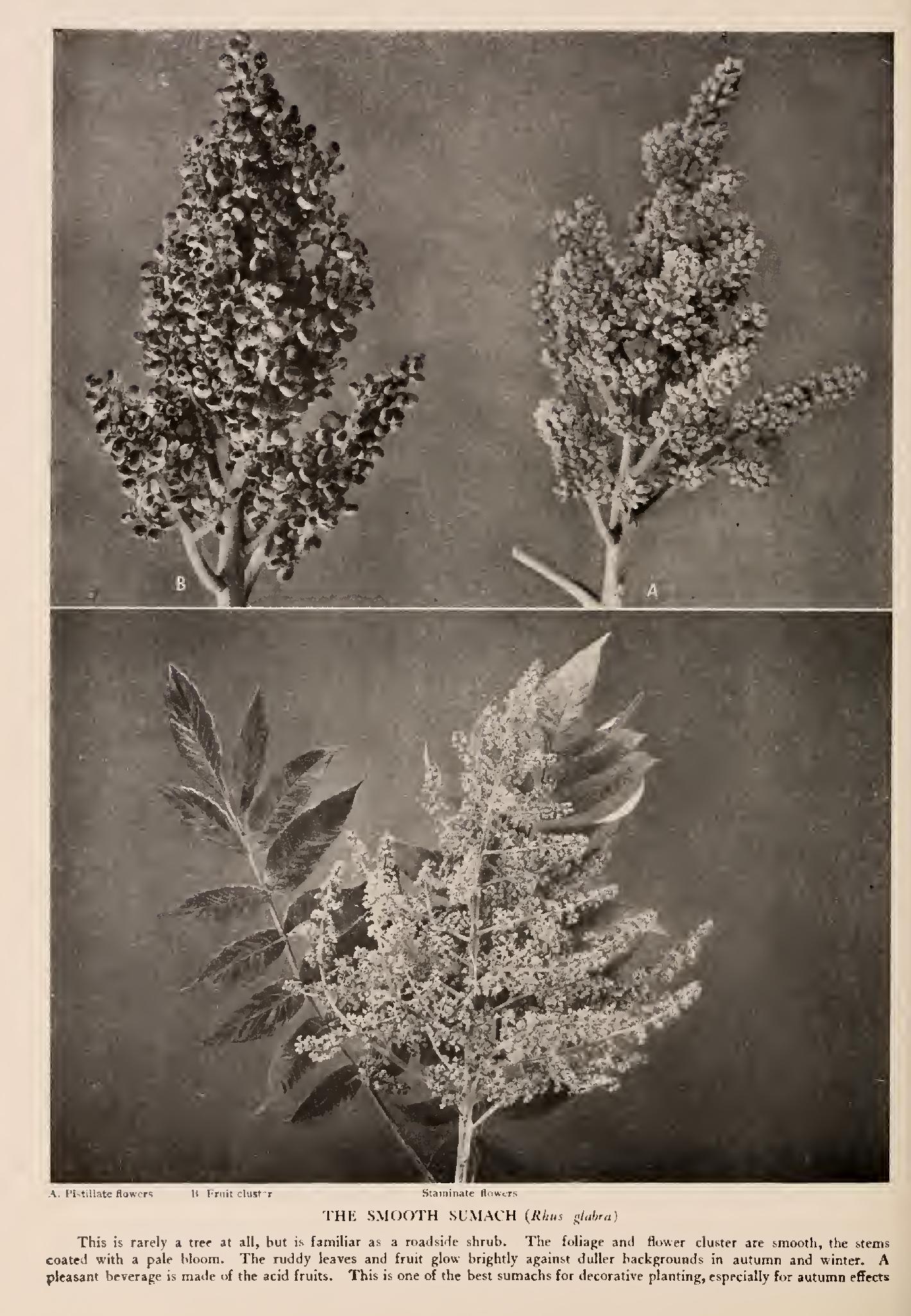
The Smooth Sumach (R. glabra, Linn.) is rarely given rank as a tree, though it sometimes almost deserves it. Like the staghorn, this species has serrate leaflets and dense, erect clusters of red fruit. But it is smooth instead of hairy, except its fruits, and its twigs have a pale, glaucous bloom. This is one of the best species for decorative planting. Its foliage is clean and fine, and turns to rich colours in fall. Its large fruits last late into winter. The berries, bark and leaves are used in the treatment of fevers. A cooling beverage, pleasantly acid, is made of the unripe fruit in summer. This species is found everywhere east of the Rocky Mountains, and extends to British Columbia and Arizona. It is oftenest seen in situations chosen also by the staghorn sumach.
2. Genus METOPIUM, P. Br.
The Poison Wood, or Hog Gum (Metopium Metopium, Small), a beautiful little West Indian sumach, breathes poison from its flowers and leaves not unlike that exhaled by Rhus toxicodendron, the poison ivy. The bitter, poisonous juice exudes as a gum from cracks in the thin, orange-brown bark. In lower Florida the tree is abundant along the coast, and on the Keys. There is an old account that says: "Wild Hogs, when wounded, by natural instinct come to this tree, where by rubbing its balsam on their wounds, they are cured." Its leaves are pinnate, some what ash-like, and the drooping clusters of glossy, orange-red berries have given the tree the name, Coral Sumach.