2 Family Burseraceae
3. Genus COTINUS, Linn.
The American Smoke Tree (Cotinus Americanus, Nutt.) shows by its pithy stems, aromatic, resinous juice, and general habit, its kinship with the sumachs, which are better known.
The large, simple leaves, 4 to 6 inches long and half as wide, are not like sumach leaves; the flowers, however, are carried aloft in terminal panicles, each sort on separate trees, and these, as well as the individual nutlets, are sumach-like. In a panicle only one flower in a hundred sets seed, so as a fruit cluster it is a very scant one. Instead of fruits these panicles show a peculiar feathery development of the bracts. These graceful and delicate plumes, tinted pink to green, form in the aggregate a great cloud of rosy haze or smoke, that makes it a thing of beauty in the late summer. Then it earns its common names, smoke tree and mist tree.
The species ranges from Tennessee to Oklahoma, and south into Alabama and Texas. It is sometimes seen in gardens, but it cannot compete in hardiness nor in vigour nor showiness with the much more commonly cultivated Cotinus Cotinus, Sarg., the Venetian sumach, or European smoke tree.
Trees of small size, or shrubs. Leaves simple, alternate, petioled. Flowers minute, axillary, dicecious or polygamous. Fruit, a berry-like drupe.
KeY TO SPECIES A. Foliage evergre en.
B. Leaves spin y. (I. opaca) AMERICAN HOLLY BB. Leaves not s piny.
C. Length 2 to 4 inches, margins mostly entire.
(1. Cassine) DAHOON CC. Length I YO 2 inches, margins crenate.
(I. vontitoria) YAUPON AA. Foliage deciduous.
B. Leaves blunt pointed, crenate, II to 2+ inches long.
(/. decidua) SWAMP HOLLY BB. Leaves taper pointed, serrate, 3 to 6 inches long.
(I. monticola) MOUNTAIN HOLLY The holly family is distributed in every continent, and ranges from the North Temperate to the South Temperate zones. Many species are tropical. They are all trees or shrubs, the centre of whose distribution seems to be in South America. Of the 175 species, about seventy are found in northern Brazil.
The mate, or Paraguay tea, to which the people of South America are addicted as North Americans are to tea and coffee, is made of the dried and powdered leaves of two holly trees of Paraguay. Chief of these is Ilex Paraguariensis. These are the
most important species, in a commercial sense. " Yerba mate" has a remarkable stimulating effect upon the human system, fortifying it for incredible exertion and endurance. Indulged in to excess, it has much the same effect as alcohol.
China and Japan have thirty different species of hollies, some of which are coming into cultivation in America. Europe has but one species. America has fourteen, four of which assume tree form; the rest are shrubby "winterberries." There are 153 distinct varieties of the European Ilex Aqui folium in cultivation. No more popular ornamental is grown. The Englishman looks out upon his bloomless garden in winter time, " And sees the clustered berries bright Among the holly's gay green leaves." It is more, I think, than a poet's fancy that holly leaves are dull in summer in contrast with other foliage, only to gleam brilliant as polished leather when other broad-leaved trees are bare. The fell-fare, a little thrush, eats these tempting red berries in winter, to the disgust of narrow-minded gardeners.
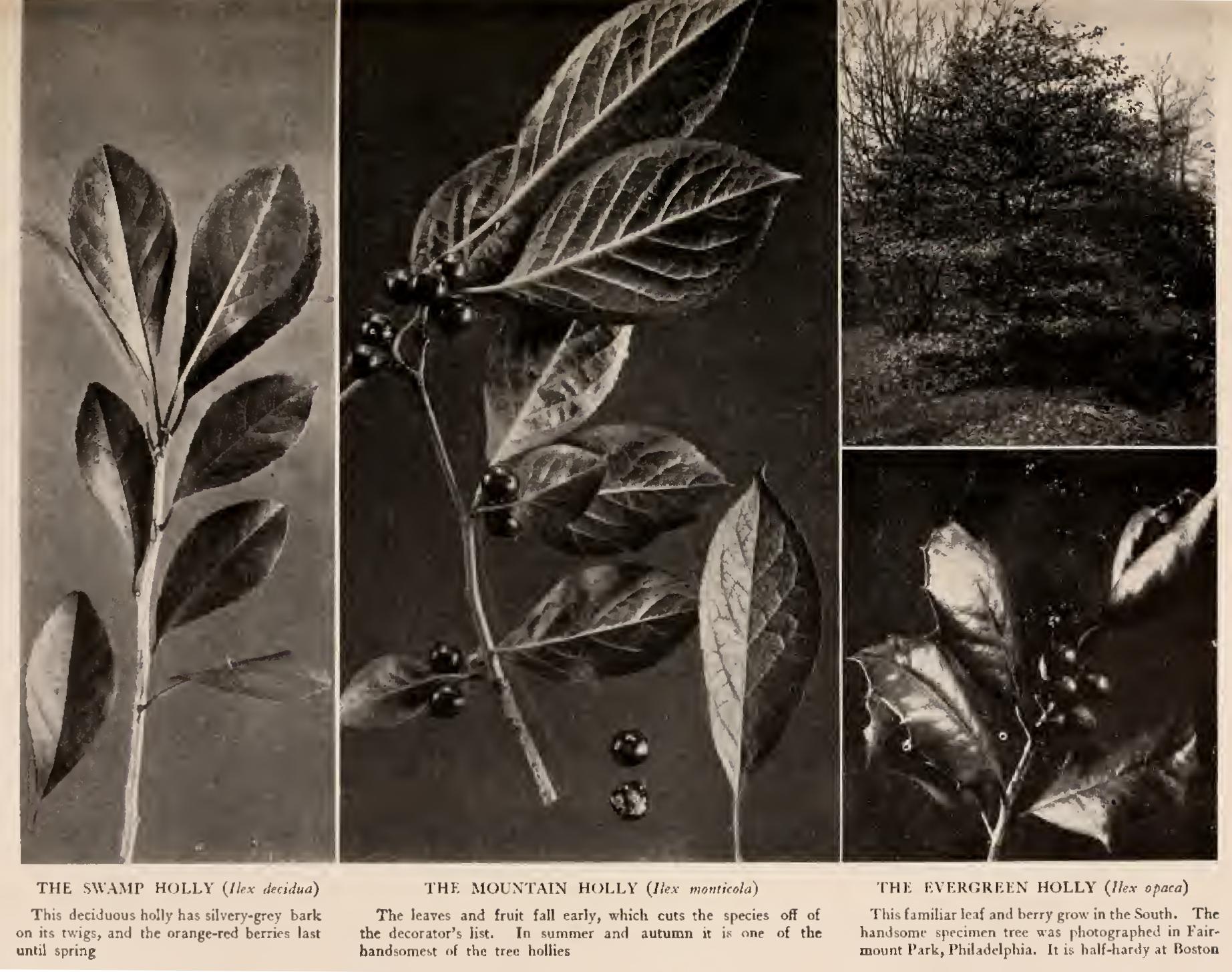
Ilex is the name by which the holm oak of southern Europe has always been popularly known. Its leaf resembles that of the holly with which it grows in the wild. Linnxus dropped the old name, Aquifolium (sharp leaf), which the holly had been called. The European species became Ilex Aquifolium and the oak Quercus Ilex.
Its sharp leaf, far more spiny and deeply cleft than that of our species, and the lustrous sheen of leaf and scarlet berry make the European holly handsomer than the American. Its specific name, opaca, meaning dull, reminds us of the inferiority of the latter.
Holly and mistletoe are inseparably linked in traditions of the English Christmas. The Druid feasts gave these two plants prominent places in pagan rites, and they have come down to modern times with few changes. Old chroniclers and ballad makers kept the ancient usages fresh in mind, and to-day the English gentleman re-enacts the customs of his forefathers right loyally, as he celebrated Christmas with all his tenantry in the great hall.