Some Little Ashes
Superstitious parents in rural England used to pass a poor little babe suffering from rupture through the cleft stem of a growing ash. Twice the stem must be sprung apart, and the child passed through. The trunk was then tightly bound, and when its halves were firmly knit, they believed that the child would also be whole. An oil distilled from ash chips was counted a sovereign remedy for many ailments, especially earache. John Gerarde writes: "It is excellent to recover the hearing, some drops of it being distilled warm into the ears" The kernels of ash seeds were credited with having medicinal value. English apothecaries of Evelyn's time had stock of "Lingua avis" on their shelves, calling them this because they were "like almost to divers birds' tongues." Gerarde, citing the authority of Pliny, says: "Serpents dare not so much as touch the morning and evening shadows of the tree, but shun them afar off. . . . Being penned with boughes laid round about [they] will sooner go into the fire than come near the boughes of the ash." And he adds: " I t is a wonderful courtesie in nature that the ash should floure before the Serpents appeare, and not cast his leaves before they be gon again." As for lightning, the ash is said to attract it. Various warn ings are current: "Beware the oak, it draws the stroke; Avoid the ash, it courts the flash; Creep under the thorn—it will save you from harm." The unfortunate rustic, caught in a shower, probably knows that beech is the safest tree to stand under, for experience and tradition both hold that "a beech is never struck by lightning." The early settlers had this saying from the Indians, and proved its truth. A quaint recipe from Gerarde may interest some of my readers, though certain makers of nostrums may frown upon me for quoting it. "Three or four leaves of the ash taken in wine each morning doe make those lean that are fat." Parkinson indorses this as "a singular good medicine—with fasting a small quantity—for those already fat or tending thereunto, to abate their greatnesse, and cause them to be lancke and gaunt." Who disbelieves in this will do well to remember that Gerarde was no mean authority in his day, and Parkinson—was he not the King's own Apothecarye? I make no doubt, however, that the con clusion will be drawn by many that the "fasting a small quantity" was the effective part of the treatment prescribed.
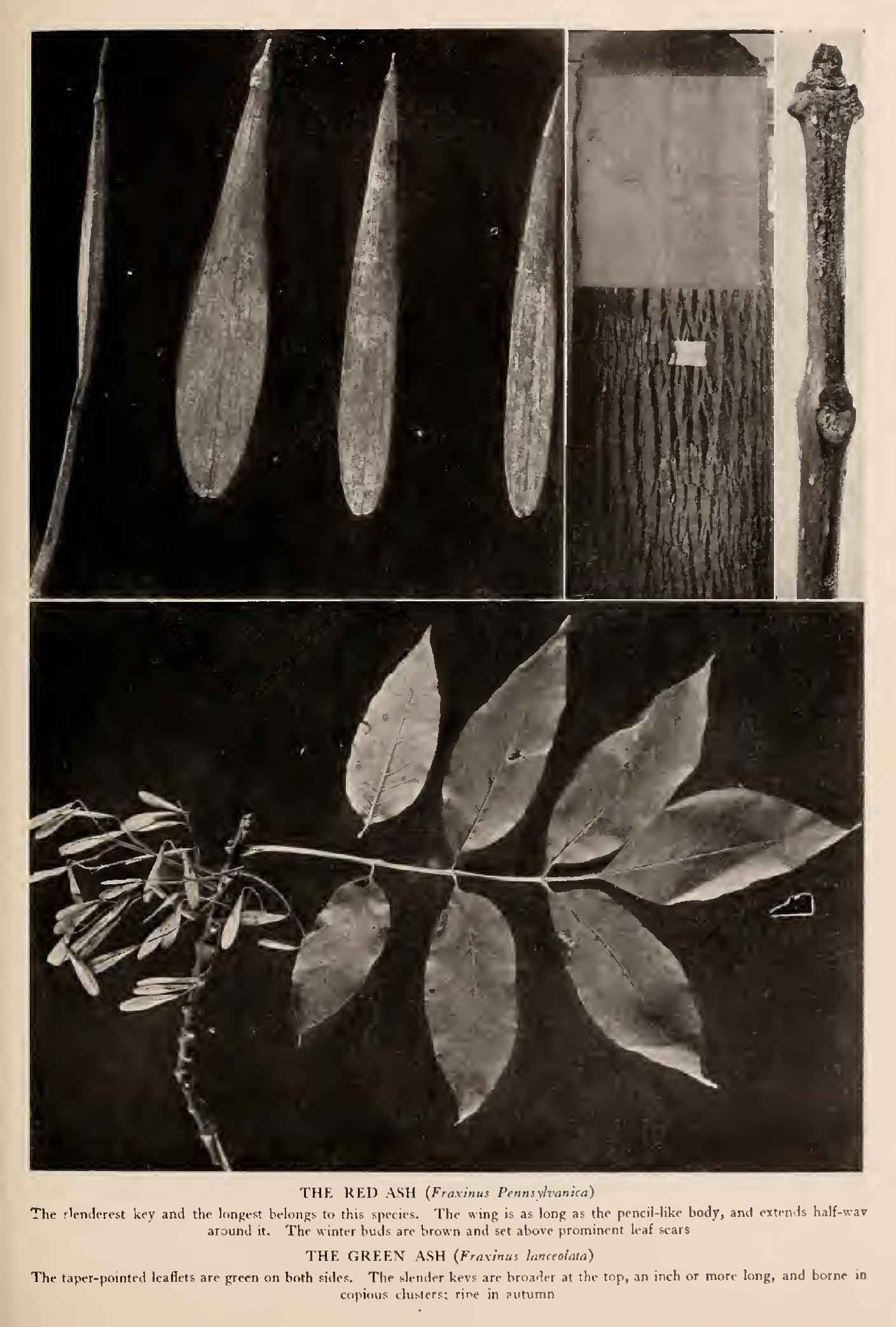
"Bee-sucken ash," black at the heart, was counted tougher and harder than the wood of sound trees, and especially desirable for making mallets. Bees were credited (or blamed) with a cankered condition produced by a tree-destroying fungus.
Finally, ash wood makes excellent fuel, and its ashes, rich in potash, make an excellent fertiliser. Certainly the genus as a whole deserves the good word of the poet Spenser, who, enumerat ing trees and their special uses, closes the list with—" the ash, for nothing ill." • 2. Genus CHIONANTHUS, Linn.
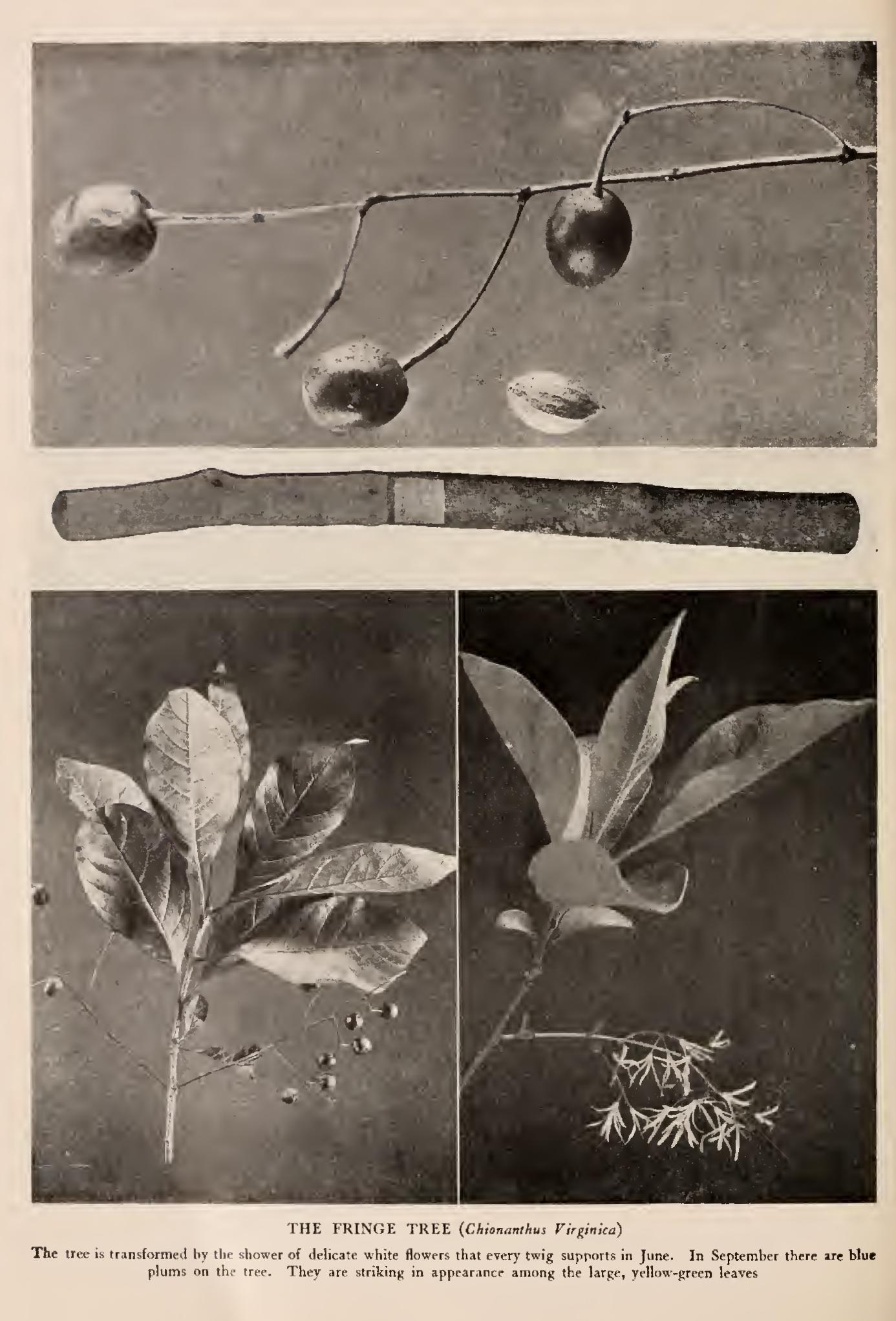
Fringe Tree (Chionanthus Virginica, Linn.)—A slender, narrow-headed tree, 20 to 3o feet high, or less. Bark reddish, scaly; branches grey or brown. Wood light brown, close, heavy, hard. Buds small, brown, ovate; inner scales becoming leaf-like. Leaves opposite, simple, 4 to 8 inches long, i to 4 inches broad, smooth, except on veins below, dark green, paler below, oval or oblong on short petioles; yellow in early autumn. Flowers, May and June, perfect, white, each with 4 slender, curving petals inch long, in graceful, pendulous clusters. Fruit in September,
clustered 1-seeded drupes, t inch long, dark blue, with slight bloom; flesh dry; skin thick. Preferred habitat, rich, moist soil on banks of streams. Distribution, southern Pennsylvania to Florida; west to Arkansas and Texas. Uses: Admirable orna mental tree, hardy to New England. Much planted in parks and gardens.
The fringe tree's beauty when its belated leaves unfold, and the delicate fringe-like flowers cover it like a bridal veil, is quite sufficient justification for the tree's existence. I do not know but that it adds to its charm to wait till the orchard has done blooming and lilacs and all the early things have passed, making us long for something new and different to come and take their places. A delicate fragrance comes out of the purple-dotted hearts of these drooping blossoms and the daintiness of the whole tree at this supreme moment of its life history is something to be seen and felt—one cannot put it into words. Later the leaves broaden and the blue fruits are unusual and quite ornamental in late summer. But the tree has become substantial looking, and somewhat commonplace. Its ethereal beauty belongs to its blooming period.
Chion means snow, anthos, a flower. There is as much beauty in this Greek name as in the flowers it describes. The light and graceful clusters of snow-white petals are indeed like feathery masses of snowflakes. The elegance and singularity of its flowers and fruit give the fringe tree high rank among the native flowering trees suitable for lawn and garden. In Europe it is planted as a beautiful exotic from America. Because it grows wild Americans have been slower to introduce it into cultivation. A species with shorter, broader petals in erect, compact clusters has been found in China. This cannot compare with our own species in grace and beauty.
Trees with soft coarse-grained, durable wood. Leaves large, simple, heart shaped, opposite or whorled. Flowers large, white, showy, perfect, in panicles. Fruit long, cylindrical pods full of compressed winged and tufted seeds.
KeY TO SPECIES A. Flowers many in clusters; leaves thin; pods slender, thin walled. (C. Catalpa) CATALPA AA. few in clusters; leaves thick; pods stout, thick walled. (C. speciosa) WESTERN CATALPA The bignonia family includes among its hundred genera of tropical plants three of arborescent habit in the United States. Large flowers and conspicuous fruits are family traits. The most important timber and ornamental trees are in the genus Catalpa, which has in all seven species. Two of these are found in the United States.
Catalpa, Indian Bean (Catalpa Catalpa, Karst.)—Low, spreading tree, 25 to 5o feet high, with broad, irregular head of coarse twigs. Bark light brown, reddish, smooth. Wood coarse grained, soft, light brown, durable in contact with the ground. Buds all lateral, above circular leaf scar, minute, globular; inner scales grow to 2 inches long. Leaves bright green, opposite or in three's, 6 to .8 inches long, half as wide, ovate, entire, or some times lobed and wavy margined, pubescent beneath; of unpleasant odour; petioles stout, long, terete. Flowers, June or July, perfect; large, white, irregular, the frilled corolla marked with two yellow/ stripes and numerous purplish dots; pedicels downy; panicles loose, 6 to io inches long. Fruit a green, cylindrical pod, 6 to 20 inches long, 2-valved, filled with flat, tufted seeds.