Some Little Ashes
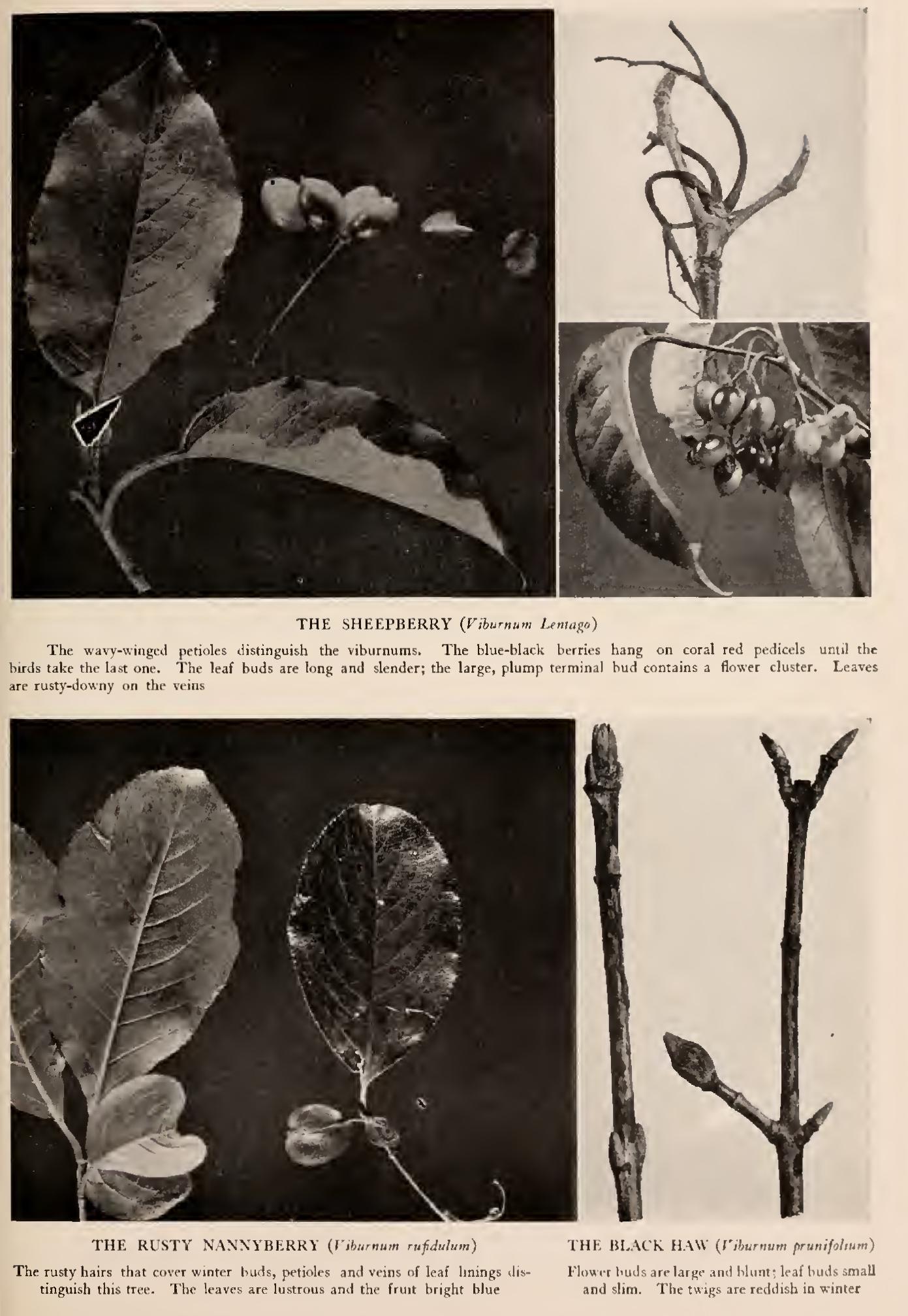
The sheepberry, with its shining leaves set opposite, is likely to be mistaken for a dogwood: But the prominent, wavy winged margins of the petioles are the best distinguishing char acter. The multitudinous tiny flowers are in cymes like the elders, and after them come a few oval berries of fair size, dark blue, looking not unlike those of a dogwood, for they hang on coral-red branching stems. They are good to eat—if one is very hungry.
The chief merit of this little tree is its beauty, and because of this it finds its way into many Eastern parks and gardens. There is no season when it is not good to look upon. It is a familiar inhabitant of fence rows and the edges of woodlands. It blooms in late May, and holds its ripe fruits over winter for birds to feed upon.
The Rusty Nannyberry (V. rufidulum, Raf.) is easily distinguished by the rusty hairs on its winter buds, petioles, and the veins on the lower side of the leaf. It is quite as hand some (though not yet as well known) as the smooth species just described. It has white flowers and large, bright blue berries. It grows from Virginia to Florida, and west to Illinois and Texas. In gardens it has proved hardy in Boston.
The Black Haw (V. prunifolium, Linn.), with leaves like a plum's, and the narrow petiole margin smooth, has flowers and fruits very much like those of the others. The berries are a trifle smaller, perhaps, and a shade darker. This species is smaller throughout than the other two; it blooms earlier, and has stout branches, like V.rufidulum. It is found from Connecticut to Georgia, and west to Michigan, Kansas, and Texas. In European parks and gardens and in those of our Eastern States this little "stag bush" is often cultivated for its handsome flowers and foliage and its persistent fruit.
2. Genus SAMBUCUS, Linn.
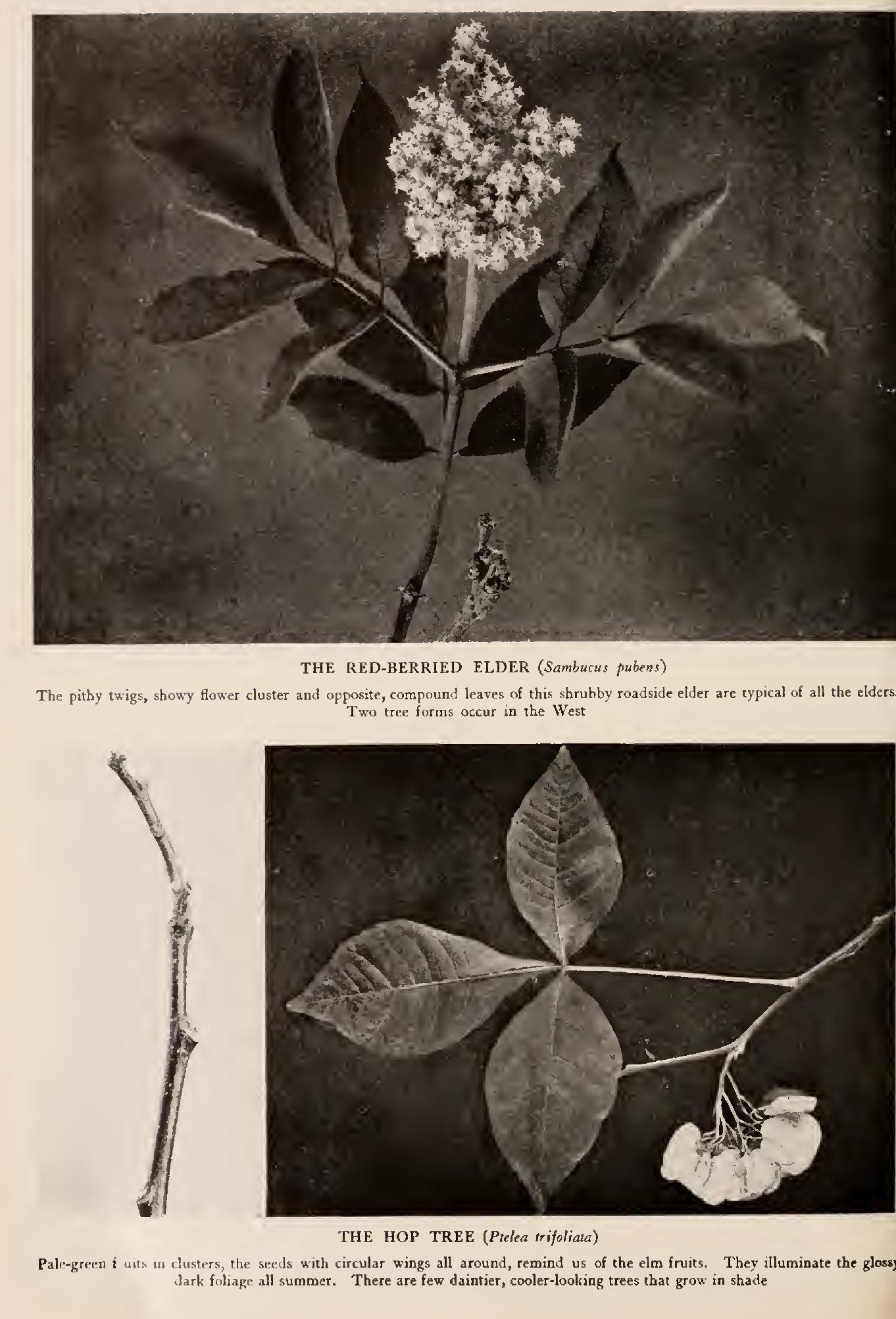
Quick-growing, stout-branched trees and shrubs, with pithy branchlets and ill-smelling sap. Wood dense. light brown, soft. Leaves pinnate, of 5 leaflets, opposite, deciduous. Flowers small, perfect, white, in broad compound cymes. Fruits small, blue or black, juicy, berry-like, each with 3 to 5 nutlets.
KeY TO SPECIES A. Leaves and young shoots pubescent; fruit destitute of bloom. (S. Mexicana) MEXICAN ELDER
AA. Leaves and young shoots smooth; fruit covered with a pale bloom. (S. glauca) PALE ELDER Our two arborescent species of the genus Sambucus are found west of the Mississippi, but the family traits are familiar to Eastern people through their acquaintance with the two shrubby species, the red-berried and the black-berried elders.
There are twenty species, all told, in the genus. The golden elder is a yellow-leaved form of the European species, Sambucus nigra, Linn. Two other species have produced golden varieties. These are altogether too much planted, and the handsome shrubby native species, above mentioned, have not been fully appreciated.
The fruit of the common elder is used in making elderberry wine, and elderberry pie is a staple viand in many country districts in the season of the ripening fruit. In fact, the idea of the im provement of this species as a small fruit has taken hold upon some plant breeders. The Brainerd elderberry with fruit as big as cherries was introduced into the trade in 1890.
Elder shoots are used in toy making and for "spiles" to draw sap from maple trees. The name of the genus is from the Greek, Sambuke, a musical wind instrument made of the hollow stems of the elder.
high in the river bottoms of western Texas, and west to California, and south through Mexico and Central America. It is a squat, round-headed tree, with its short trunk bulging suddenly at the base. A soft pubescence covers leaves and twigs. The shiny, black fruit, borne in loose clusters, is eaten by Indians and Mex icans. The tree is often planted near homes for its shade and fruit.
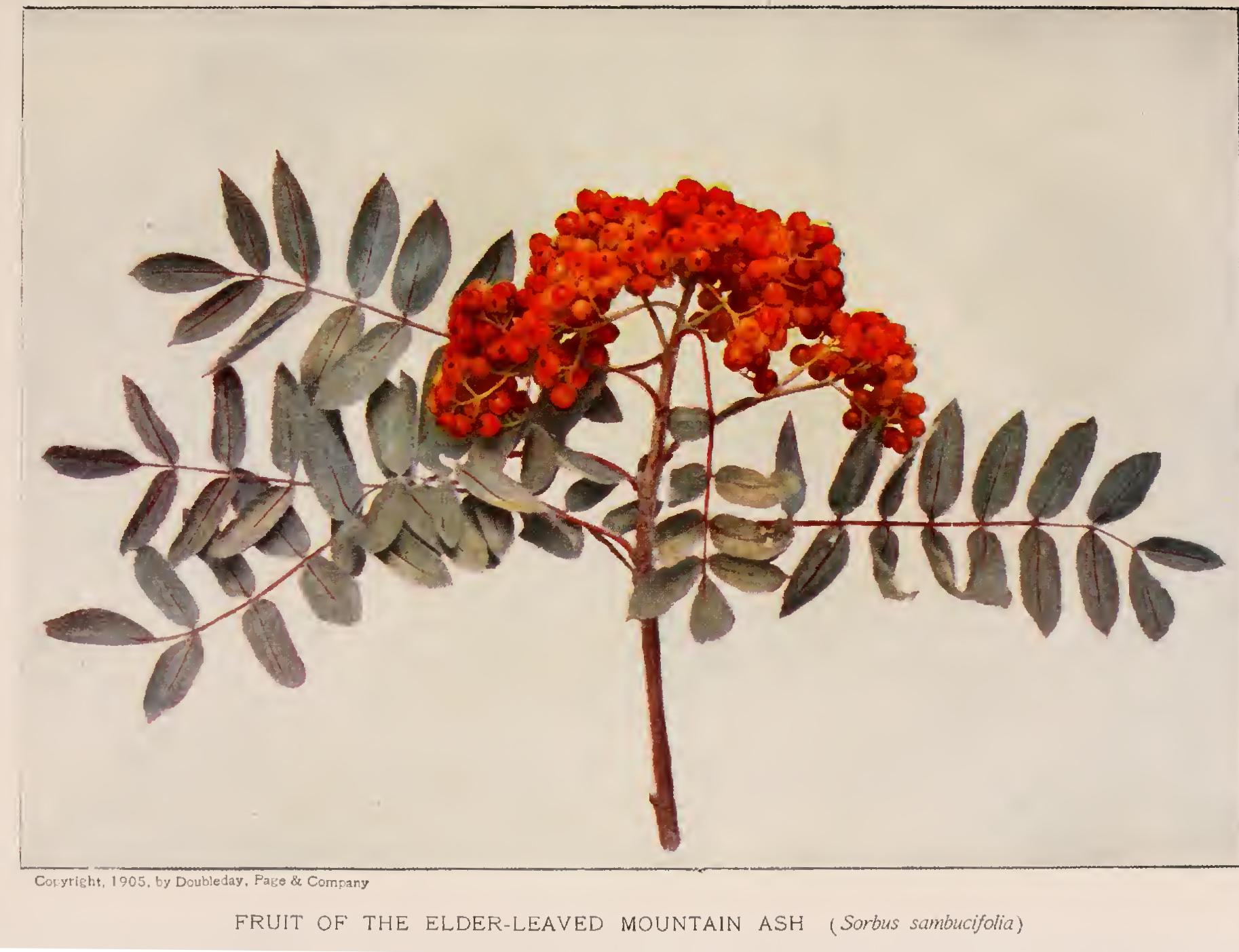
The Pale Elder (S. glauca, Nutt.) is smooth throughout, and gets its name from the whitish floury covering of the berries. The leaves are pale beneath. The berries are edible. This elder grows from British Columbia to southern California, and east scantily and reduced in stature as far as Montana and Utah. It is sometimes planted as an ornamental. Trees from 3o to 5o feet high are seen in dry, gravelly soil in the coast region, especially in Oregon.