The Apples - Family Rosaceae
THE APPLES - FAMILY ROSACEAE. Genus MALUS, Hall. Trees which are parents of cultivated apples. Leaves simple, alternate, deciduous. Flowers showy, perfect, fragrant, in terminal times. Fruit fleshy, enclosing papery 5-celled core.
KeY TO SPECIES A. Leaves smooth at maturity; flowers rose pink.
B. Blades of leaves ovate, blunt, minutely serrate, thin.
(M. coronaria) WILD CRAB Apple BB. Blades of leaves narrow, pointed, coarsely toothed, leathery.
(M. auguslifolia) NARROW-LEAVED CRAB APPLE AA. Leaves tomentose beneath; flowers pale.
B. Fruit flattened, 2 to 4 inches in diameter.
C. Stems slender. (Exotic.) (M. Malus) COMMON APPLE CC. Stems stout (Al. Soulardi) SOULARD'S APPLE BB. Fruit not flattened, z to Iz inches in diameter.
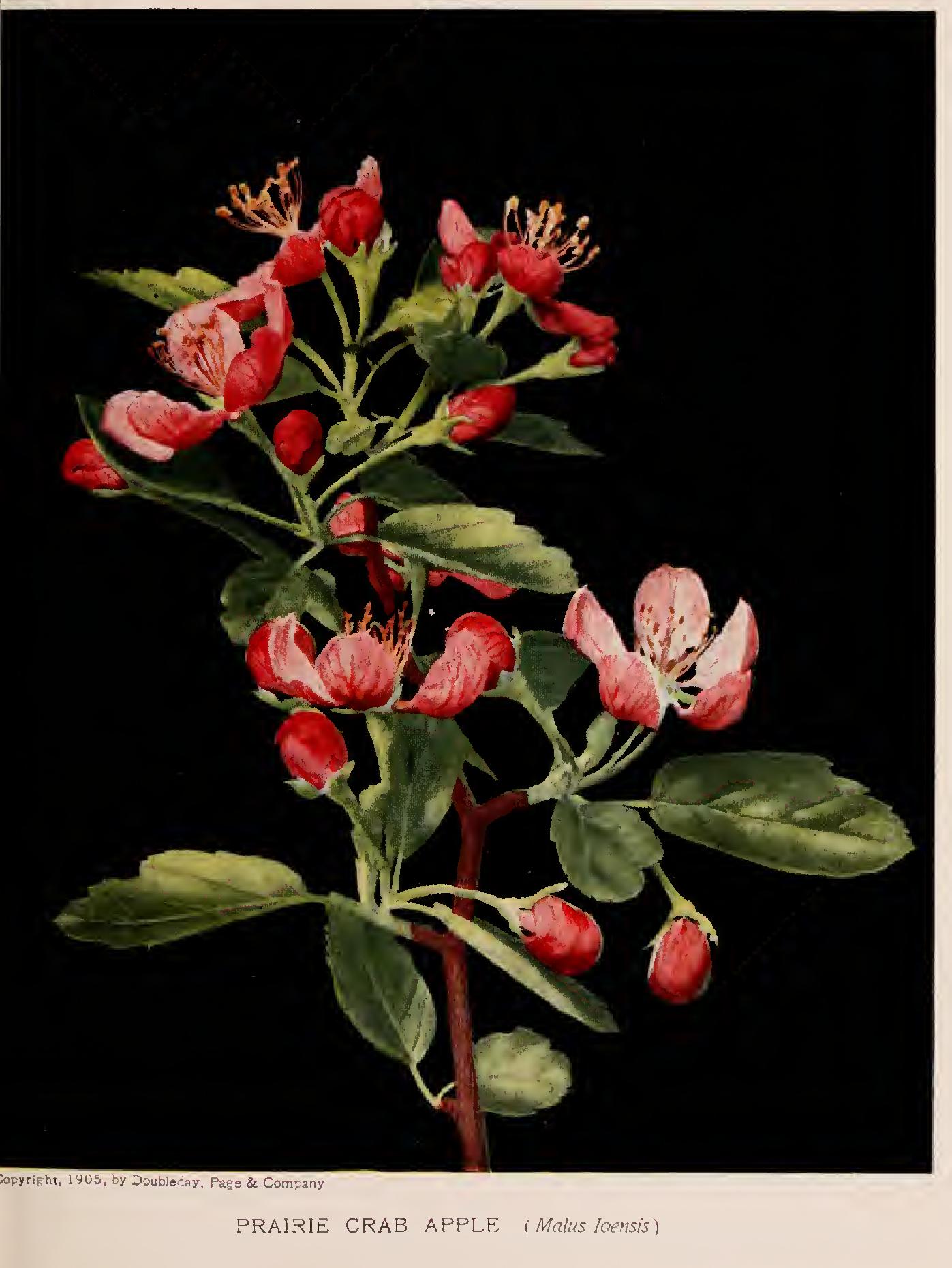
C. Flowers white. (M. rivularis) OREGON CRAB CC. Flowers pink. (M. loensis) IOWA CRAB The genus Malus is native to the whole of eastern Asia. We have four native species. Our cultivated crab apples and the hundreds of orchard varieties have their ancestral home somewhere in Asia Minor. For centuries horticulturists have been at work improving wild apples. In Europe and in America the effort is to get better fruit. In the Far East the aim has been to produce the finest flowering trees. The results are both ad vantageous to the horticulture of the world.
Closely allied to apples are the other pome fruits, pears and quinces. Neither are native to America, though they are widely cultivated here.
Wild Crab Apple (Malus coronaria, Mill.)—A low, bushy tree, with thorny angular twigs, rarely 3o feet high. Bark reddish brown, scaly. Wood heavy, fine grained, weak, reddish brown. Buds small, blunt, bright red. Leaves ovate or trian gular, 3 to 4 inches long, half as broad, velvety beneath, blunt pointed, sharply serrate, often lobed near base; petioles 1-1 to 2 inches long. Flowers May to June, after the leaves, in 5 to 6 flowered umbels, perfect, white to deep pink, spicy, fragrant— t to 2 inches across. Fruit flattened, yellow, i inch in diameter; flesh hard, sour. September. Preferred habitat, upland woods, in moist, rich soil. Distribution, Ontario to Minnesota; south
along Alleghanies to Alabama; Nebraska to eastern Texas; New York to South Carolina. Uses: An ornamental, flowering tree. Fruit made into jellies and preserves. Wood used for levers, tool handles, etc.
The wild, sweet-scented crab apple! The bare mention of its name is enough to make the heart leap up, though spring be months away, and barriers of brick hem us in. In the corner of the back pasture stands a clump of these trees, huddled together like cattle. Their flat, matted tops reach out sidewise until the stubby limbs of neighbouring trees meet. It would not occur to anyone to call them handsome trees. But wait! The twigs silver over with young foliage, then coral buds appear, thickly sprinkling the green leaves. Now all their asperity is softened, and a great burst of rose-coloured bloom overspreads the treetops and fills the air with perfume. It is not mere sweetness, but an exquisite, spicy, stimulating fragrance that belongs only to wild crab-apple flowers. Linnwus probably never saw more than a dried specimen, but he named this tree most worthily, coronaria, for crowns and garlands." Break off an armful of these blossoming twigs and take them home. They will never be missed. Be thankful that your friends in distant parts of the country may share your pleasure, for though this particular species does not cover the whole United States, yet there is a wild crab apple for each region.
In the fall the tree is covered with hard little yellow apples. They have a delightful fragrance, but they are neither sweet nor mellow. Take a few home and make them into jelly. Then you will understand why the early settlers gathered them for winter use. The jelly has a wild tang in it, an indescribable piquancy of flavour as different from common apple jelly as the flowers are in their way more charming than ordinary apple blossoms. 1t is the rare gamy taste of a primitive apple.