The Beeches - Family Fagaceae
THE BEECHES - FAMILY FAGACEAE. Genus FAGUS, Linn. Trees valuable for their timber and nuts, and also for shade and ornamental planting. Leaves simple, alternate, feather veined, deciduous. Flowers moncecious, small, crowded into spikes or heads. Fruit a pair of triangular nuts in a 4-valved bur.
The great family of the cup bearers includes the beeches, chestnuts and oaks—trees of profound importance to the human race. They are the mast trees, whose fruit has fed man and beast from the days when they both depended upon Nature's bounty. Times have changed, and men have less primitive appe tites, but their need of these trees is not diminished, but rather broadened with the advance of civilisation. Mast of oak, beech and chestnut remain the chief reliance of many wild animals.
There are in all five species of beech, three of which are Asiatic. America has one species and Europe one. Two are native to China and Japan. The so-called beeches of the Southern Hemi sphere form a genus, Nothofagus, of twelve species. They differ in habit and in flowers from Fagus, and the leaves, often ever green, are very small. Nevertheless, the two genera are closely related.
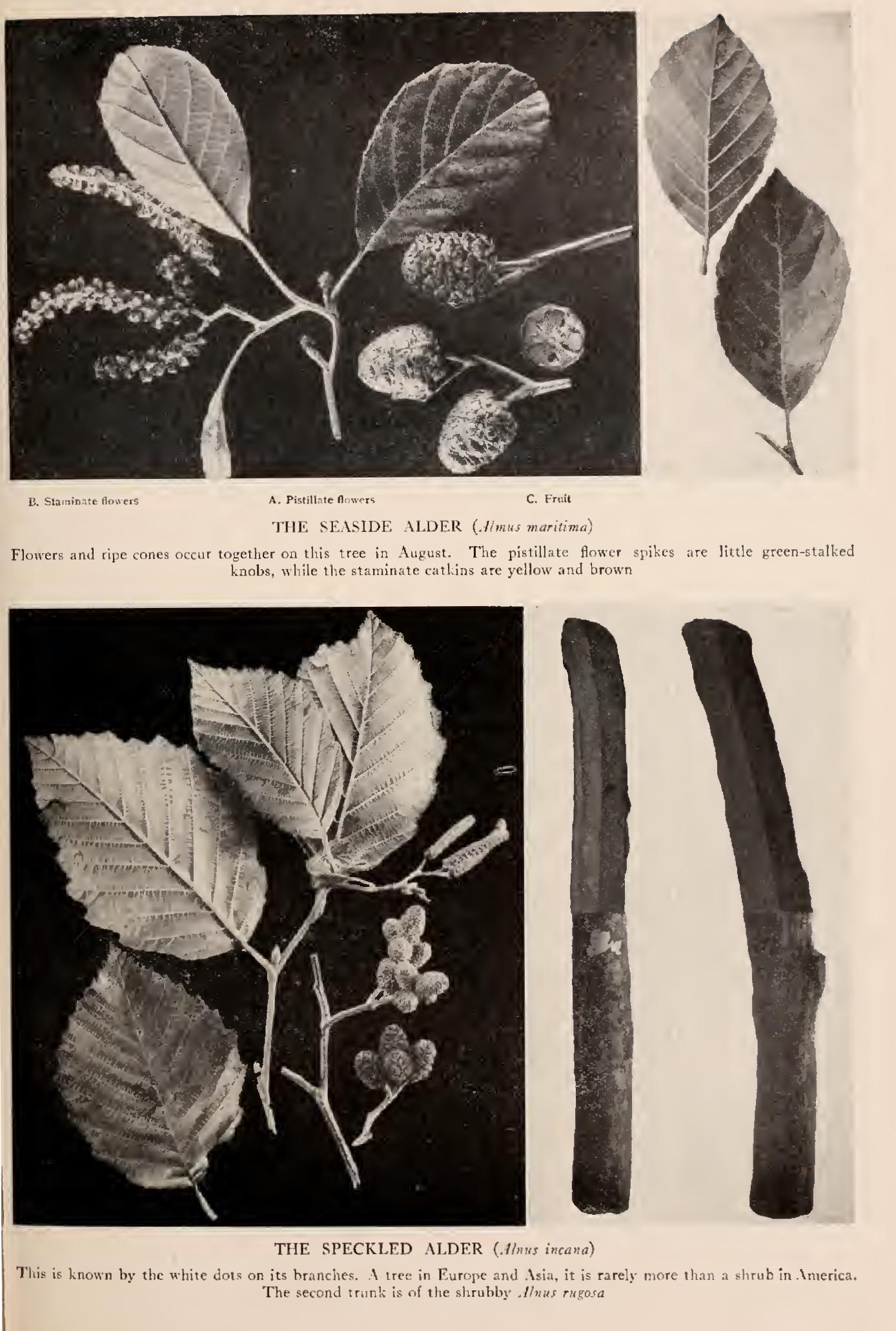
Beech (Fagus/1 nwricana, Sweet.)—A round-topped or conical tree, with horizontal or drooping branches, and dense foliage; 5o to 75 feet high. Bark close, smooth, pale grey, or darker, often blotched; branches grey, twigs brown, shining. Wood light red, close grained, hard, strong, not durable, tough; lustrous when polished. Buds alternate, tapering, to 1 inch long, brown, in silky scales. Leaves oblong-ovate, strongly feather veined, saw toothed, pointed, smooth, silky or leathery, green on both sides; autumn colour, pale yellow, persistent till late. Flowers moncecious, May, staminate in pendant balls, few at base of leafy shoot, yellow-green; pistillate, solitary or paired, in axils of upper leaves, short-stemmed, in scaly involucre. Fruit, October, a prickly bur containing 2 triangular, pale-brown nuts, sweet, edible, in thin shells. Preferred habitat, rich river bottoms. Dis tribution, Nova Scotia to Lake Huron, and northern Wisconsin; south to Florida, Missouri and Texas. Uses: Beautiful orna
mental and shade tree. Wood used for chairs, tool handles, plane stocks, shoe lasts, and for fuel. Nuts fatten hogs, and feed wild animals and birds.
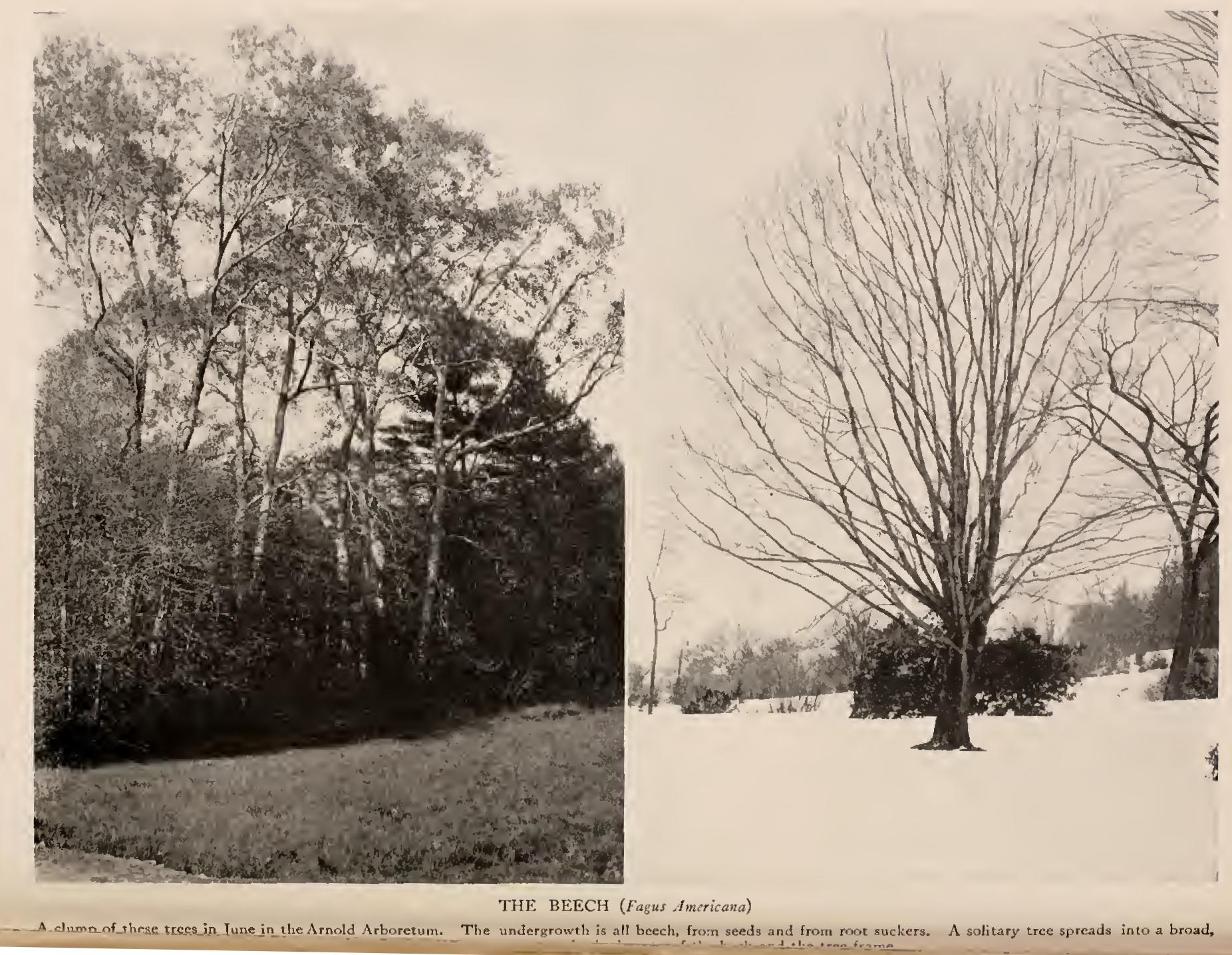
We have but one native beech, and it is a clannish tree. Find me a single specimen in the woods, and I will show you a miniature forest of beeches springing up around it as soon as the tree comes into bearing. Squirrels carry the nuts, so do the bluejays, and the wind helps to scatter them. Beech nuts have much vitality, and the seedlings grow well, even in dense shade. This gives them a distinct advantage over the young of many other trees. Seeds of sun-loving species must fall in the clearings if they hope to grow. In a few years there is a dense beech thicket, with only large trees of other kinds. When these are cut out the area comes to be called "the beech woods." In April and May we may see the germination of beech nuts. The gaping burs and three-cornered nuts lie in plain sight under the tree. A nut splits along one sharp edge and a slender root protrudes. It grows downward and burrows in the leaf mould. The stem emerges at the same time and place and extends in the opposite direction. It is topped by a crumpled green bundle, which unfolds directly into a pair of short and broad seed leaves, totally unlike the leaves of the beech tree.
In this case the triangular shell clings but a little while to the growing plantlet. Oftener, however, the opening is just wide enough to let the root out. Then the stem carries the shell up and wears it like a helmet until the leaves within spread themselves and cast it off.
Young beech trees are very weak and pale and twisted at first. They lean helplessly against dead leaves and twigs for support. But when the roots get a grip on the soil and the leaves turn a brighter green they become quite independent. A shoot bearing true beech leaves rises from the bud between the two seed leaves, which soon wither away. In the fall a long whip set with winter buds represents the first season's growth.