The Birches - Family Betulaceae
THE BIRCHES - FAMILY BETULACEAE. Genus BETULA, Linn. Trees with smooth bark marked with conspicuous horizontal slits (lenticels), usually curling back in thin horizontal layers. Leaves simple, alternate, deciduous, serrate, stalked. Flowers moncecious, in catkins. Fruit cone-like, scaly; seed flat, winged.
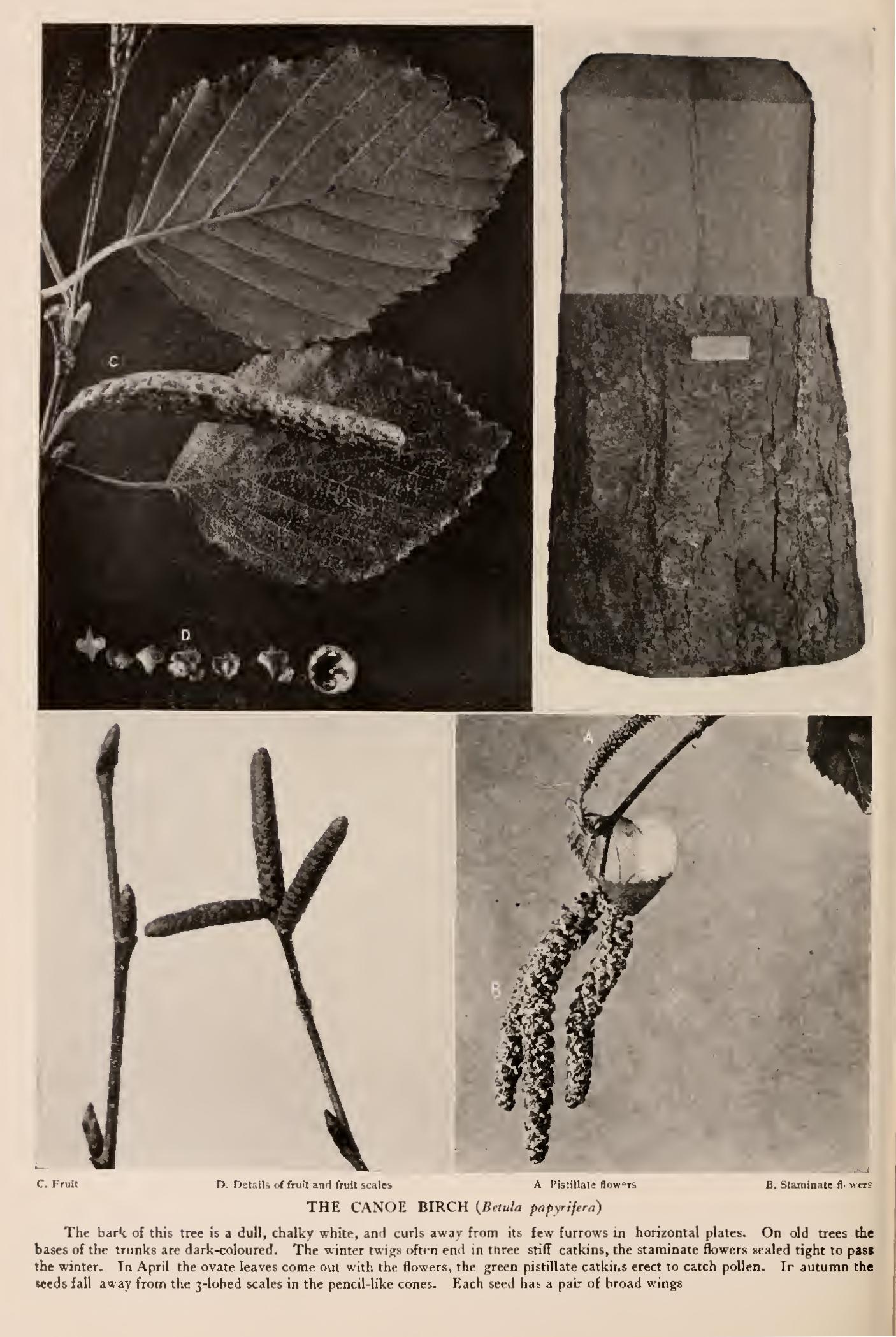
KeY TO SPECIES A. Bark chalky white, yellow beneath.
B. Leaves triangular, bark close.
(B. populifolia) WHITE BIRCH BB. Leaves ovate; bark separating freely into layers.
(B. papyrifera) CANOE BIRCH AA. Bark grey, curling back, yellow beneath.
(B. lutea) YELLOW BIRCH AaA. Bark red, curling in thin ribbons; cones ripe in June.
(B. nigra) RED BIRCH AAaA. Bark dark brown, lustrous.
B. Twigs aromatic; bark separating into thick plates.
(B. lenta) SWEET BIRCH B B. Twigs not aromatic; bark separating into thin, papery layers. (B. occidentalis) WESTERN BLACK BIRCH There is no denying the inferiority of the wood in most species of birch. The toughness and durability of the bark prevent the prompt evaporation of the abundant sap, which ferments and breaks down the wood cells. It is not uncommon to find in the woods a birch trunk with the bark intact, but the wood crumbling like chalk when touched. When the trees are stripped of their bark immediately after being cut down, the wood seasons properly and lasts fairly well as lumber.
There are twenty-eight known species of the genus Betula distributed over the Northern Hemisphere, and a fugitive species grows in Terra del Fuego! Ten of these are North American. seven or eight Asiatic, and six European. The white birch of Europe extends through Asia to Japan, and is cultivated in many varieties in America.
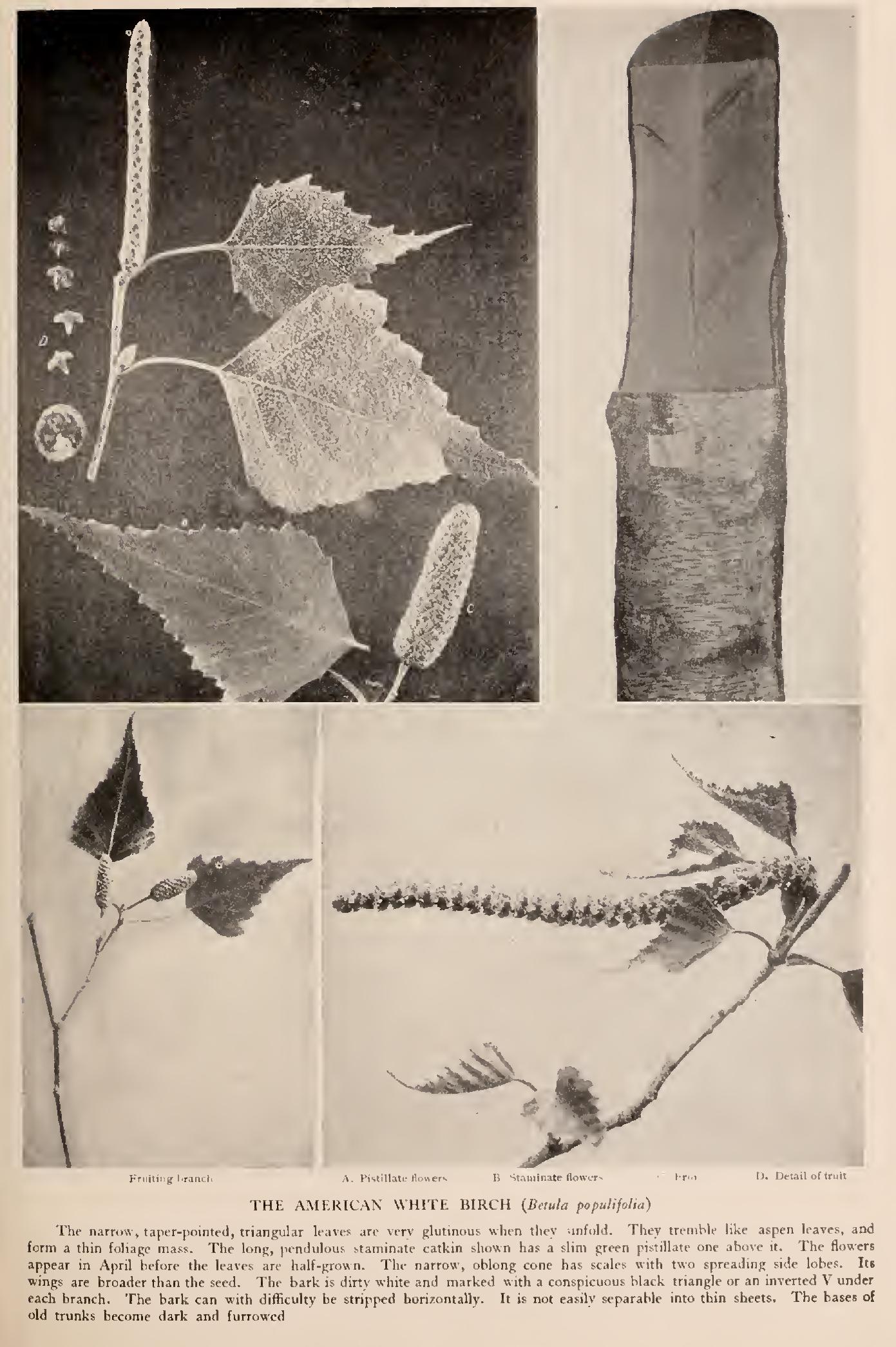
American White Birch, Birch (Betula populifolia, Marsh.)—Small, short-lived tree, 25 to 4o feet high, with slender horizontal branches and tremulous foliage. Bark chalky white or greyish, with triangular dark patches where branches are or have been; not easily separated into layers; white does not rub off on clothing; branches dark brown. Wood light, soft, weak, close grained, not durable in contact with soil; light brown; takes good polish. Buds slender, brown, inch long. Leaves alternate, simple, triangular, 2 to 3 inches long, long pointed, double saw toothed; dark green above, paler beneath, yellow in autumn; teeth of margin glandular; petioles long, slim, twisted. Flowers before leaves, April, moncecious; staminate in terminal catkins, single, or paired, formed in previous summer; pistillate catkins, inch long, pale green, scales ovate. Fruits
cylindrical cones, i inch long, blunt at both ends, drooping; scales downy, 3-lobed, side lobes large, spreading; nut oval, pointed, with broad wing. Preferred habitat, dry, gravelly soils, or borders of swamps. Distribution, Nova Scotia along coast to Delaware; northwest to Lake Ontario. Uses: Graceful and hardy ornamental tree; thrives in any soil, but rarely planted. Wood used for spools, shoe pegs, wood pulp and fuel. Valuable nurse trees to hardwoods and conifers on land Nature is reforesting.
The only native species with which this white birch might be confused is the canoe birch. Look first at the bark. It is chalky white and yellowish beneath, but the chalk does not rub off. It is hard, close bark, which does not part into thin layers. It is cracked in growth, and the short crevices are dark, making the trunk look grey at a distance. Wherever a bud or branch has been, a large, ever-widening black V brands the trunk and limbs. Near the base of the trunk, the white bark is about all gone, leaving a black, furrowed area that grows gradually higher.
The foliage mass of the American white birch is much thinner and lighter than that of the canoe birch. The leaves are small and dainty, triangular, taper pointed, suggesting in shape and tremulous poise the aspens or poplars.
This is the one of our birches that most nearly resembles the European white birch. It is not a large tree, and the woods man scorned it, until the manufacturer of wood pulp, shoe pegs and spools sent forth a demand for it. Now the owner looks with satisfaction upon the graceful, bending birches that bow to each other in the swamps along the streams, over abandoned fields and deforested mountain sides. The harvest is his in due season. This threatened doom of the white birch casts no warning shadow across these sunny, thick-set acres. The trees are all young together, and no matter how scant a living the sterile soil yields, these gypsy trees never seem to languish. Their silken ribbons of dirty white bark are flaunted gaily against the sombre back ground of evergreens, and they "lean out over the stream," as Doctor Van Dyke puts it, "Narcissus-like, as if to see their own beauty in the moving mirror." Life is short—but it is care free and joyous.