The Birches - Family Betulaceae
It is a surprise to find this, our semi-aquatic and southern most birch, growing in apparent complacency and comfort in dry, upland soil in the New England States and Minnesota. But so it behaves in cultivation. It well exemplifies the versatility of the family.
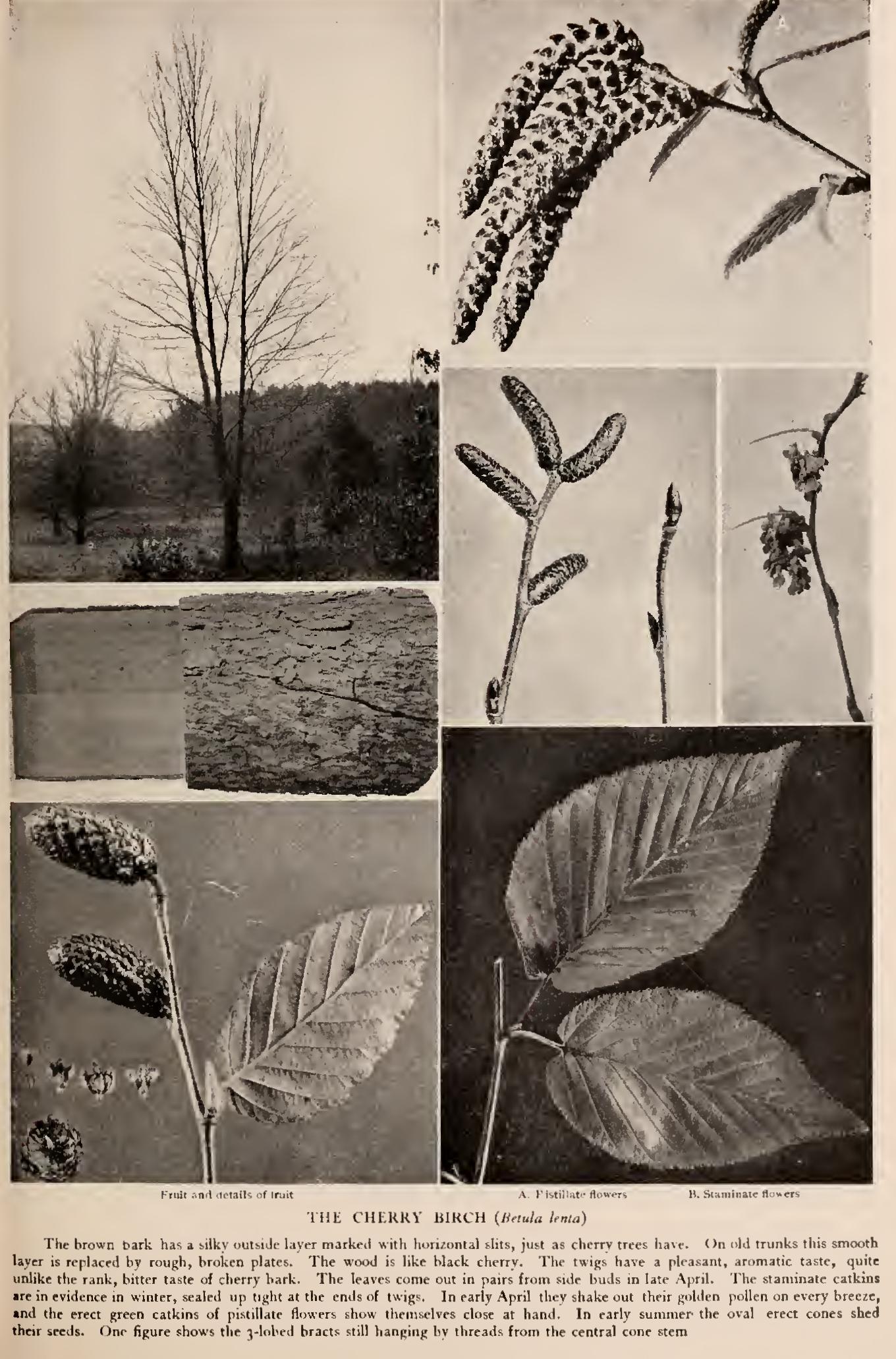
Cherry Birch, Sweet Birch, Black Birch (Betula lenta, Linn.)—Handsome, round-headed tree, 5o to 8o feet high, symmetrical, with slender, often tortuous but graceful limbs, lower ones drooping; twigs delicate, polished. Bark dark brown, broken by furrows into thick irregular plates which show frag ments of the smooth, silky bark that covers young limbs. Lenti cels prominent as horizontal lines; inner bark aromatic, spicy. Wood dark brown, reddish, heavy, strong, hard, close grained. Buds slender, acute, brown, I inch long. Leaves ovate, 2 to 6 inches long, pointed, doubly serrate, dull, dark green above, yellow-green below; midrib yellow; veins prominent, straight, downy; petioles short. Flowers before leaves, April; staminate catkins, 3 to 4 inches long, purplish yellow, pendulous; pistillate, erect, sessile, to i inch long; bracts hairy, ovate. Fruit, June, erect cones, sessile, scales broad, of three equal, rounded lobes; nuts with narrow wings, tapering at base. Preferred habitat, fertile soil, moist and well drained. Distribution, Newfoundland to western Ontario; south to Florida, Kentucky, Tennessee and Kansas. Uses: Occasionally cultivated for shade and ornament; wood used for wheel hubs, furniture and fuel; inner bark yields salicylic acid and wintergreen oil, used in medicine; sap made into birch beer.
The cherry birch has several common names, and each one has a good reason for being. The bark is very dark, and it breaks into rough, square plates with edges curling stiffly back but not fraying into ribbons at all. The smooth outer layer, with its prominent horizontal lenticels, reminds one of the bark of cherry trees. This epidermis finally disappears from the large trunks, but it may always be found covering the limbs.
This birch is one of the handsomest trees of the woods. In winter the grace of the pendulous branches and the symmetry of the round head are best revealed. On the bark, from dark brown trunk to golden-brown twig, a satiny sheen gives brilliancy and depth to the colours. The tree seems aglow with life even in its
winter sleep, and the plump buds and the impatient catkins, already nearly an inch long, promise what the spring fulfils. The abundant sap which mounts upward in early April forces out the catkins into tassels that hang, all purplish yellow, and very large, from near the ends of the branches. Erect among them are the green pistillate ones, rising on the ends of short side shoots. The abundance of its leaves and their glossy sheen and brightness set this birch apart from others in midsummer. In autumn they turn to gold.
The small boy pulls a twig off the sweet birch sapling, and chews it sedulously as he fares through the woods. The stimu lating flavour of wintergreen, which is in the bark the year round, is especially strong in spring. Wintergreen oil, used in flavouring medicines, and esteemed in the treatment of rheumatism for the salicylic acid it contains, is extracted from the bark of this species. Birch beer is brewed from the sweet sap. The spicy fragrance extends to the leaves also, and a twig enables one to identify the tree at any time of year. In Kamchatka the natives strip the inner bark of B. lenta into long shreds like vermicelli. This is done in spring, when it is richest in starch and sugar. These strips are dried for winter use as food. They are boiled with caviar and with fish.
The wood of cherry birch is stained to imitate mahogany and cherry. This is a pity, for it has character of its own and beauty that deserve recognition. It has its own good colour, reddish brown, and this in "natural finis)," well rubbed, is lustrous and satiny, often showing what the cabinetmaker calls "landscape" or clouded areas of unusual beauty.
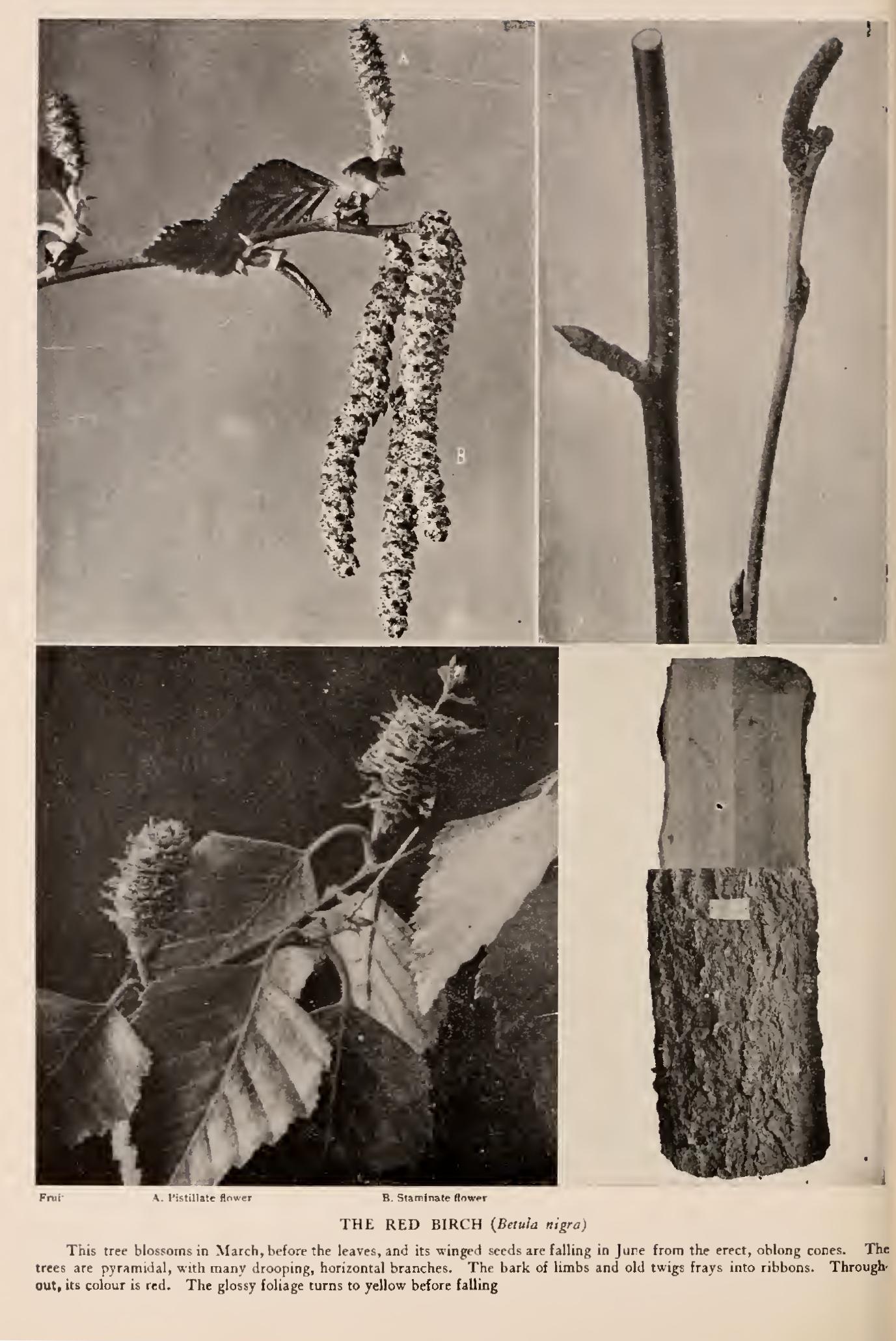
The Western Black Birch (B. occidenlalis, Hook.) grows from the Black Hills westward, widening its range to south and north, into Alaska and California along the coast, and following the Rocky Mountains to New Mexico. It is widespread, but nowhere common. This graceful little tree is a true birch in habit and in the lustrous, horizontal lenticelled bark, the bronze colour of which is quite sufficient to justify its name and to identify the tree. Unlike the cherry birch, this tree sheds its bark in thin, papery layers.