The Chestnuts - Family Fagaceae
THE CHESTNUTS - FAMILY FAGACEAE. Trees of ornamental and timber value. Leaves simple, oblong to lanceolate, strongly ribbed, alternate, leathery. Flowers moncecious, in spikes, showy. Fruit, nuts in spiny burs.
KeY TO GENERA AND SPECIES A. Leaves deciduous; fruit annual.
I. Genus CASTANEA, Adans.
B. Trees large; leaves smooth and green on both sides; nuts 2 to 3 in 4-valved, spiny bur.
(C. dentata) CHESTNUT BB. Trees shrubby, leaves pale and pubescent beneath; nuts solitary in 2-valved bur. (C. pumi/a) CHINQUAPIN AA. Leaves evergreen; fruit biennial.
2. Genus CASTANOPSIS, Spach.
(C. chrysophylla) GOLDEN-LEAVED CHESTNUT x. Genus CASTANEA, Adans.
There are five known species of the true chestnuts, three of which are American. One of these is a shrub, C. alnifolia, Nutt. The European species (C. sativa, Mill.) is the well-known sweet chestnut of Italy and Spain, as important in the diet of the peas antry as are potatoes in Ireland. This species extends its range to Eastern Asia. The Japanese C. crenata, Sieb. & Zucc., has been introduced into American gardens. The trees begin to bear when very young. The nuts are not sweet like our native chestnuts, but they are good when cooked.
Chestnut (Castanea dentata, Borkh.)—Oblong, thick-topped, symmetrical tree, 6o to Lao feet high, of rapid, vigorous growth. Bark grey-brown, cut into broad irregular ridges by shallow fissures; branchlets reddish, smooth. Wood brown, light, coarse, soft, weak, durable, easily worked. Buds dark brown, ovate The Chestnuts pointed, small, lateral. Leaves alternate, 6 to 8 inches long, tapering at both ends, strong ribbed, toothed, shining above, paler lining; autumn colour yellow; petioles short, stout. Flowers moncecious, in July; staminate catkins, slender, 4 to 6 inches long, clustered at bases of leafy shoots, spreading, pollen abun dant; pistillate, solitary or few, short stalked on base of staminate catkins or in axils of leaves; involucre, prickly, green, styles thrust out, stigmas branched. Fruit 2 to 3 compressed nuts, thin shelled, in 4-valved spiny bur, 2 to 4 inches in diameter, globular, opening after frosts. Preferred habitat, strong, well-drained soil; pastures, hillsides, rocky woods. Distribution, southern Maine to
Michigan; south to Delaware and Indiana; along mountains to Alabama and Mississippi. Uses: Valuable lumber tree, used for interior woodwork of houses, furniture, railroad ties, fence posts and fuel. A handsome shade and ornamental tree. Nuts com mercially important.
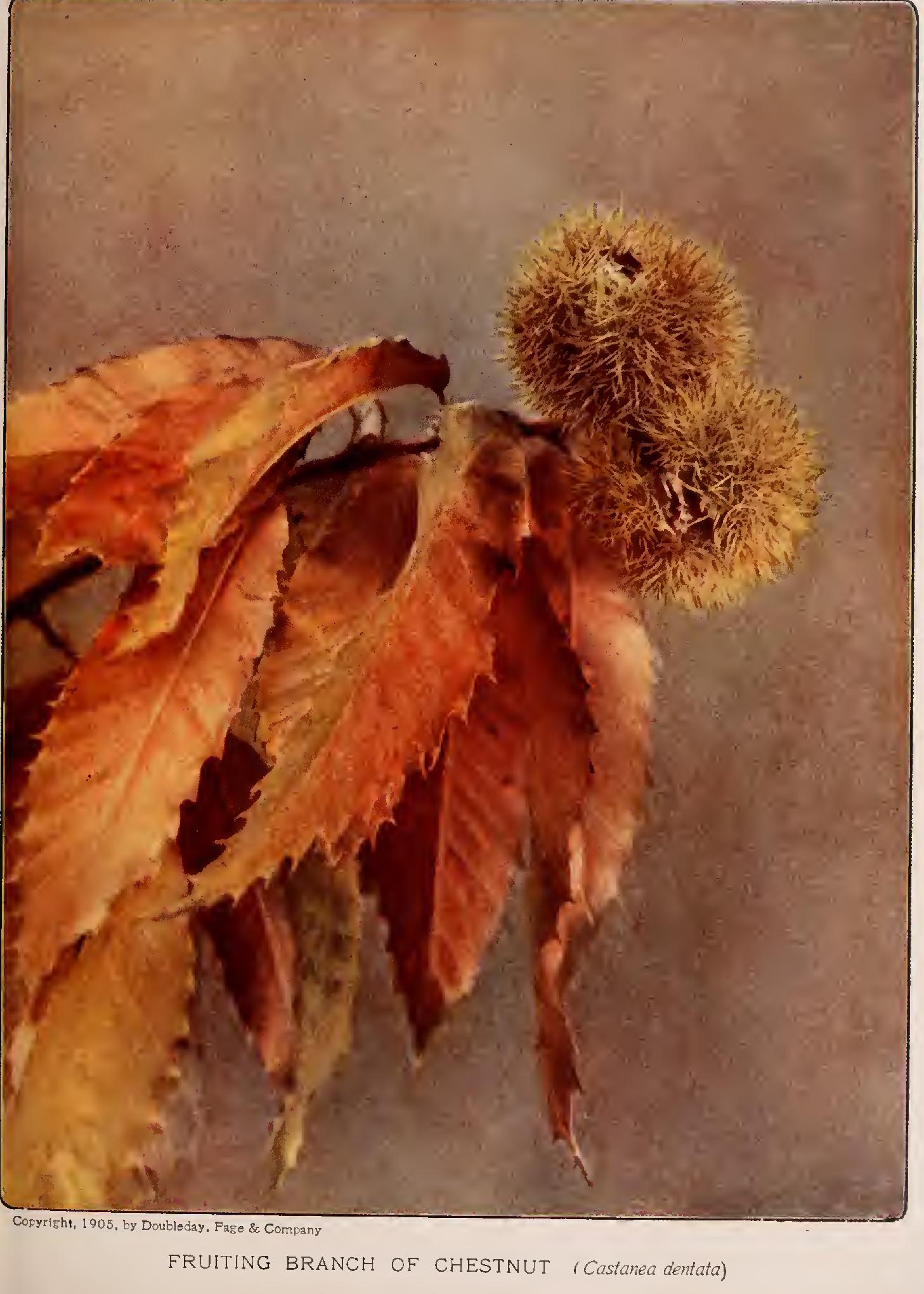
The elegance of chestnut foliage must strike the most casual observer. Each leaf is so long and tapering, so regularly veined and toothed, so polished, and finally so admirably set among the others as to make it a beautiful and useful part of the great green dome that hides the limbs in summer time.
Buds of the chestnut are small and plump set askew on the smooth winter twigs. They open late in spring. The fresh leaves make the neighbour oaks look dingy. The other trees have all done blooming but the lindens and the catalpas when the chestnut dome on the hillside gradually brightens from green to pale gold, and each twig holds up its feathery plume, and waves it, pollen laden, in the wind. July has come, and the fields of grain have passed into stacks and stubble. The chestnut takes on its flower crown to harmonise with the golden midsummer landscape. It is the most beautiful thing in the woods at this time. A solitary tree on a lawn or in a lonesome pasture is a joy to every beholder.
A near view of the tree shows along the bases of certain scantily furnished spikes a few green scaly flowers, with pale yellow threads extended at the tips. These are the chestnuts in embryo, with stigmas reaching out for the pollen that "sets seed." Two or three, or sometimes only one, of these flowers are fertilised. They develop rapidly, and by the middle of August the tree bristles with spiny green globes.
first frost is the signal for the splitting of the husks into four velvet-lined valves, from which the smooth brown nuts fall. The over-anxious small boy who beats the nuts off earlier wounds his fingers painfully in attempting to force open the stubborn husks. The nuts are not nearly so sweet and rich flavoured as those that wait until the frost unlocks their cells. But boys will never believe this.