The Firs
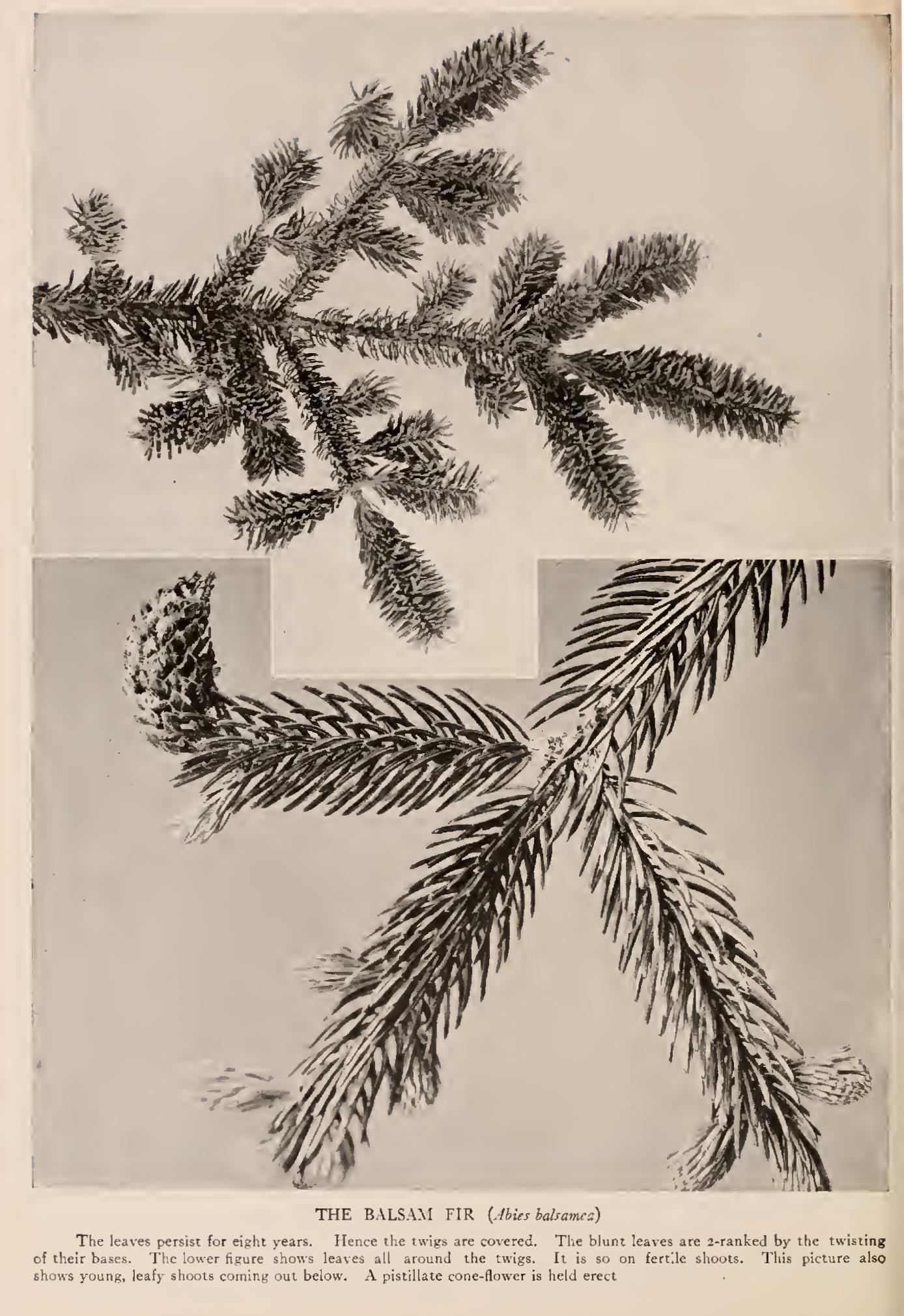
THE FIRS - Genus ABIES, Link. Trees of pyramidal habit with wide-spreading horizontal limbs bearing thick foliage masses. Wood weak, coarse grained. Bark smooth until quite old, pale, thin and blistered with over flowing resin vescicles; later, deeply and irregularly furrowed. Leaves usually flat, blunt, 2-ranked, persistent for 8 to to years, leaving circular scars. Flowers in axillary, scaly cones, pistillate erect on upper branches; staminate on under side of branches lower down on the tree. Fruit annual, erect cones whose scales fall off at maturity; seed resinous.
KeY TO SPECIES A. Leaves flat and grooved down the middle.
B. Colour of leaves dark green, shining, with pale linings. C. Scales concealing the Bracts of the cones.
D. Cones purple.
• E. Leaves straight, 2-ranked, not crowded; bark smooth, brown.
(A. balsamea) BALSAM FIR EE. Leaves curved, erect on twigs, crowded; bark rough, grey. (A. amabilis) WHITE FIR DD. Cones green; leaves about 2 inches long.
(A. grandis) WHITE FIR CC. Scales not concealing the pale green, reflexed bracts of the purple cones. (A. Fraseri) BALSAM FIR BB. Colour of leaves pale blue-green.
C. Cones purple. (A. lasiocarpa) BALSAM FIR CC. Cones purple, green or yellow.
D. Bracts of cone scales concealed; leaves uniformly glaucous. (A. concolor) WHITE FIR DD. Bracts of cone scales extending into long, whip like projections; leaves yellow-green, pale below. (A. venusta) SILVER FIR AA. Leaves mostly 4-angled, thick, blue-green; cones purple. B. Cone scales covered by pale green, reflexed bracts.
(A. nobilis) RED FIR BB. Cone scales covering bracts. (A. magnifica) RED FIR Twenty-five species of Abies are widely distributed over the Northern Hemisphere, including the northern highlands of Africa. Nordmann's fir (A. Nordmanniana) has come from the Caucasus into extensive cultivation in our Eastern and Northern States. It is supplemented by four European and two Japanese species of recognised merit for ornamental planting. The beauty of our native firs has been pointed out in the names botanists gave them. But they do not thrive, as a rule, in cultivation. For the lawn, we wisely choose exotic species.
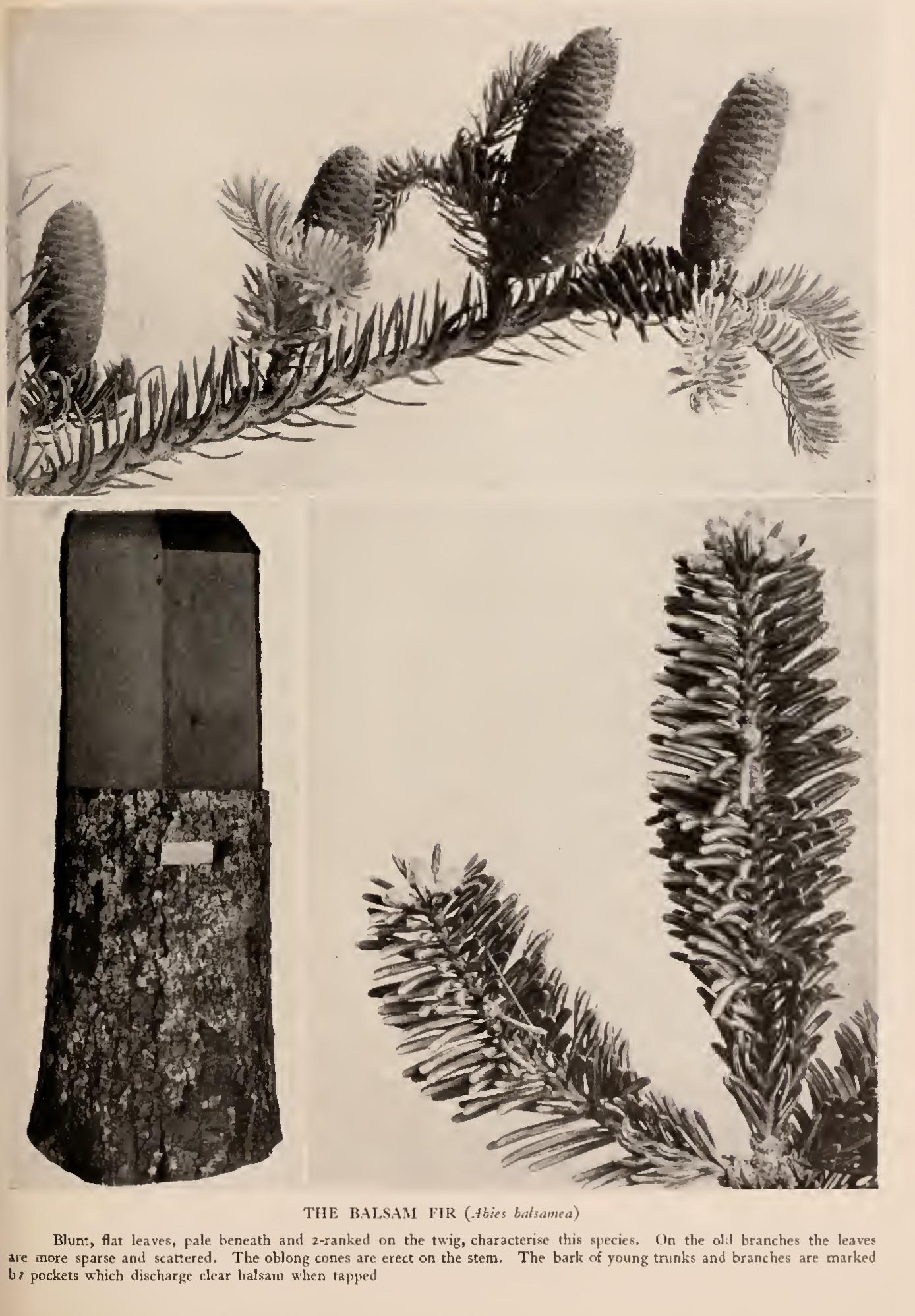
Balsam Fir (Abies balsamea, Mill.)—A broad, pyramidal
tree, 5o to 6o feet high, with slender pubescent branchlets. Bark brown, thin, broken into scaly plates with dried balsam in white blisters. Wood soft, weak, coarse, brown with yellow streaks, not durable. Leaves blunt, dark green, lustrous above, with pale linings, to i inches long, spreading in 2-ranked order. Flowers axillary, staminate, yellow shaded to purplish; pistillate purple. Fruit erect, rich purple, oblong-cylindrical, 2 to 4 inches long, blunt at ends; scales broad, entire, closely overlapping. Pre ferred habitat, swamps or hilly slopes. Distribution, Labrador through Canada and New England, to Minnesota; south along mountains to southwestern Virginia. Uses: Wood used for box material; bark furnishes oil and Canada balsam, used in medicine and in the arts. Fresh leaves cut for balsam pillows.
In the North Woods the hunter cuts the fragrant boughs of the fir balsam to make his bed, and the ladies of every camping party industriously shear balsam twigs in order to fill sofa pillows later with the leaves. The native finds it profitable to collect the limpid balsam by draining the white resin blisters that occur plen tifully on the smooth bark of young trees, and on the limbs of older ones. Wounding the tree produces increased flow. Whole families are often employed in this enterprise. The resin thus obtained is the "Canada balsam" employed in every laboratory for the mounting of microscopic specimens. It is used also in the practise of medicine and in other useful arts. "Oil of fir" is also obtained from the bark.
The erect cones of this tree distinguish it from the spruces with which it grows, and the hemlocks whose leaves are also pale beneath and 2-rant in arrangement. Balsam fir leaves are blunt and stemless. Hemlock leaves have minute petiole The cultivation o balsam fir has been rather stupidly con e° tinued in the Northeastern States, despite the fact that the tree is short lived and early loses its lower limbs. There are other firs that may be as easily obtained and grown, and these are chosen by wise planters for their greater beauty and longer life.