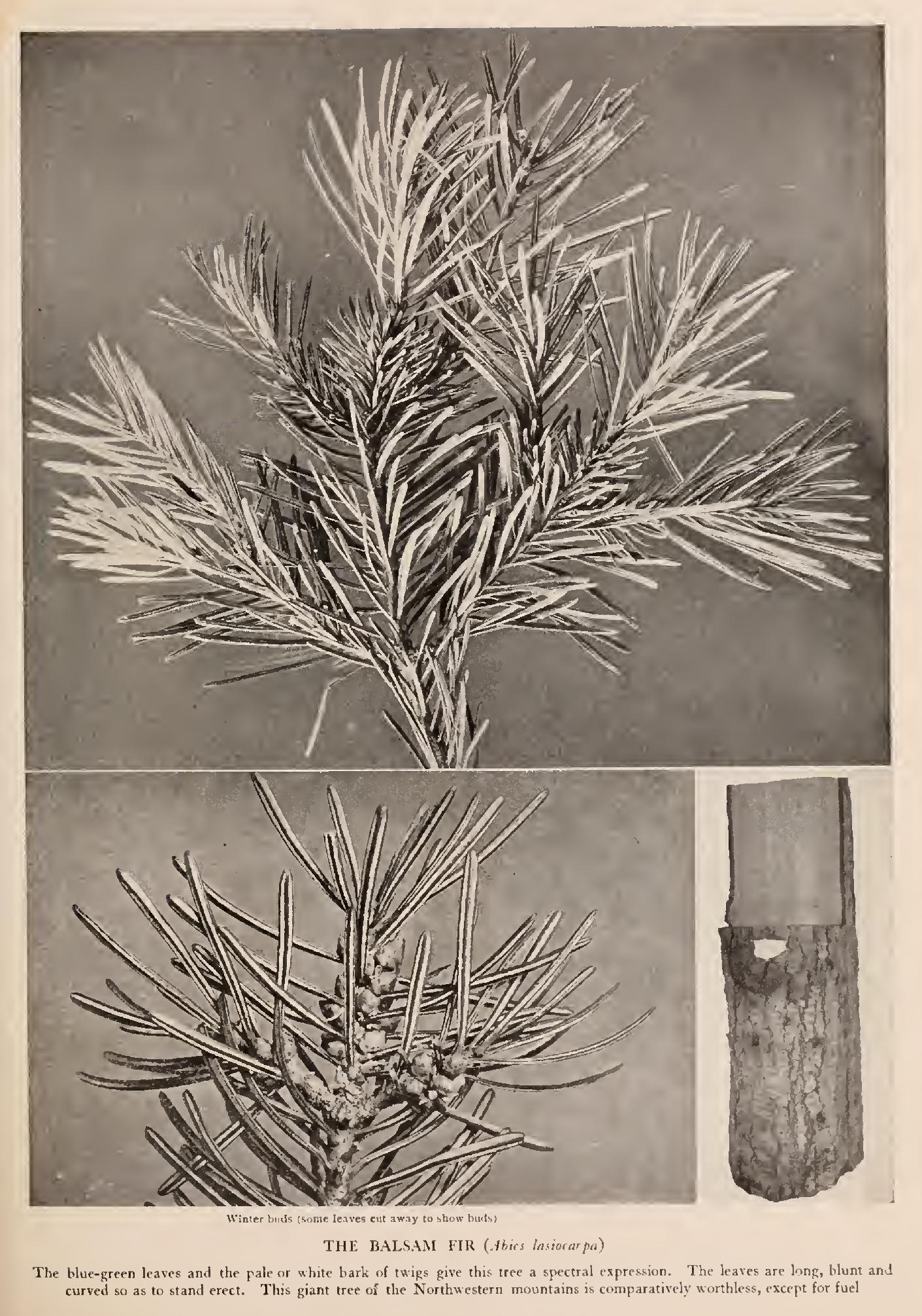
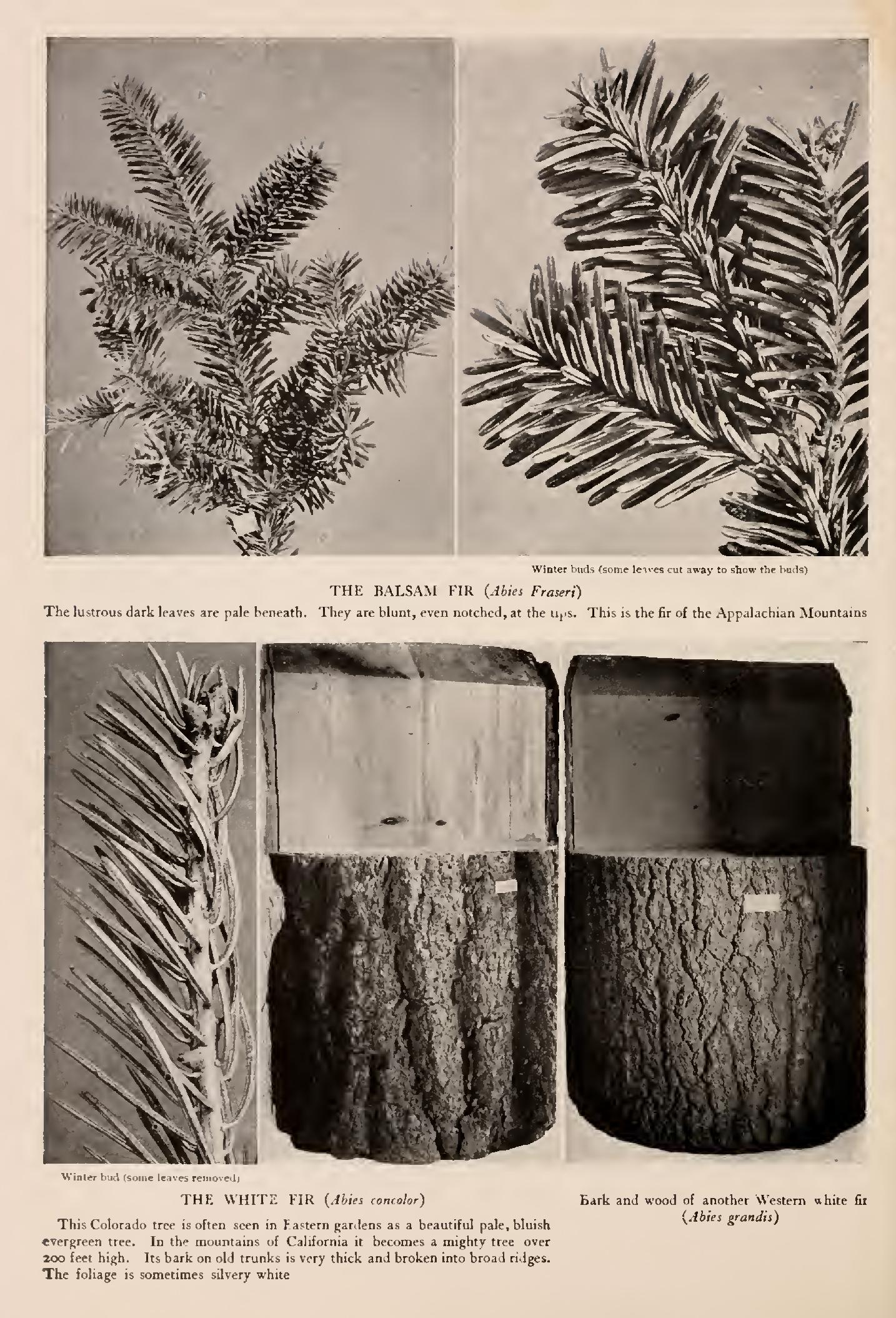
The Firs
The tree is often planted in Europe; it is the most vigorous native fir tree met in cultivation on the Atlantic side of this con tinent. The best trees in Eastern nurseries come from seeds col lected in the Rocky Mountains.
Another Silver Fir (A. venusta, K. Koch.) has leaves almost willow-like in form, so broad are the flat, pointed blades. They are i to zi inches long, yellow-green with silvery linings, especially bright on the newest shoots. The spray is flat by reason of the 2-ranked arrangement of the leaves, which stand out at right angles to the twig. The tree habit is peculiar. A slender trunk ioo to 15o feet high bears a broad pyramid of pendulous limbs, which is surmounted by a narrow spire for the last zo feet of the tree's height. The cones are 3 to 4 inches long, and striking in ornamentation. The long, stiff whip of a pale yellowish brown bract extends an inch or two beyond each purple scale.
This fir is confined to elevated canon sides in the mountains of Monterey County, California, and has no commercial signifi cance. Seeds sent to Europe produce handsome ornamental trees in North Italy and in warmer sections of England. .
Red Fir (Abies nobilis, Lindl.)—A broad, round-headed tree 15o to 250 feet high, with trunk 6 to 8 feet through; branches stiff; twigs red velvety. Bark i to 2 inches thick, irregularly furrowed, red-brown. Wood hard, pale brown, streaked with red, light, strong, moderately close in texture; sap wood darker. Buds small, blunt, reddish. Leaves blue-green, often glaucous when young, flat, grooved above, crowded to upper side of twigs, and curved backward, i to i inches long, on fertile shoots, 4-angled, sharp. Flowers : staminate reddish purple; pistillate scattered on upper limbs, bracts ornate with recurved tips. Fruit oblong, thick, blunt at apex and base, 4 to 5 inches long, purplish or brown, pubescent; scales covered with thin toothed bracts which end in recurving, pencil-like projections. Preferred habitat, mountain slopes at 2,50o to 5,000 feet elevation. Distribution, mountains of western Washington, Oregon and California. Uses: Lumber for interior finish of houses and for boxing. Rarely planted in Eastern States. Needs shelter at Boston. Cultivated in Europe.
The red fir, another giant of the Northwest, attains its best development in the Cascade Mountains of Washington and Oregon on elevated slopes facing the sea. An old tree is often zoo to 250 feet high, with a trunk 6 to 8 feet in diameter, crowned with a broad, round head, quite distinct from the spire form usual among firs. There are forests of this tree which furnish, at present in limited quantities, wood for boxing and house finishing. The wood is brownish red, with sap wood of a darker colour. The lumber dealer calls it "larch." As long as better lumber is to be had, these forests will be allowed to wait.
The distinctive features of this tree are its glaucous, blue green foliage and the stout brown or purple cones, 4 to 5 inches long, and richly ornamented by the bracts which turn back like little pale green scallop shells over each scale.
Red Fir (Abies magnifica, A. Murr.)—A pyramidal tree which becomes round-topped with age, 15o to 200 feet high; trunk 6 to 8 feet through; limbs pendulous, Bark red-brown, 4 to 6 inches thick, scaly and broken into ridges and deep fissures that cross and join; twigs reddish, becoming silvery white. Wood soft, light, weak, durable, red. Buds scaly, ovate, red, lustrous. Leaves 4-angled, pale at first, then blue-green, crowded to erect position on the twig. Flowers : conspicuous; staminate reddish purple; pistillate green with red tips on scales. Fruit oblong cylindrical cones, 6 to 9 inches long, purplish brown; scales plain, i inch broad at apex, closely overlapping and concealing the bracts. Preferred habitat, mountain slopes, at 5,000 to 7,000 feet elevation. Distribution, Cascade range in southern Oregon, throughout the western slopes of the Sierra Nevada Mountains. Uses: Wood makes packing cases and cheap buildings. Tree planted as an ornamental in western Europe. Scarcely hardy in our Eastern States.
"The magnificent silver fir," as John Muir calls it, is one of the noblest trees of the Northwest, a lover of the mountain slopes, which it climbs to two miles above sea level before it reaches its limit. On moraines, at an elevation of 7,000 to 8,000 feet, it grows to a height of 200 to 250 feet and a diameter of 5 to 7 feet.