The Larches - Family Coniferae
The Alpine larch never grows below an altitude of 4,000 feet. It ranges from Montana west to the coast and north into the British possessions.
Pyramidal cone-bearing evergreens, with tall, tapering trunks and slender horizontal branches ending in stout twigs. Roots long, tough, fibrous. Leaves 4-angled, stiff, pointed, solitary, spirally arranged, each set on a prominent, woody pro jection. Flowers moncecious, solitary, in conical aments on new shoots. Fruits pendant, woody, annual cones. Wood soft, straight grained, valuable.
KeY TO SPECIES A. Leaves distinctly 4-angled. B. Branchlets pubescent.
C. Leaves blue-green, short.
D. Cones ovate, to I inches long, persistent,foliage spiny. (Picea Mariana) BLACK SPRUCE DD. Cones oblong, t to 3 inches long, deciduous; foliage soft and flexible.
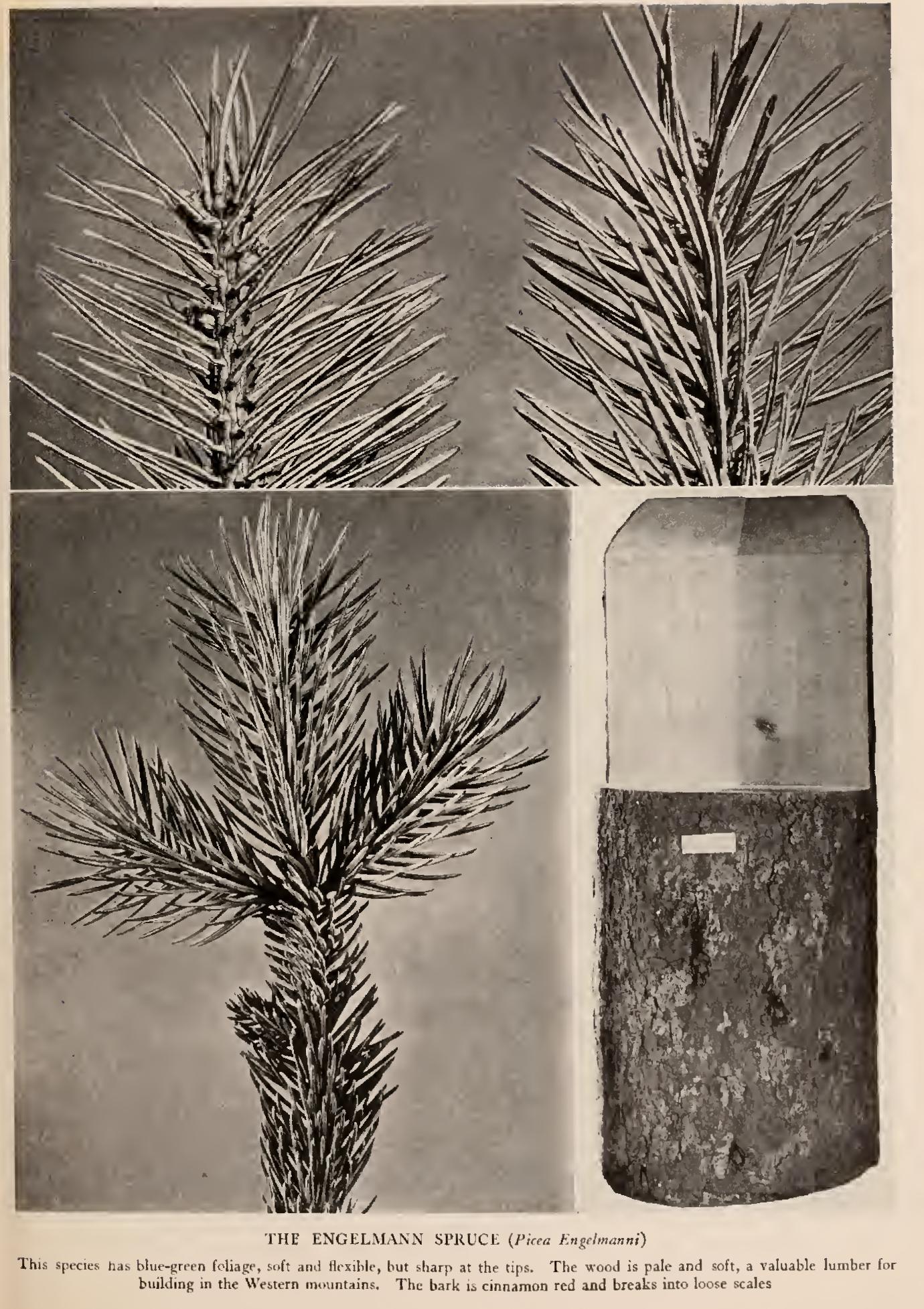
(Picea En‘elmanni) ENGELMANN SPrUCE CC. Leaves yellow-green, spiny, cones i to al inches long, early deciduous. (Picea rubens) RED SPRUCE BB. Branchlets smooth ; leaves spiny, incurving, blue green.
C. Cones slender; scales entire, flexible, blunt; leaves strong smelling, to inch long.
(Picea Canadensis) WHITE SPRUCE CC. Cones stout, scales, ridged, pointed; leaves to inches long.
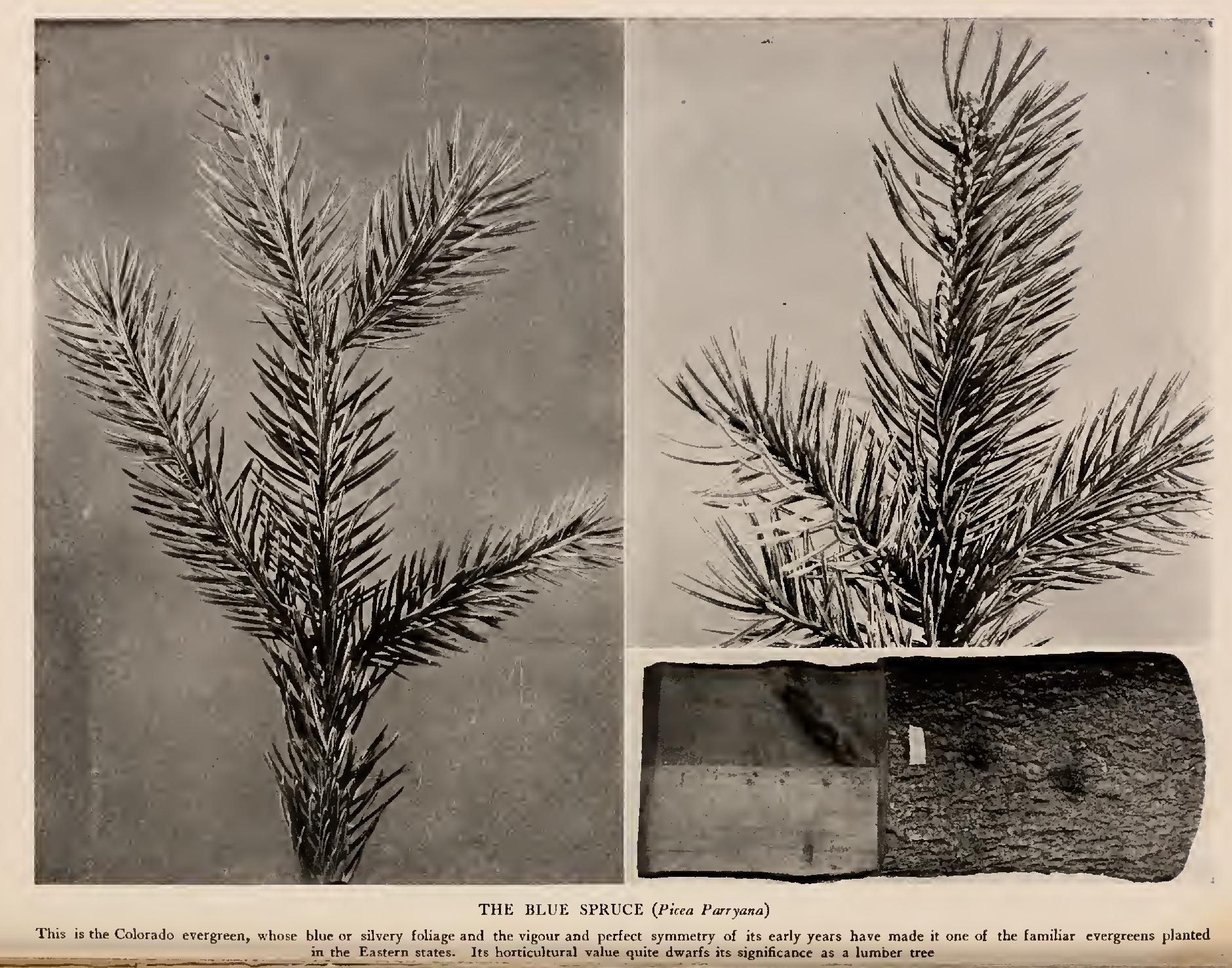
(Picea Parryana) COLORADO BLUE SPrUCE AA. Leaves more or less flattened; cones 2 to 5 inches long. B. Branchlets pubescent, pendulous; leaves blunt; cone scales entire, rounded.
(Picea Breweriana) WEEPING SPrUCE BB. Branchlets smooth, erect; leaves pointed ;,cone scales toothed, pointed. (Picea Sitchensis) SITKA SPRUCEThe genus Picea includes some of the most useful as well as ornamental of the conifers. There are eighteen species, seven of them American, distributed over the Northern Heimsphere. The Norway spruce (P. excelsa, Link.) is the commonest spe cies in cultivation. It is the familiar spruce of dooryards, grow ing to great size in this country, and evidently more comfortable in domestication than our native species. The long cones hang on the topmost branches, and the lower limbs droop to the ground. It is planted for windbreaks, hedges and shelter belts, often with white pine. The species is strongly recommended for plantations of trees for timber.
The Caucasian Spruce (P. orientalis, Carr.), graceful and slow of growth, with lustrous, dark-green foliage, is well adapted to small gardens. It retains its lower limbs until quite old. Two or three Japanese species have been introduced.
Black Spruce (Picea Mariana, B. S. & P.)—Pyramidal evergreen, with short, drooping branches, usually 3o to 40 feet high, occasionally 8o feet high. Twigs downy. Bark thin, scaly, brownish grey. Wood light, weak, soft, yellow. Buds brownish red, downy, ovate. Leaves blue-green, with pale bloom above, linear, sharp, stiff, I to f inch long, set around twig. Flowers cone-like, moncecious, solitary, axillary. Fruit oval cones, to inches long, pendant, persistent for many years; scales thin, entire. Preferred habitat, dry lowlands, rocky slopes and Distribution, Labrador to Alaska; south to Wisconsin, Pennsyl vania and northern Virginia. Uses: Locally as lumber and fuel. Wood made into paper pulp. Resin used as chewing gum. Sap made into beer.
The least of all spruce cones grow on the black spruce trees, and the tree is burdened with the empty husks of twenty or more crops before it lets the oldest ones drop. It is a peculiar habit, and gives the tree an unkempt, dingy appearance that the grey bark intensifies. The habit of the tree is ragged and uneven, and the foliage dull bluish grey. Altogether it is not to be won dered at that the black spruce is ignored by planters. The tree has always proved short lived in gardens.
The vast forests of this timber will be converted into paper. Wherever spruce timber grows to-day there are fortunes awaiting the owners. This wood that lumbermen reject exactly suits the pulp man's needs. Thousands of acres are consumed every year.
Black as its name is, the wood is almost white, and .the paper needs little or no bleaching.
The Engelmann Spruce (P. Engelmanni, Engelm.) is the white spruce of the Rocky Mountains and the Cascade range in Washington and Oregon. It crowns the lower and higher peaks, climbing to altitudes between one and two miles above the level of the sea. In the rocky sides of glacier-polished ravines these hardy trees find foothold, and set their spires like serried ranks of spearsmen to cover the bare cliffs. Snow loads them down for many months of the year ; they can survive that, but their destruction comes when a fire sweeps over them, killing all it touches, for the cambium of these trees is protected by a very thin bark. The seeds and seedlings go. There is no repro duction of forests thus destroyed. They give way to the lodge pole pine and other more fortunate species.