The Pitch Pines
The Scrub Pine (P. contorta, Lond.) is one of four stunted, gnarly, round-shouldered trees that are prostrated by exposure to the ocean winds. They are the beach pines. This one grows from northern California into Alaska in bogs, and sand dunes, bearing its cones when only a few inches high in the bleakest situations. These trees form a windbreak behind which many sorts of tender plants thrive in quiet security. The bark is thin and pale and gummy on these dwarfs, and once a fire is started it devours all within reach. Now a very interesting habit of the tree comes into prominence. The cones hang on the trees for years without opening, but their seeds are safely sealed up and retain their vitality. The burned trees drop their cones, which, opening, free the seeds. From them young trees spring up to take the places of those wiped out by the fire.
It is hard to believe that the tall, slim lodge pole, or tamarack pine is but a variety—Murrayana—of P. contorta, but so it is considered on good authority. The mountains of Wyoming, Colorado and the states further west are clothed with • dense forests of this tree. They grow as thick as wheat in a field, and so are all delicately tall, but in favoured situations iso lated trees reach the height of ioo feet, and a trunk diameter of 11 feet. An average forest specimen is 5 inches through and 4o to 5o feet high. The Indians cut poles for their lodges or tepees. These pines, flexible, slender and always abundant, seemed designed by Nature to serve this need. The name re mains, though the lodge of the Indian is rapidly disappearing.
There is great variation in this species and its variety, Murrayana, as the trees meet very different conditions. The leaves are in twos, and i to 3 inches long, dark green in contorta, yellow-green and quite wide in the variety. The wood of contorta is hard, brownish red, and strong; of Murrayana, soft, pale yellow, and weak. The latter is used for lumber to a limited extent, and both are cut for fuel. While it is not a promi nent commercial tree, it is the main reliance of the pioneer in many regions. It supplies mines with supporting beams, fences the settler's homestead, and furnishes ties for the pioneer railroads.
The Indians cut the trees down and strip out the inner bark. This is broken into pieces by the patient squaws, who mash it in water into a pulp which they mould into large cakes. Then a hole is dug in the ground and lined with stones, and a fire kindled. When the stones are hot the embers are removed, and the cakes packed in with leaves of the Western skunk cabbage between. A fire of damp moss is built on top, and the baking
takes an hour or more. Then the cakes are laid on slat frames and smoked for a week in a close tent. Now they are ready to put away for future use, or to carry in canoes or on ponies to distant places.
This " hard bread" is prepared for use by breaking it in pieces and boiling them until soft. The pieces are skimmed out and laid on the snow to cool. " Ulikou " fat is used on this strange Alaskan bread as we use butter.
The Indians make berry baskets out of the bark of the lodge pole pine. Nuttall, in his extension of Michaux's "Sylva of North America," calls this the twisted-branched pine. I well recall the curious rustic chairs and seats at the Dome Lake Club House in the Big Horn Mountains in Wyoming, made of the extravagantly twisted branches of this tree. They called it " screw pine," I remember. The name contorta may allude to this characteristic, too, although it is not constant in the species. It may rather be regarded as a freak of nature, the cause of which is not understood. However, the hard life of the species on the bleak, wind-swept coast and unprotected sand dunes may easily earn it the name there.
The Sand Pine (P. clausa, Sarg.) has a striking habit of swallowing its persistent woody cones by the growth of the stems that bear them. Chopping frequently reveals cones in the solid wood—a peculiar kind of modified knot. The tree is unim portant to the lumber trade, being inferior in quality and scant in quantity. It grows near the coast on either side of northern Florida and west into Alabama. It is used locally as masts for small vessels.
The Spruce Pine (P. glabra, Walt.) is a close relative of the shortleaf, P. echinata. It grows from South Carolina to Louisiana, in lowlands, solitary or in considerable groves. It attains the height of 120 feet, and spreads over a considerable territory in northwestern Florida. Little use is made of its light, soft wood beyond the local fuel supply. It is known as "cedar pine" in Mississippi. Its foliage is soft, and bright, dark green, being shed when but two years old.
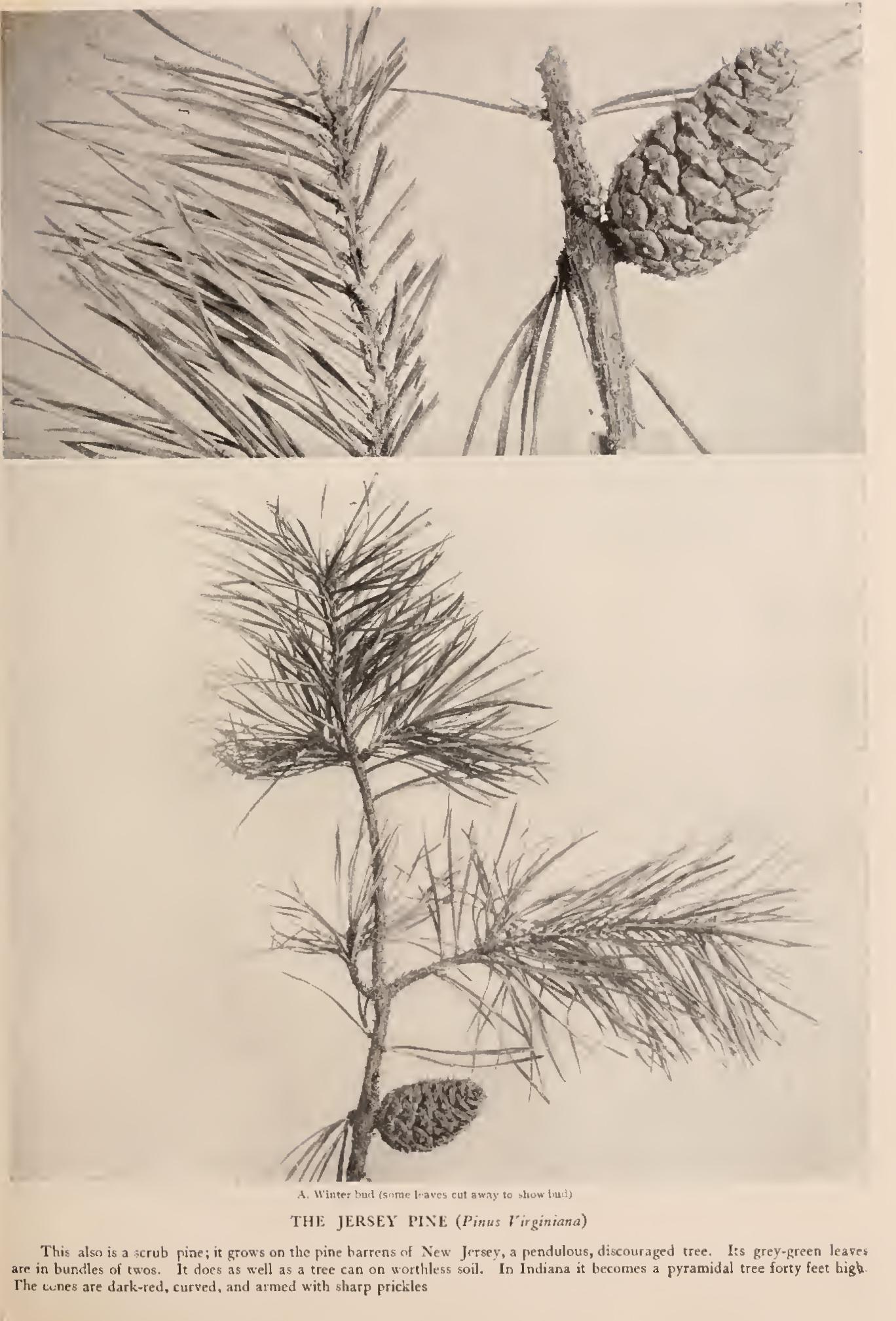
The Jersey or Scrub Pine (P. Virginiana, Mill.) is another of those unfortunate trees whose lot seems to be to extort a meagre and miserable living out of worthless soil. A tortuous low tree, pendulous and discouraged looking, with grey-green leaves, that are• yellowish as they first appear, stubby, i to 3 inches long, in clusters of twos. This is the tree of the Jersey pine barrens—the tree that clothes these waste places and gets little credit for it.