The Pod-Bearers - Family Leguminosae
The foliage mass of the honey locust is wonderfully light and graceful. New leaves with a silvery sheen upon them are con stantly appearing; some once, some twice compound, on the same tree. The colour of them is a clear, intense emerald. The pods in midsummer show many shades of changeable red and green velvet against the leaves, and are as beautiful in form as in colour and texture.
In this stage of growth the pods contain a sweet, edible pulp which later dries and turns bitter. An Old-World tree has pods that are thicker but otherWise resemble those of the honey locust; these sweetish pods are sold on the streets of New York as "St. John's Bread," and are believed to be the locusts eaten by John the Baptist in the wilderness.
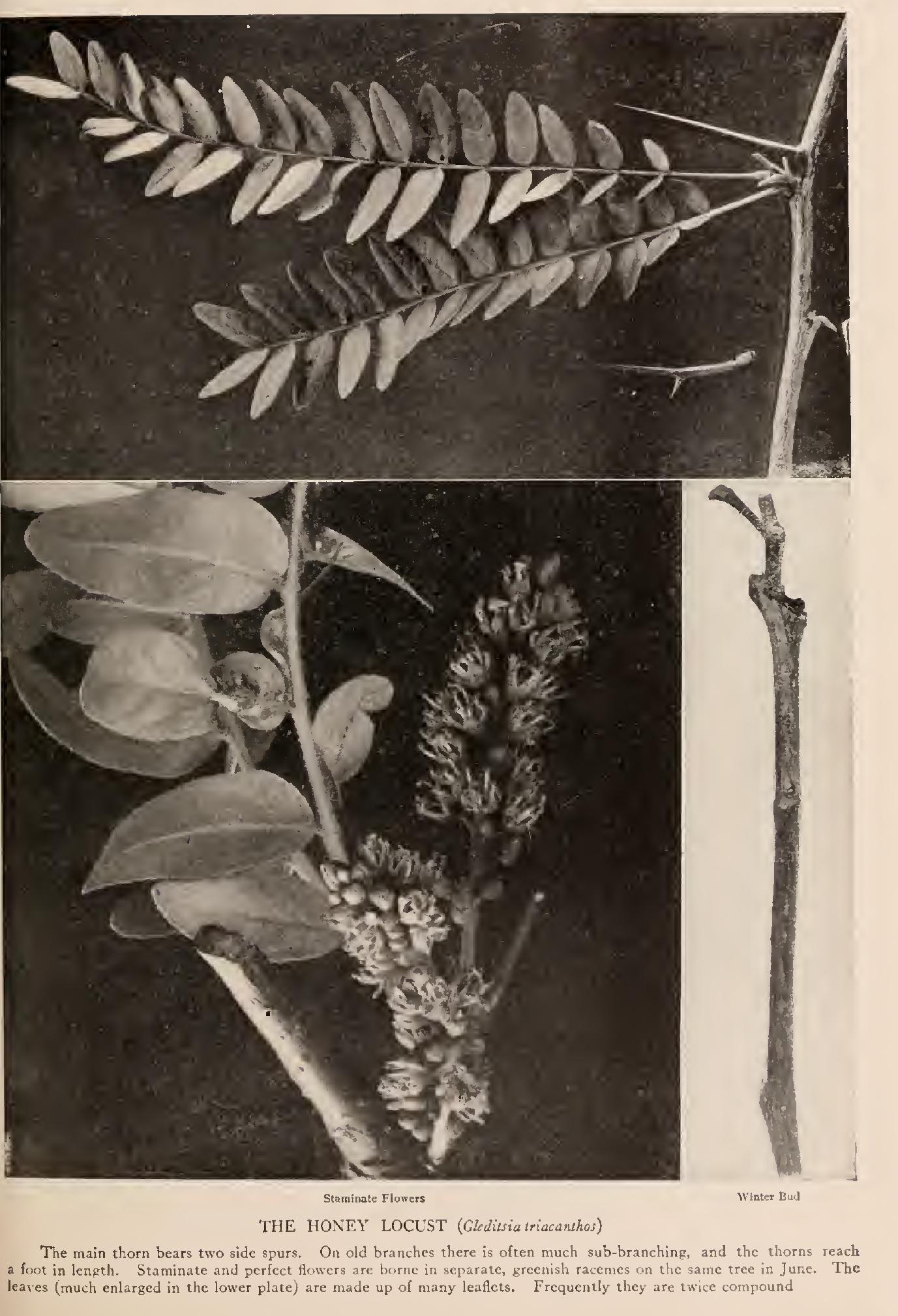
The curving, S-shaped pods of the honey locust hang on the tree until winter, when the wind whirls them along over the icy ground until they lodge. Here the seeds eventually soften and germinate, and saplings spring up far from the parent tree. The range of this tree is extensive, but it has nowhere a very plentiful growth. The wood is not as well known nor as fully appreciated as it deserves. The claims of the tree for ornamental planting and for shade are granted by enterprising nurserymen. It is a handsome park tree, and thrives in almost any soil. It is hardy, and endures heavy pruning. This character combined with its thorns make it one of the best of our native hedge plants. It is necessary to soften the hard seeds in hot water before planting, else they will not germinate until the second year.
Unlike most of the pod-bearers, the honey locust has greenish, inconspicuous flowers, not of the pea-blossom form. The bees find them, as they are fragrant and nectar laden. The "honey" mentioned in the name is not in the flower but in the half-ripe fruit.
The Texan Honey Locust (G. Texana, Sarg.), with the characters given in the key, has so far been found only in one grove near Brazoria, Texas. It is a large, thornless tree, with thin, smooth bark.
The Water Locust (G. aquatica, Marsh.) is a small, flat topped, irregular tree which grows best in the swamps just west of the lower Mississippi. It is found sparingly from South Caro lina through the eastern Gulf States, and north as far as the Ohio River. The tree can easily be recognised by its brown polished thorns which are 3 to 5 inches long, pointed and stiff, and some times flattened, like the blade of a sword. The two lateral
thorns arise close to the base of the main one.
The pods, which are usually but 1-seeded, are oval and pointed, and much more thickly clustered than those of G. triacan tbos. The wood is coarse and inferior to other locusts, though it is heavy, hard and strong, and has been put to many uses.
3. Genus GYMNOCLADUS, K. Koch.
The genus Gymnoclodus has one species in China and another in eastern North America. Both are bare-limbed, clumsy mem bers of a family which boasts many graceful trees. The pulp in the heavy pod is used in China for soap. Our tree is planted for shade on city streets, and for the sake of its peculiar, great pods, which hang on the bare limbs all winter. The characters of the genus are embodied in the native species.
Kentucky Coffee Tree (Gymnocladus dioicus, K. Koch.)— A narrow, round-topped tree with tall trunk, 75 to loo feet high, with stout, thornless twigs. Bark grey, deeply furrowed; ridges scaly. Wood light brown, soft, heavy, coarse, strong, durable. Buds scaly, half hidden in the twig. Leaves twice pinnate, I to 3 feet long, i to 2 feet broad, of 4o to 6o oval leaflets, dark green, smooth; petioles stout, long, enlarged at base; autumn colour, clear yellow. Flowers, June, dioecious, regular, greenish white, in racemes staminate, 3 to 4 inches long; pistillate to to 12 inches long, somewhat hairy. Fruit a thick-walled, purple pod, 6 to io inches long, 2 inches wide, dark red, short stalked; seeds several, bony, globular, inch in diameter, in sweetish, sticky pulp, bitter at maturity. Preferred habitat, rich, moist soil. Distribution, New York to Minnesota and Nebraska; south to Pennsylvania, Tennessee, Arkansas and Indian Territory. Uses: A good street and shade tree. Wood used for fencing, in con struction and rarely in cabinet work.
The Kentucky coffee tree is one of the rarest of American forest trees. It ranges widely, but is nowhere common. It is remarkable for its dead-looking frame, which holds aloft its stiff, bare twigs in spring after other trees are clothed with new leaves. But at length the buds open and the leaves appear, twice com pound, and often 3 feet long. The basal leaflets are bronze green while the tips are still pink from having just unfolded. This stately tree, its trunk topped with a close pyramid of these wonderful leaves, is a sight to remember. Often the trunk is free from limbs for 5o feet or more.