The Pod-Bearers - Family Leguminosae
Unfortunately for us, the locust borer has put an end to raising this valuable timber in any but the mountainous parts of its natural range. Lumbermen well know there is no more profitable timber crop, except when the locust borer attacks it. The wood is riddled by these, even to the twigs, and no effective means of combating them is known. For this reason, the cultiva tion of the tree has been abandoned in the regions where this insect has appeared. In Europe, locusts seem to be comparatively free from insect injury.
The extreme hardness of locust wood is due to crystals, called rhaphides, formed in the wood cells. These hard mineral deposits soon take the edge off of saws and chisels.
As an ornamental tree, the chief drawback of the locust is its unsightliness when bare of leaves. The fact should he added that the leaves come late and fall early. The tree sends up suckers freely from the roots, which unfits it for planting on lawns. There are sixteen varieties of this tree known in cultivation. With all its faults they love it still; the American people plant locusts for the borers to distort.
The prickles that arm these trees are not thorns at all. They are but skin deep, like prickles of rose and gooseberry bushes. But they persist and become quite formidable. They are merely stipules of the leaves. Each pair of leaflets has a pair of tiny spines guarding the base. But they are transient, falling with the leaf. Thornless trees often occur in groves of locusts.
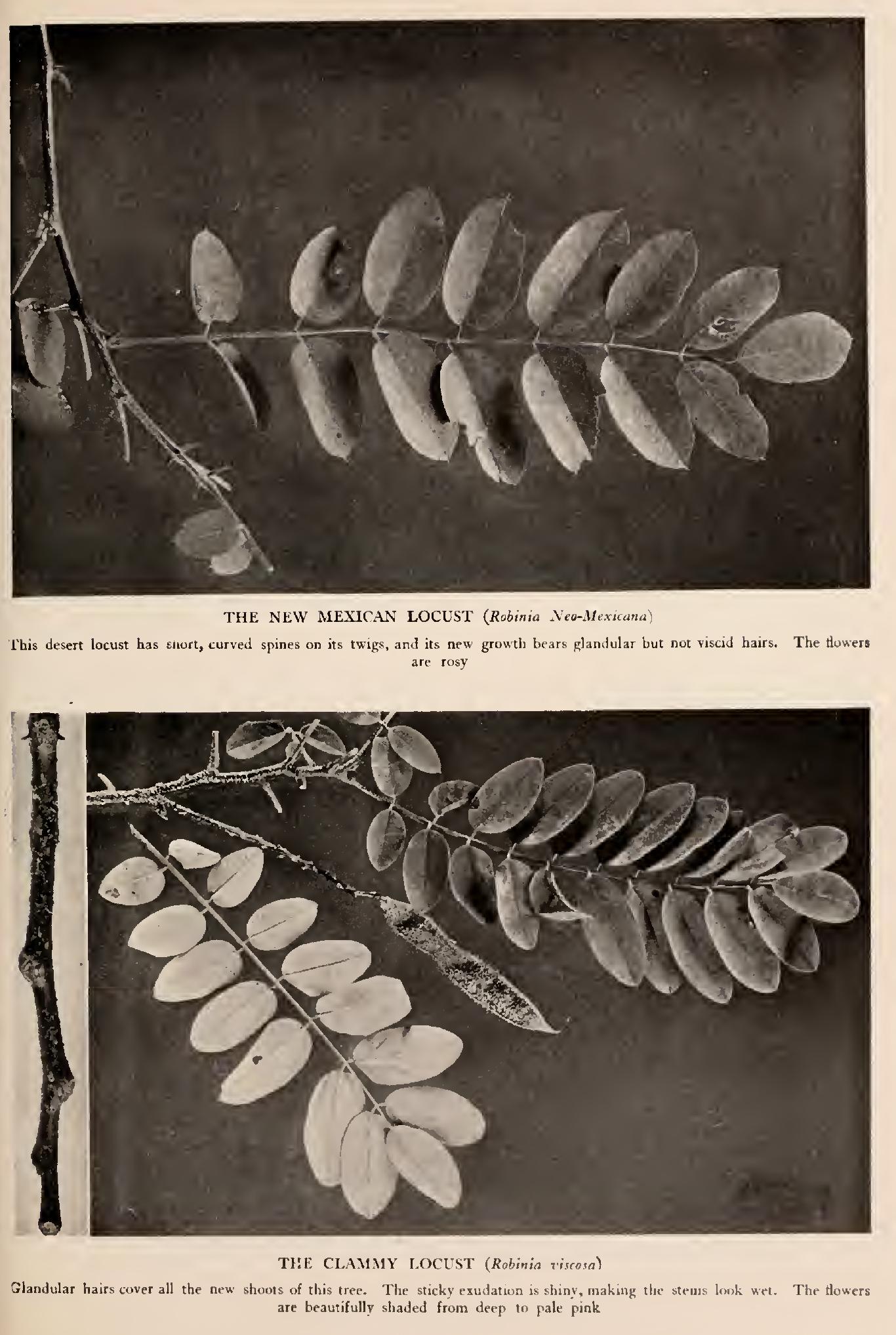
The Clammy Locust (Robinia viscosa, Vent.) is a little, rough-barked tree that grows wild in the mountains of North Carolina. It is a favourite garden ornament, for it has delicate feathery foliage and the shaded pinks of its close flower cluster make a combination of form and colour no artist can resist. The calyxes are dark red, and all the new growth shines with the sticky substance that exudes from the covering of glandular hairs, and gives the tree its name. The spines are inconspicuous.
The New Mexican Locust (Robinia Neo-Mexicana, Gray) rarely rises higher than a shrub in the Southwestern semi-desert regions. Its tender shoots are covered with glandular but not viscid hairs. The flowers are rosy and handsome. The twigs are armed with short, stout, recurved spines.
The Bristly Locust (Robinia hispida, Linn.), a garden shrub with large crimson flowers and bristly hairs covering its shoots, is probably the most common locust in cultivation.
5. Genus CLADRASTIS, Raf.
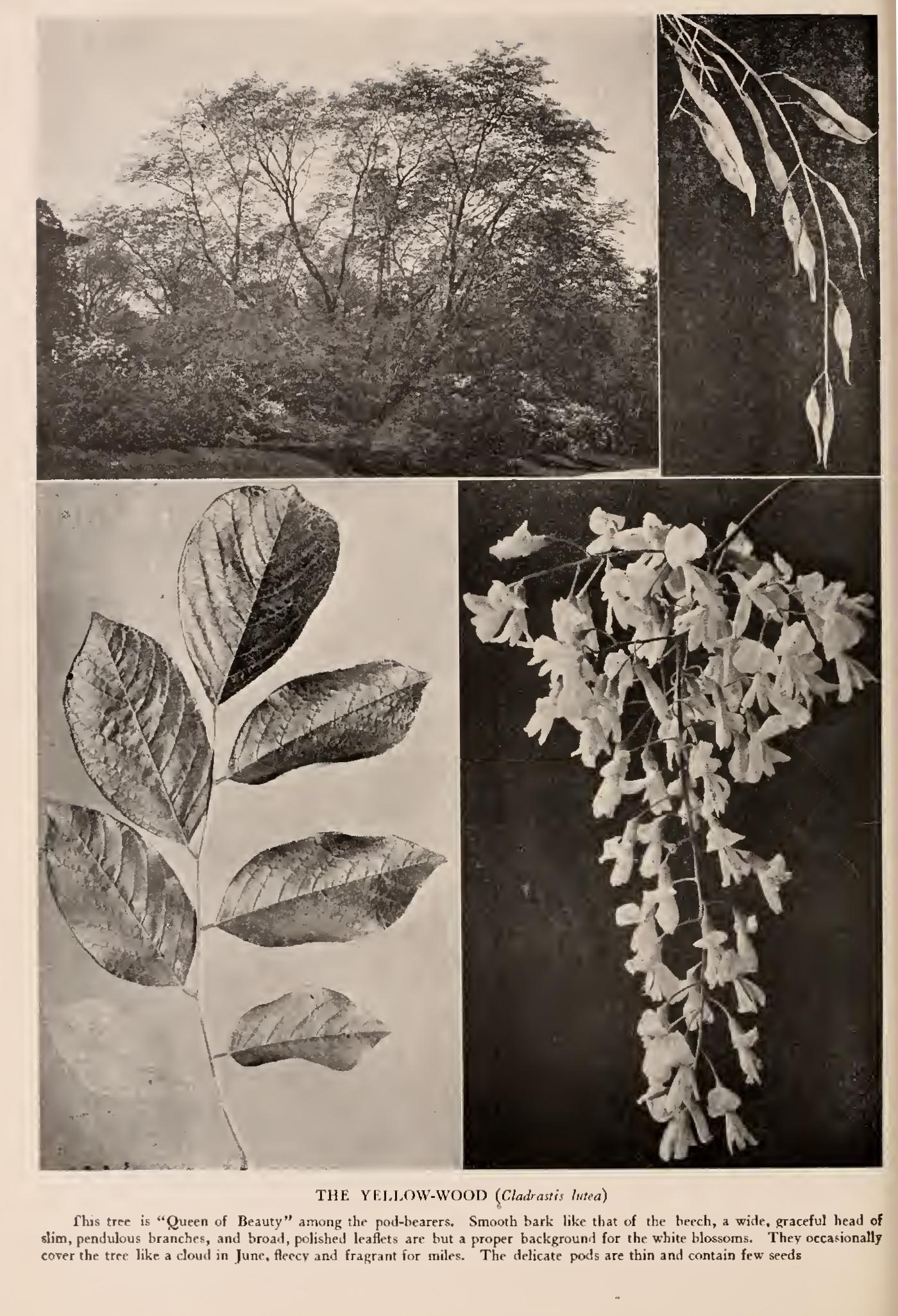
" The genus Cladrastis is "Queen of Beauty" among the pod-bearers. It is represented by one species in the eastern United States and another in Manchuria. The name, from two Greek words, refers to the brittleness of the branches.
The Yellow-wood, or Virgilia (Cladrastis lutea, K. Koch.), is native to the limestone hillslopes of Tennessee, Kentucky and North Carolina, but even here it is very rare. It is cultivated,
34' however, and good specimen trees may be seen in nurseries and in private grounds in the East. It is hardy as far north as New England and Ontario, and is one of the most desirable native ornamental trees.
It is a small tree, rarely reaching 5o feet in height, with wide, graceful head of slender, pendulous branches, grey bark as smooth as that of a beech, and four little winter buds enclosed in the hollow base of each leaf stem. The leaves are compound, a foot long, of seven to eleven oval, broad leaflets, diminishing in size toward the base, pale beneath, and turning a clear yellow in the autumn.
The flowers are large, white, pea-like, fragrant, and borne in drooping, terminal clusters, often a foot long. The pods are thin, smooth, few-seeded. Virgilia is the garden name of this tree. It is called so in the nursery catalogues. The wood is yellow, and its sap yields a dye of that colmir.
These are the botanical characters of the yellow-wood. One can easily identify it. But to remember the tree, to have it indelibly impressed upon the memory, one must see it in blossom. It is a "shy bloomer"; at least it never blooms in two successive years, and rarely does it cover itself with flowers oftener than twice or three times in a decade. That is quite enough to justify planting it as a lawn tree, with evergreens for a background—a frame for the picture when it comes.
The virgilia is always beautiful. But in wealth of bloom, as I saw it in the gardens and parks about Boston in the summer of tgo4, it surpassed all other trees. Every twig ended in a long, loose raceme in which each pure white blossom had room to reach its full development—to get its fill of light and sun and air. The weight of the flowers made every twig bend outward and down ward. Each tree was overspread for days with this marvellous veil of white, and out of each came all day long the low murmur of contented bees.
The tree is rare and local, hanging over mountain streams and edging the woodlands of its range, the highlands of western North Carolina, eastern Tennessee, central Kentucky and northern Ala bama. Its beauty is much enhanced by cultivation. The hand some foliage turns yellow before it falls, and all through the summer and on through the autumn the pendant clusters of dainty pods are highly ornamental.
The virgilia has no bad habits; it is hardy in the climate of Boston; it thrives in many different soils; it is easily propagated by seeds or root cuttings; it is a handsome lawn or park tree at any season of the year. It ought to be in gardens up and down the land—increasingly planted wherever a beautiful native tree is desired and appreciated.