The Poplars - Family Salicaceae
THE POPLARS - FAMILY SALICACEAE. Genus POPULUS Quick-growing trees with angled or round twigs, set with scaly buds, soft, light wood, and bitter bark. Leaves deciduous, simple, alternate, usually broad, on long petioles. Flowers dicecious, both kinds in crowded, pendulous catkins; each flower subtended by a bract with deeply cut, hairy margin. Fruit pendulous racemes of 2 to 4-valved pods; seeds minute, with dense, silky float attached.
KeY TO SPECIES A. Leaf stalks flattened.
B. Buds smooth, resinous.
C. Leaves triangular, coarsely serrate.
D. Blades of leaves 3 to 5 inches long.
(P. deltoidea) corroxwoon DD. Blades of leaves 2 to 2i inches long.
E. Twigs slender, pubescent, yellow.
(P. Fremontii) coTToNwooD EE. Twigs stout, smooth, orange.
(P. Wisliteni) COTTONWOOD CC. Leaves roundish, finely serrate.
(P. tremuloides) QUAKING ASP BB. Buds downy; leaves ovate, coarsely toothed.
(P. grandidentata) GREAT-TOOTHED ASPEN AA. Leaf stalks round; buds resinous.
B. Foliage green on both sides.
C. Shape of leaves lanceolate.
(P. angustifolia) NARROW-LEAVED COTTONWOOD CC. Shape of leaves rhombic or deltoid, with long pointed apex.
D. Margins finely serrate.
(P. acuminata) LANCE-LEAVED COTTONWOOD DD. Margins coarsely and crenately toothed.
(P. Mexicana) MEXICAN COTTONWOOD BB. Foliage pale, silvery or rusty below; margins finely serrate.
C. Buds thickly covered with yellow resin.
(P. balsamif era) BALM OF GILEAD CC. Buds somewhat resinous.
D. Bark pale grey.
(P. trichocarpa) BLACK COTTONWOOD DD. Bark reddish brown.
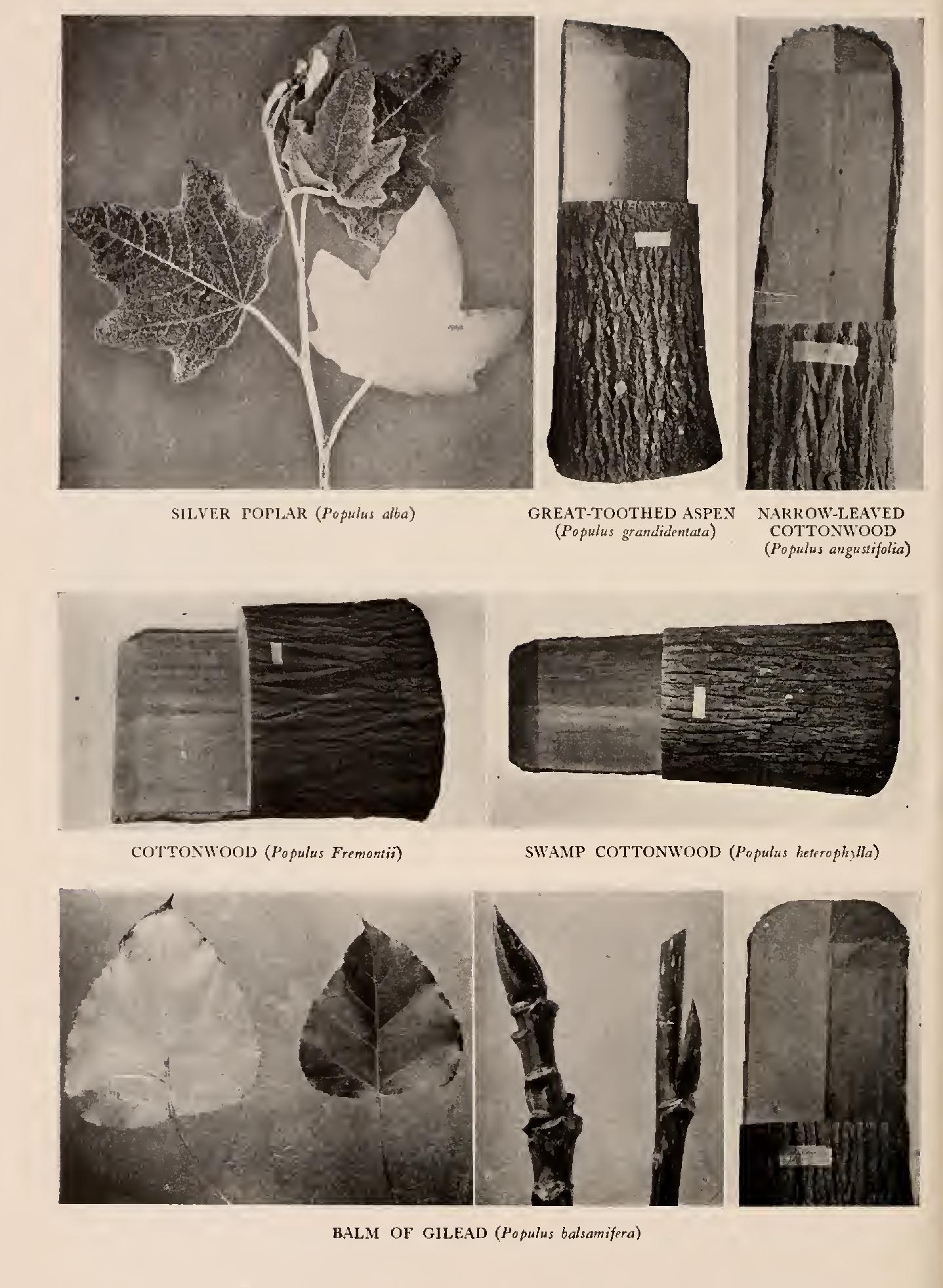
(P. heterophylla) SWAMI' COTTONWOOD Trees of the genus Populus form extensive ,forests in low, rich land and on high slopes of mountains. They attain large size, are quick of growth, and have exceeding tenacity of life, striking roots from twigs and sending up suckers from under ground. Seeds are also a reliable means of reproduction, as they are produced in great numbers, and are widely scattered by the wind. The wood is one of the best materials for pulp making, and for a multitude of cheap wares for which a wood easy to work is demanded. The trees are largely planted for shade and ornament, for windbreaks, and to hold the banks of streams.
There are twenty-five species of Populus known, eleven of which are native to America. European species are often planted in this country, where they usually thrive as if at home. Some
Russian varieties are successful on the Western prairies. China and Japan each have representative poplars here.
Cottonwood (Populus deltoidea, Marsh.)—Much-branched tree, 6o to 15o feet in height; diameter 5 to 7 feet. Bark deeply furrowed, grey-brown, becoming greenish; often ashen grey on old trees. Wood dark brown; sap wood white; weak, compact, light. Buds large, pointed, resinous. Leaves broadly ovate, taper pointed, 3 to 5 inches long, margin wavy and coarsely toothed, thick, shining, paler beneath, yellow in fall; petiole long, slender, flat, red or yellow. Flowers, March, in pendant catkins, 3 to 5 inches long, loosely flowered; staminate red, numerous; pistillate green, sparse on trees. Fruits, May, aments 6 to 12 inches long; capsules ovate, often curved, 2-valved; seeds in white, cottony mass. Preferred habitat, moist soil along streams. Distribution, Quebec to Northwest Territory; south to Florida; west to Colorado and New Mexico. Uses: Much planted for shade and windbreaks in the prairie states. Wood has recently come into use in making packing cases.
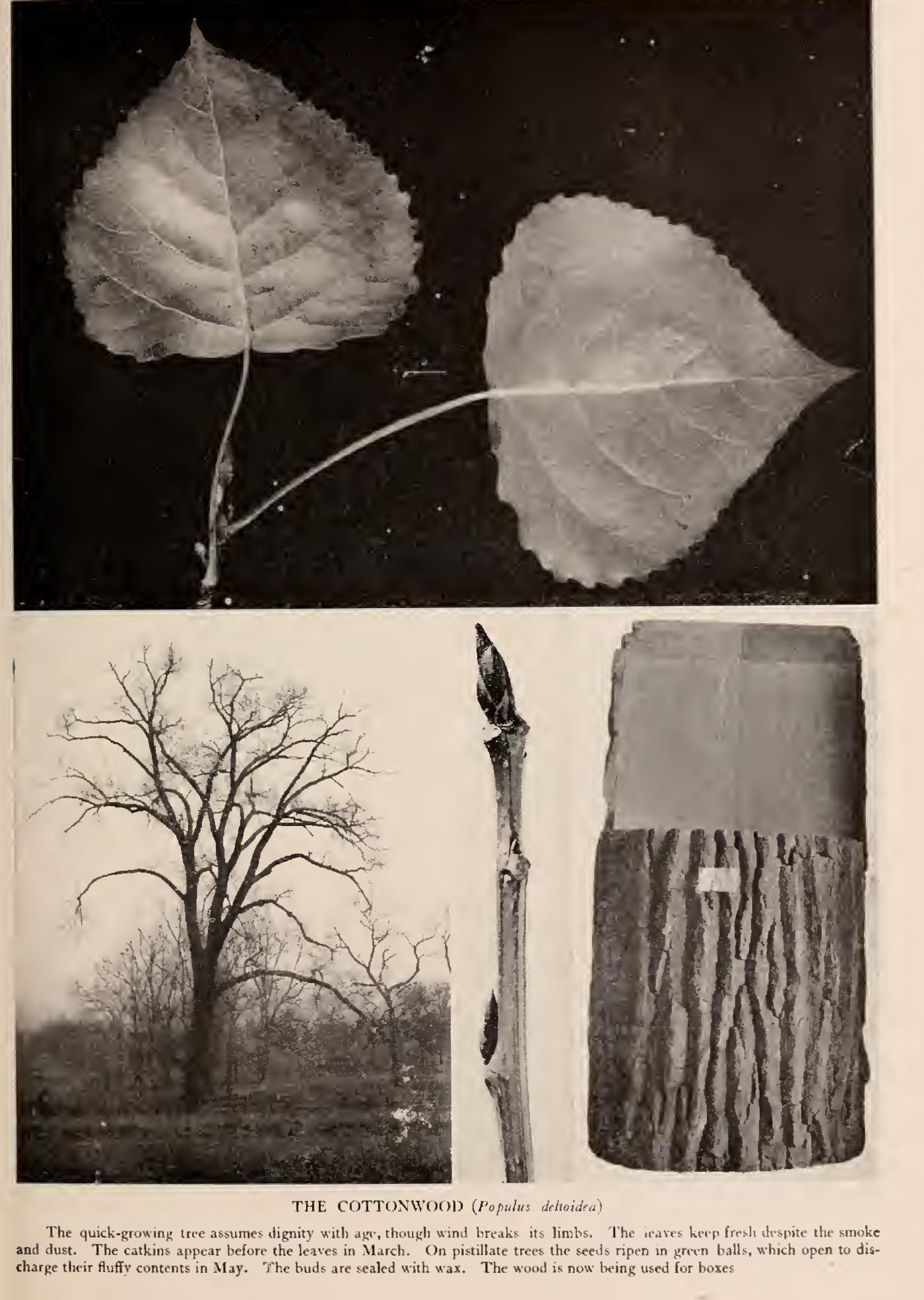
We all concede that the cottonwood has faults. The brittle wood cannot withstand the winds, the leaves drop untidily through the summer, the cast-off staminate catkins are a nuisance in spring, and the fluffy cottony seeds shed so deliberately in early summer by the fertile trees fill the air and the meshes of door and window screens to the exasperation of the whole neigh bourhood.
But go out into one of the little breathing spaces called parks in a great city like New York in the early spring days when the children of the tenements and the stuffy flats are brought out for a first breath of the spring air. The old cottonwood has its buds all a-glisten with promise, and in a few days longer the dainty little leaves twinkle all over the treetop with the most cheerful green. In the late summer, in spite of its losses, the tree still carries a bright green crown of shade which turns yellow before it falls. With all its faults, it endures the heat of cities, and the dust and soot with commendable patience. In the protection of great buildings it does not suffer by winds as it does in exposed situations.