The Poplars - Family Salicaceae
"The green wood moved, and the 'light poplar shook Its silver pyramid of leaves." We might easily adapt these graceful lines to our quaking asp, but that the word "silver" will not apply accurately. The English poet, Barry Cornwall, was describing the white poplar with white leaf linings.
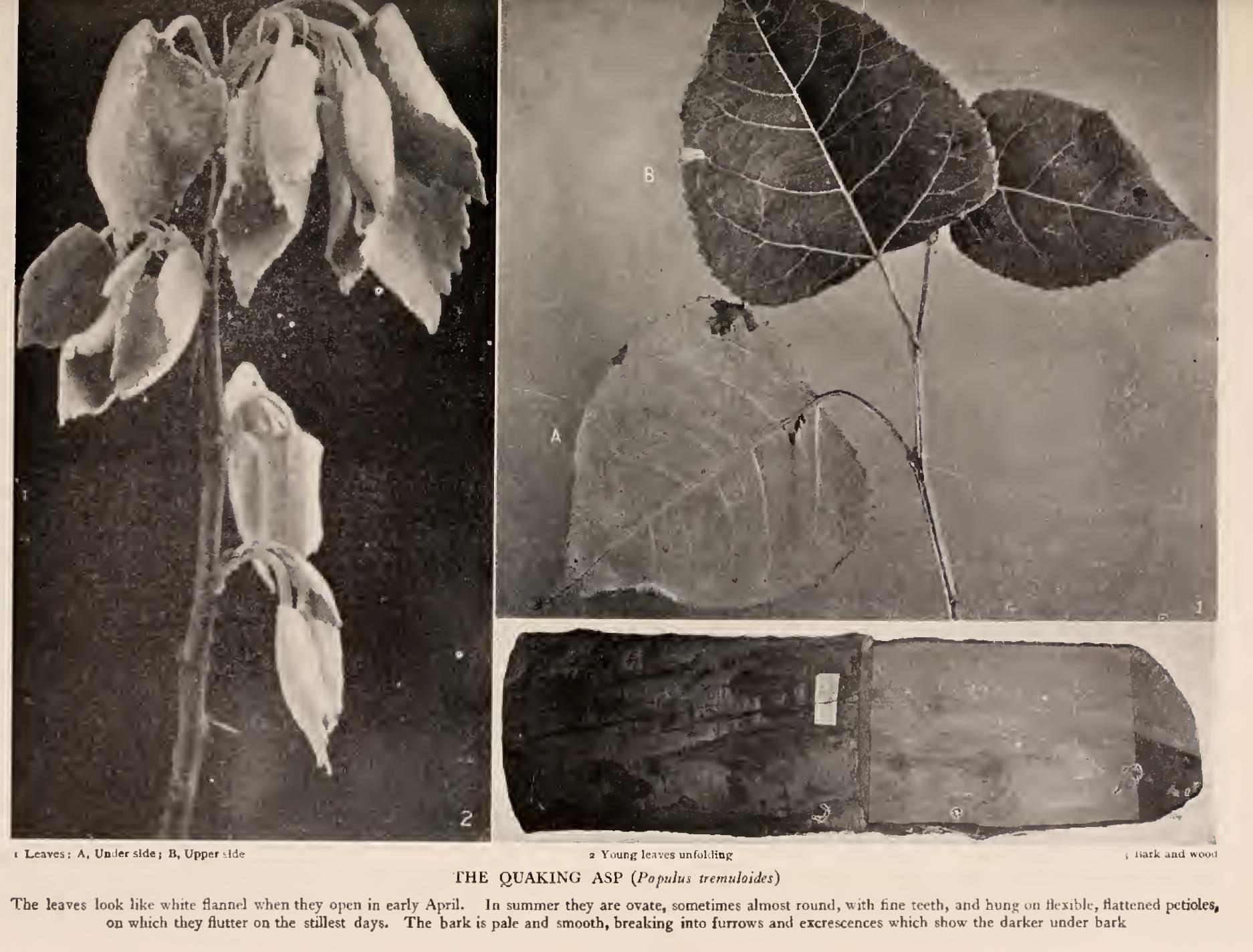
There is no mystery in the trembling of these aspen leaves. Examine one. The stem is long and flexible. It is flattened in a plane at right angles with the blade of the leaf. Now, given a leaf that is dangling from its twig, and has four flat surfaces exposed, it is a cautious breeze indeed that is able to get by without disturbing the leaf's unstable equilibrium. Given, a treetop of leaves similarly made and hung, and you have a quaking asp. It waves you an invitation to examine, and see if the explanation above is not correct.
Homer's famous simile based on the leaves of poplar trees is not ungallant as that of Gerarde, who compares them to "women's tongues which seldom cease wagging." The most delicate colouring is found in this aspen tree. The pale bark takes on a cool, greenish tinge in earliest spring. The furry catkins flush pink with their silvery grey silk. The opening leaves unroll, soft and white, like flannel—"ju' luk a kitten's ear," each one of them, to quote Uncle Eb. They pass through various tones of rose and olive on the way to their lustrous adult stage. Every day from early March till May it is worth while to go by a copse of trembling aspen and look up to see what new phase of the trees' life history has opened since last we passed that way.
Large-toothed Aspen (Populus grandidentata, Michx.)— Narrow, round-headed tree, 5o to 75 feet high, with stout, angular branchlets, roughened by leaf scars. Bark dark brown and deeply fissured between broad ridges on old trunks; grey-green on limbs. Twigs smooth, pubescent at first. Wood soft, weak, pale brown; sap wood white. Buds ovate, pointed, scaly, waxed. Leaves ovate to roundish, heart shaped at base, acute, with sparse, irregular-rounded teeth; 3 to 4 inches long, 2 to 3 inches wide, thick, green, with pale somewhat tomentose linings; petioles slender, laterally flattened, 2 to 3 inches long. Flowers, April, dicecious, in pendulous catkins, 2 to 3 inches long; staminate red from anthers; pistillate green from spreading stigmas; bracts deeply cleft. Fruits, hairy capsules, 2-valved, thin walled, slender, crooked, filled with minute seeds, each with white, hairy float; May. Preferred habitat, rich, sandy loam, on borders of streams. Distribution, Nova Scotia to Minnesota; south to New Jersey, and on Alleghanies to North Carolina, Tennessee and Kentucky.
The coarse, thick leaves with large, rounded teeth on the margins, distinguished this great-toothed aspen from its dainty cousin, the quaking asp, with which it is often associated in the woods. In fact, the tree is coarser throughout, the branchlets stout and the buds downy, so no one who is interested and ob servant will have any trouble to tell them apart.
The Cottonwood (P. angustifolia, James) has lanceolate leaves, more like a willow's than a poplar's. The margins are finely saw toothed, the petioles short, and the texture thin and firm. It is easy to see that the tree is a poplar, the flattened petiole alone being a sufficient clue. The tree lines the banks of mountain streams of the Rockies, 5,000 to io,000 feet in elevation. It grows from 40 to 6o feet high, a narrow pyramid of slender limbs.
The Cottonwood (P. acuminate; Rydb.), with scarcely wider leaves than the preceding species, is a compact, round-headed little tree that grows on stream borders and arid foothills of the Rocky Mountains from 'British Columbia to southern Nebraska and Colorado. Its distribution is not fully ascertained. It is used for fuel and planted for shade in com munities within its natural range.
The Mexican Cottonwood (P. Mexican, Wesm.) grows, a graceful, wide-spreading tree of medium size, along mountain 15o streams near the Mexican border of Arizona and New Mexico. Its rhombic, long-pointed leaves are very coarsely toothed, and when they first unfold are dark red, soon becoming yellow-green and leathery. The bark is grey or almost white.
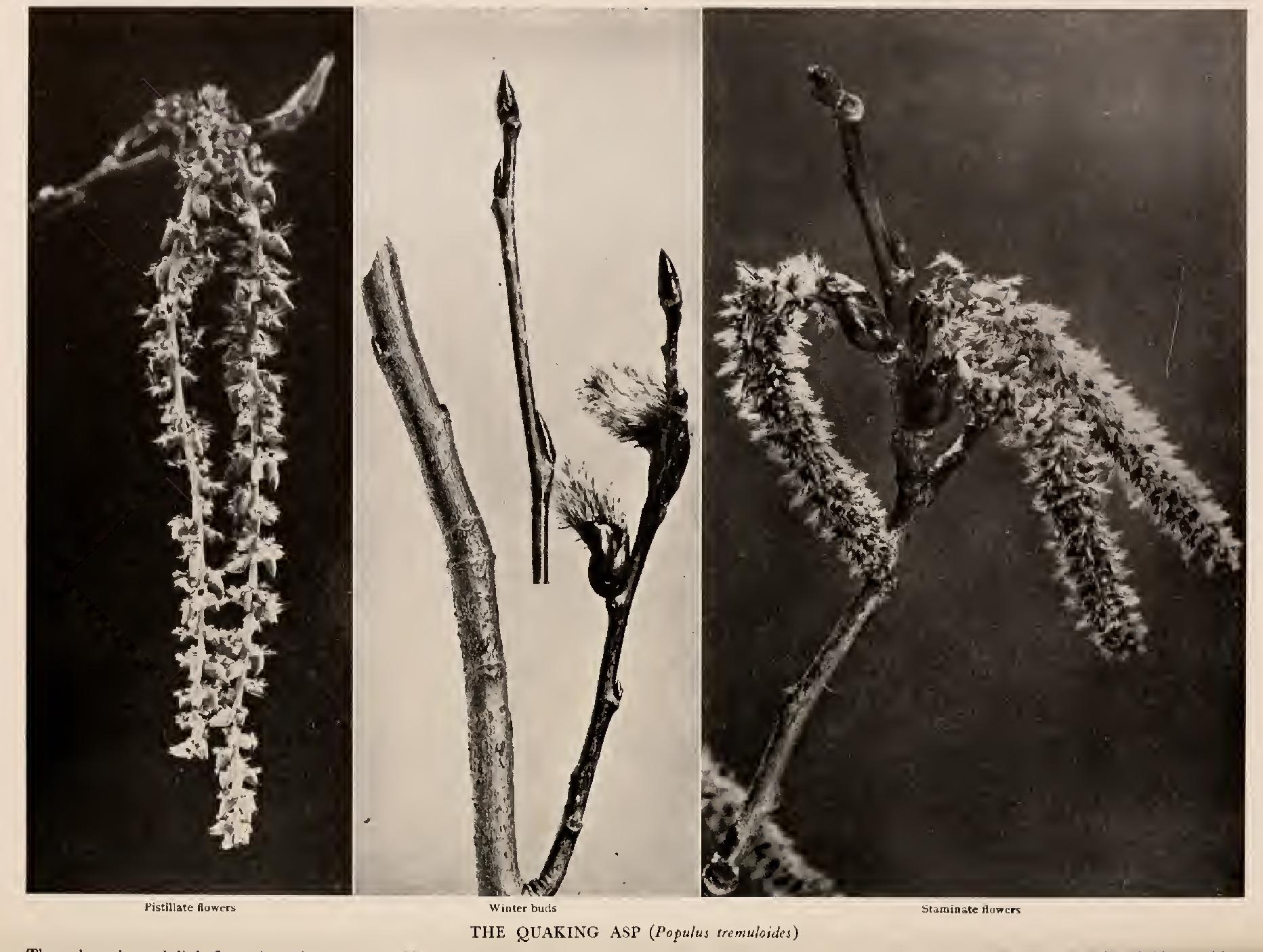
Balm of Gilead (Populus balsamifera, Linn.)—Large tree with stout trunk, 75 to ioo feet high. Bark grey, broken into broad ridges; branches greenish, smooth or with warty out growths. Wood pale, soft, compact, weak, light brown. Buds long, slender, shining with yellow wax. Leaves broadly ovate, acute, finely and bluntly toothed, thick, shining, dark green, pale, often rusty beneath, 3 to 5 inches long; petioles slender; autumn colour yellow. Flowers, March, before leaves; aments drooping, hairy; stamens 18 to 3o, crowded on disc; anthers pale red; pistils green with spreading stigmas; flowers scattered. Fruits, May, capsules scattered on stems 4 to 6 inches long; seed brown, buried in cottony float. Preferred habitat, moist or dry soil near water. Distribution, Newfoundland to Hudson Bay and Alaska; south to Maine, New York, Michigan. Nebraska, Idaho and British Columbia. Uses: Well worthy of planting for shade, ornament and shelter.