How a Yacht Is Sailed
wind, tack, sail, fig, yachts, port and line
HOW A YACHT IS SAILED The method and principle upon which a yacht race is sailed may be described in a way easily understood by any landsman. The course is usually a triangle or a square. Suppose the starting and finishing line is between the two mark boats XY (fig. I) ; and suppose the start to be in an easterly direction. Suppose also the direction of the wind to be north. Then the course would be from the starting line round the marks or buoys placed at B, C, D, A, and back to finish across the line XY. The start of a yacht race is at a fixed hour, say r i A.M. Two signal guns are fired, one at 10.55 to prepare, and the other at r r A.M. to start. During the five minutes interval between the guns, the yachts may sail about anywhere they like, "jockeying," so as to try to get into the best position as the second gun fires. The object of the steersman is to sail his yacht across the line XY at full speed immediately after the starting gun has fired.
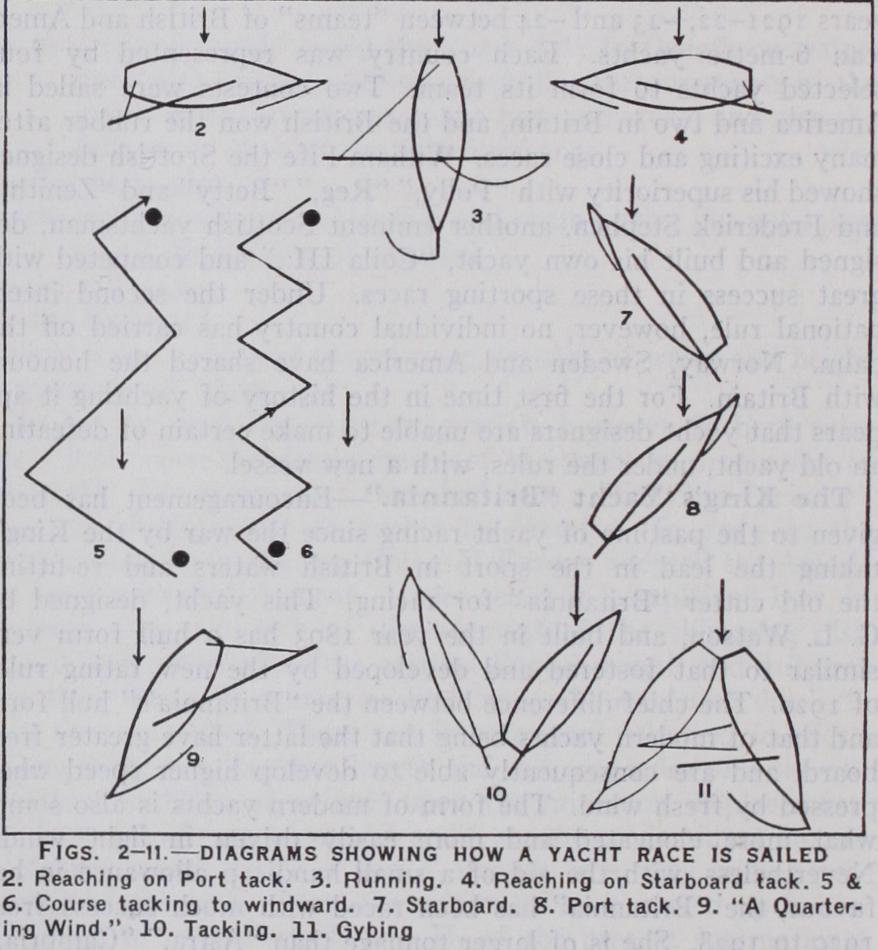
The first leg of the course is easterly, from the line XY to the point B. This is sailing at right-angles to the wind and is called "reaching." The yacht sailing from XY to B is said to be "reach ing on the port tack" because the wind is blowing upon her "port" or left hand side. When reaching, the sails are trimmed as in fig. 2. The next course is from B to C. This is dead before the wind and is called "running." When the wind is dead aft, or nearly so, and the yacht is running before it, the balloon sail called the spinnaker is set. The spinnaker must be taken in before the yacht gets to C. When running, the sheets are eased right off as in fig. 3. The third course is from C to D, this is again reaching, as from A to B, but the yacht is now "reaching on the starboard tack" because the wind is blowing upon her "starboard" or right hand side (fig. 4).
The yacht having reached to D, now has to sail from D to A. This is absolutely dead against the direction of the wind. The yacht cannot sail dead against the wind but only at an angle of rather less than 45° from it. The yacht, therefore, has to "tack to windward," or "turn to windward," making a zig-zag course. She may either make long tacks (fig. 5), or short tacks (fig. 6), which ever method will take her quickest from D to A. This turning to windward is the greatest test of the yacht's ability, and also of the ability of the helmsman. Much more distance and time may be
gained or lost during the zig-zag than at any other period of the race. When sailing to windward the sheets are hauled very close. In fig. 7 the yacht is close hauled on the starboard tack, and in fig. 8 she is close hauled on the port tack. Having arrived at A, the course is next a reach on the port tack, with the wind on the left side, from A to the finishing line XY. As the bowsprit of the win ning yacht crosses the finishing line, her winning gun is fired. A gun is usually fired for the first three yachts in a race. If the course had been a triangular course from the start to BD, A and back to the finish, then the leg of the course BD would have been at an angle "between running and reaching." To sail off the wind from B to D in this manner is called "a free reach" or "a quarter ing wind," or to sail with "wind on the quarter." This is the fastest point of sailing, appreciably faster than running with spinnaker be fore the wind. With a quartering wind the sheets are trimmed as in fig. 9. A yacht is said to "tack" when she changes her course from port tack to starboard tack, or vice versa, when sailing to wards the wind. Similarly, she is said to "gybe" when she changes her course from port tack to starboard tack, or vice versa, when sailing "off" or away from the wind. The boom in "tacking" and "gybing" passes from one side to the other, as in figs. i o and Yachts are not allowed to collide during the five minutes interval between the guns before the start or during the race. Those over taking must keep out of the way of those which are being over taken. Those with the wind on their left (port) side must keep out of the way of those with the wind on their right (starboard) side. When, also, two vessels find themselves converging, the yacht which is to windward must keep clear. When rounding or passing marks at the corners of the course or other obstructions, the outside yachts must give the inside yachts room, and no yacht must hit or touch any of the marks or buoys marking the course. The length of the course varies with the size of the competing yachts. Large yachts sail twice round a course of 20M.-a dis tance of 4o miles. Small craft may sail a course of 6 or 8 miles.