How a Yacht Is Sailed
centreboard, york, cutter, cup, beam, yachts, club, design and sloop
Development of Design.
At the time of the formation of the New York Yacht Club, and for many years thereafter, the designing of yachts was not pursued as a science. Most of the yachts were turned out by local builders, working by "rule-of thumb," each builder having his own particular fad or fancy for some particular type or model, these models being influenced largely by the environment and water conditions. With the shoal waters of the Atlantic coast, American yachtsmen as a whole pre ferred broad, shoal centreboard craft, with great initial stability, which enabled them to carry a large spread of sail without a great amount of ballast. These boats were very fast in smooth water. The centreboard was an adaptation of the leeboards of Holland, but was lowered through the keel instead of over the side.
On New York waters, therefore, under the stimulus of the New York Yacht Club, a large fleet of light draft centreboard yachts soon made its appearance, the boats being modelled by such noted builders as J. B. Van Deusen and "Pat" McGiehan, or such well known boat sailors as Phil and Joe Ellsworth, or the Van Buskirks. These men had practical experience, but little technical knowledge of designing, and little real development was made during this period, it being an easier matter to rely on beam for stability and great sail area for speed, rather than on refinement of design. In New England, also, the centreboarder was becoming the popular type when speed was the consideration. All of the yachts of the period were then built on the accepted theory of full bow and fine, easy run, or the "cod's head and mackerel tail" principle, and de sign had not progressed as far as in England. Even very large yachts were centreboarders. In 1845 John C. Stevens built the "Maria," a sloop 92ft. in length, which proved very fast.
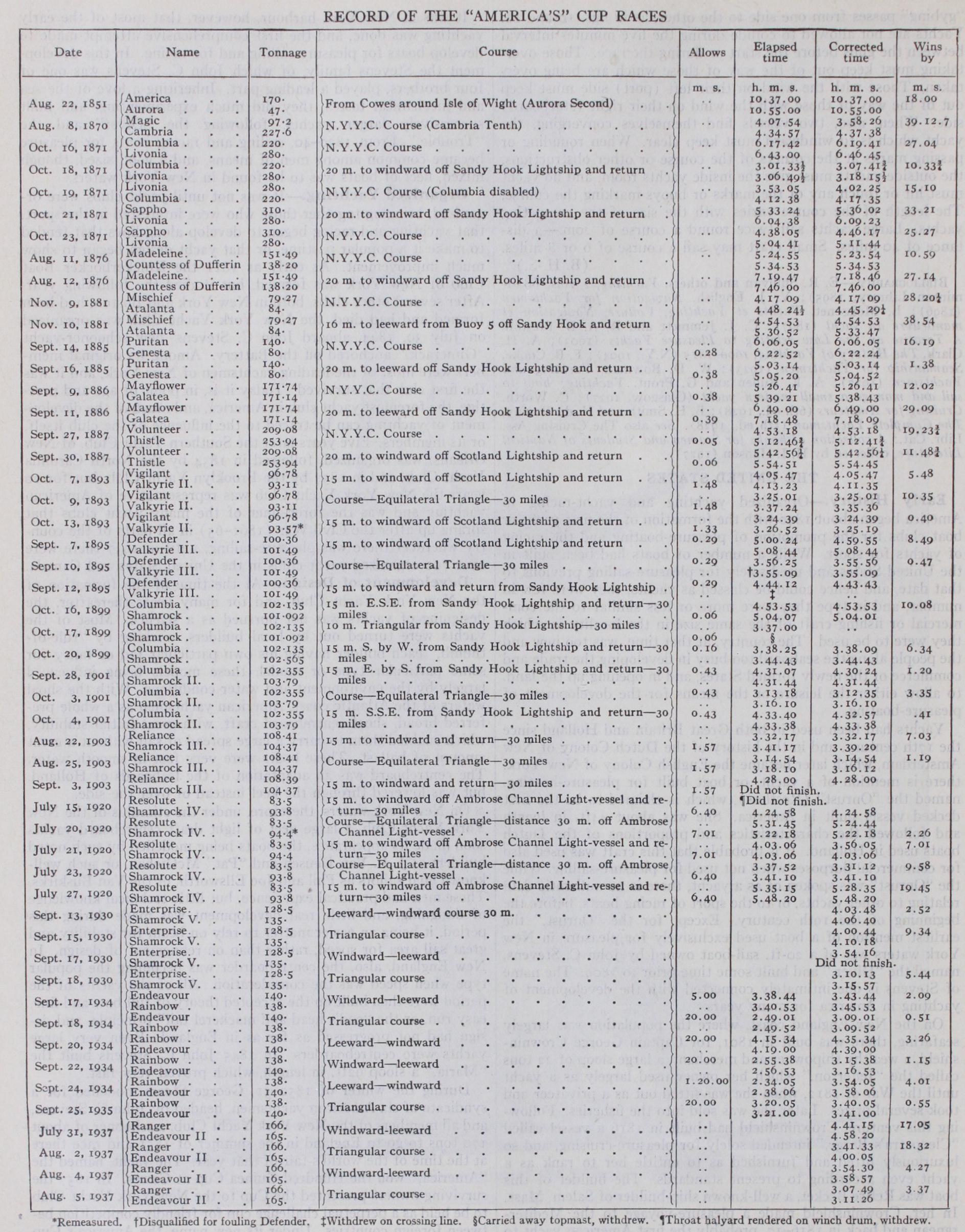
During the winter of 1850-51, George Steers modelled for a syndicate of six American yachtsmen, headed by John C. Stevens, and all members of the New York Yacht Club, a schooner of about 170 tons to go to England in the summer of 1851 and race there at the time of the world's fair of that year. The yacht, named the "America," won the Hundred Guinea Cup at Cowes. In 1857 the surviving owners presented the Cup to the New York Yacht Club to be held as a perpetual challenge cup for friendly competition be tween foreign countries. Under its new name, the America's Cup became the most coveted yachting trophy in the world. Sportsmen from England and Canada have ventured forth with challenging yachts, but, as the chart above reveals, with no success.
In 1876, the advocates of the shoal-draft boat were given a rude jolt when the new 14o-ft. centreboard schooner "Mohawk," built for Commodore W. T. Garner, of the New York Yacht Club,
was capsized off Staten Island, drowning her owner and several guests. She was lying at anchor with her sails up and sheets made fast when she was struck by a squall, heeled down on her beam ends, where she filled and sank. A few years after the "Mohawk" disaster Cary Smith turned out the sloop "Mischief," called a "compromise sloop," a centreboard boat, but deeper than the "skimming dishes," with more shape, and relying not alone on beam for stability. "Mischief," 67ft. long, successfully defended the America's Cup in 188i against the Canadian centreboard chal lenger "Atalanta." That same year there arrived in New York from Scotland a little cutter that was to exert a powerful influ ence on the future of yacht design in America, and that strength ened the growing band of yachting enthusiasts who were looking for something better in design than the wide, shoal centreboarders. This was the "Madge," designed by George L. Watson, a young British designer, and owned by James Coats, of Paisley, who had recently lived in America. "Madge" was a typical British cutter, 46ft. long over all, 384ft. on the water, and only 7f t. 9in. beam. She was shipped to New York. That first summer she won nearly all her races against the crack centreboarders, most of them being won without calling on her time allowance. The success of the "Madge" put centreboard advocates on the defensive.
The discussion was still acute when the next challenge for the America's Cup was received, in 1885, from the British yacht "Genesta," a typical narrow cutter. There was much difference of opinion in America as to what type to build to meet the chal lenger ; but a group of Boston yachtsmen, less committed to shoal draft than those around New York, went to a young Boston naval architect, Edward Burgess, and commissioned him to design a large sloop to defend the cup. Burgess was familiar with the cutter type, recognized its good points, and also knew the centreboard boats as they had developed around Cape Cod. Discarding all tradition, he decided to strike out in a radical way and design a yacht that to him appeared best suited to the conditions to be met, and combining the best points of the cutter with the wider beam and shoaler hull of the centreboard sloops. The result was the "compromise cutter," "Puritan," 81 ft. long on the water. On this length, "Puritan" had a beam of 221ft., draft of 8f t. 8in., and a centreboard. She had the plumb stem of the cutter and was deep enough to get a beautifully modelled underbody. "Puritan" proved most successful, beating the shoal-draft defender built in New York handily and defeating the cutter "Genesta," the challenger.