Nature of
tube, x-ray, gas, cathode, time, tubes and introduced
The earliest form of electrical generator to operate the vacuum X-ray tube was the induction coil, which in Rontgen's time was of a very primitive pattern. The discovery of X-rays, however, gave a great stimulus to the development of this piece of apparatus and comparatively soon afterwards mammoth induction coils were constructed having an electric potential of many thousands of volts and capable of giving electric sparks of i or even 2 ft. in length.
X-ray Tubes.
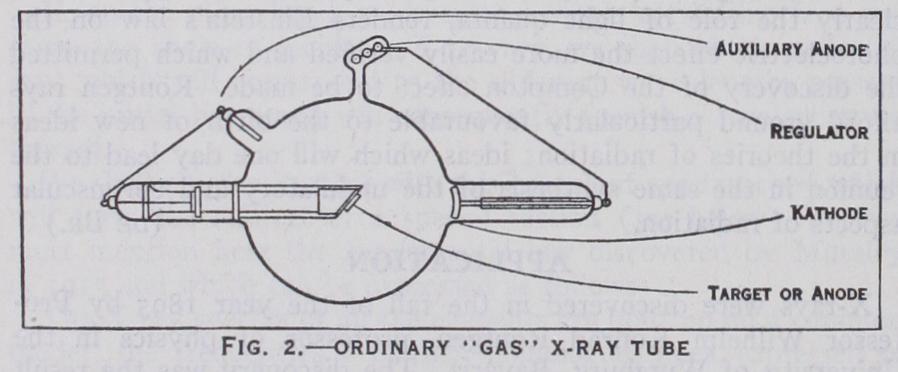
One of the earliest experimenters with X-rays, Sir Herbert Jackson, introduced the "focus" tube some two months after Rontgen's discovery. In this tube the cathode stream was "focussed" by means of a concave negative electrode on to a small area of a metal target which was mounted in the centre of the bulb. The actual focussing of the cathode stream, however, was not a new thing, as it had been demonstrated by Sir William Crookes some 20 years previously to show the heating effect of the cathode stream. The X-ray tube introduced by Sir Herbert Jackson has remained the standard type of tube for over 3o years, except that refinements and modifications have been added from time to time to legislate for ancillary developments. The early tubes depended for their operation upon the presence of a certain amount of residual gas, which became ionized and so provided the electrons constituting the cathode stream. Such tubes, known as gas tubes, are still in use and have many advantages.
To provide for the gradual absorption of the residual gas which takes place during operation various devices have been introduced from time to time whereby small fresh supplies of gas can be introduced into the bulb. A common form of such a regulator, as it is called, consisted of a small piece of mica mounted in a small auxiliary tube and arranged so that the mica could be heated, the effect of which was to drive out a little air from between the layers of mica, which passed into the main bulb. In 1898 the self regulating X-ray tube was introduced. Heated regulators were made automatic in operation by attaching wires to the regulator terminals, which could be placed quite near to the main terminals of the tube. As the gas in the X-ray tube becomes less its re sistance to the passage of the current increases, and finally it ar rives at a condition where it is easier for the discharge to jump from the main terminal to the regulator wire than to pass through the tube. The passage of the current through the regulating sub
stance releases a little gas which passes into the main bulb, the resistance of which is lowered, and the discharge once more passes normally through the X-ray tube. In the early tubes platinum was generally used as the target because of its very high melting point.
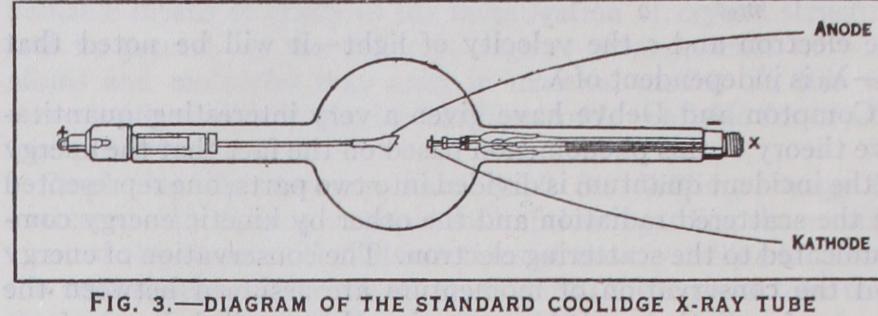
In 1913 a new type of X-ray tube was introduced by Dr. W. D. Coolidge, of Schenectady, U.S.A. Its advent was the result of a considerable amount of work that had been done on thermionics by many investigators, notably Fleming and Richardson. The new tube is entirely independent of residual gas and depends upon the evaporation of electrons from an incandescent filament to form the cathode stream. The target of the Coolidge tube is of massive tungsten. The use of this highly desirable metal in the form of a massive target followed the valuable work done by Dr. W. D.
Coolidge on the metallurgy and hot working of metallic tungsten. Another form of hot cathode X-ray tube was invented about the same time by Lilienfeld in Germany, in which the electrons were produced in a reservoir and "boosted" by an auxiliary high tension circuit through a small hole communicating with the main portion of the tube, where they were taken in hand by the main high tension circuit and shot across to the target. By virtue of its extreme simplicity of operation, however, the Coolidge tube enjoys great popularity.
Still another type of hot cathode tube is the "Metalix," intro duced by Philips of Holland; a novel feature of this tube is that it is cylindrical and narrow in shape and a large portion of the tube is made of metal. The X-rays emerge only from a com paratively small opening either at the end or in the centre. The tube is, therefore, self "protecting" and does not require the heavy and complicated tube boxes which safety of operation demands for other types of tube.
Hot cathode X-ray tubes operate at saturation voltage, and the penetrating power and X-ray intensity, which depend upon voltage and current, are adjustable and controllable independently; a state of affairs which it is impossible to realize in the older "gas" X-ray tubes.