Nature of
x-ray, voltage, x-rays, transformer, current, power and light
Electrical Apparatus.
Although the induction coil is still used to provide the high tension electricity to operate X-ray tubes, it has largely been supplanted by the more consistent piece of apparatus known as the high tension transformer. The voltage delivered by such generators in common use for X-ray work may be anything from 6o,000 to 250,000 volts. The normal voltage for medical and surgical radiography is about ioo,000. X-rays for the treatment of disease, however, are required at 250,000 volts and even more.
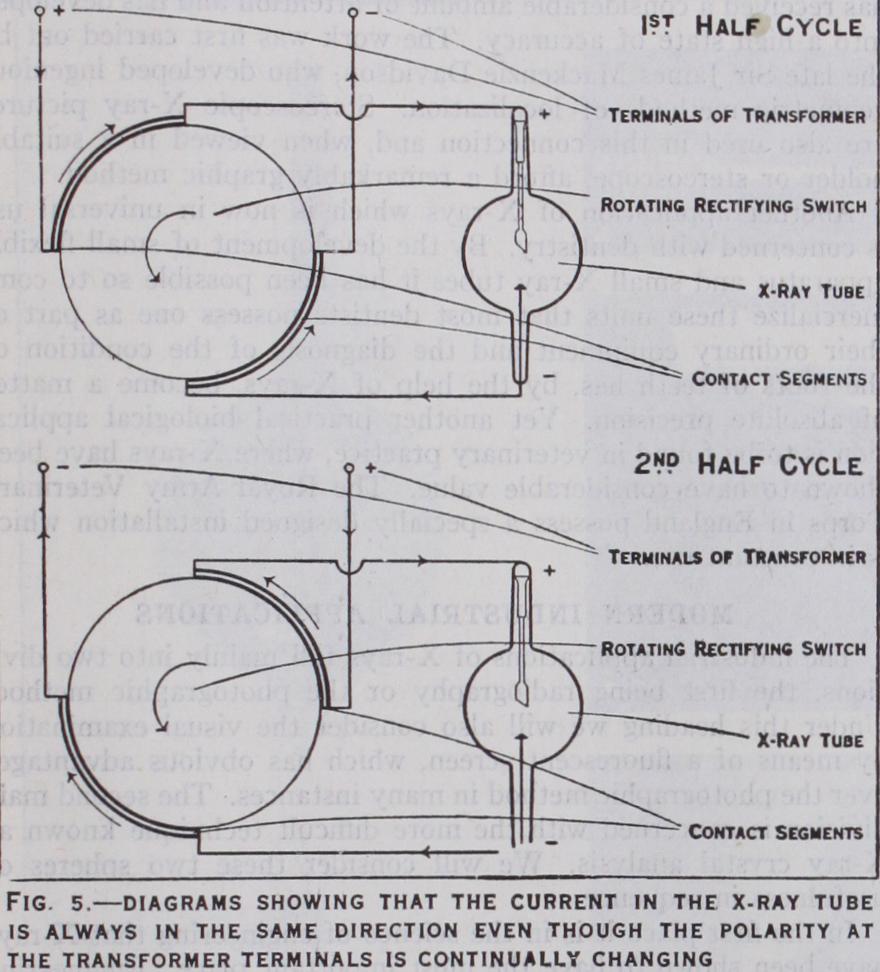
The type of voltage normally yielded by a static high tension transformer is what is known as alternating; in other words, the current passes first in one direction and then in the other, the duration of each impulse being very small (there are about ioo such impulses per second in the usual type of X-ray transformer). Such an alternating supply is unsuitable for the generation of X-rays. The voltage impulses must all be in the same direction, consequently arrangements have to be made to suppress or re verse one set of impulses. The device generally employed for this purpose is a switch, the contacts of which revolve in harmony with the voltage impulses of the transformer as it is rotated by a motor run synchronously with the electrical pulsations. The electrical connections of this switch or commutator are so arranged that only current in one direction is allowed to pass through the X-ray tube. Another method of "rectification," as it is called, is by means of large thermionic valves.
A transformer and rectifying device such as we have outlined produces what is known as a pulsating voltage. This is because each little voltage impulse grows in strength and dies away, and as it is only a portion at the maximum that is utilized in an X-ray tube it follows that each impulse of current is followed by an interval of no current. There is another type of X-ray transformer so arranged that certain electricity storers or condensers, as they are called, are connected in the circuit in such a way that they discharge a current during each of these intervals and so produce a constant or continuous voltage. The latter type of transformer is in fairly general use for the purpose of X-ray treatment and also for the radiography of metals.
Nature and Properties.
X-rays have the power of penetrat ing materials which are opaque to ordinary light. This property was immediately appreciated by Röntgen. Another property, which in fact led to their discovery, is that they cause certain chemicals, for example barium-platinocyanide, to fluoresce; in other words, to emit visible light. This property is made use of in the familiar X-ray fluorescent screen, which is a piece of card board or other material covered with fine crystals of a suitable salt. Any object placed between the source of the X-rays and the screen throws a sharp shadow on the brilliantly glowing sur face. X-rays affect a photographic plate in exactly the same way as does ordinary light, the only difference being that they act equally well whether the plate is wrapped or unwrapped. They have certain other chemical properties ; for example, they cause iodine to be freed from a solution of iodoform in chloroform. They have also certain biological effects which are very imper fectly understood and form the subject of extensive research.
One of the most important properties possessed by X-rays is their power to change a non-conducting gas into an electrical conductor. It is known as the power of ionization. Like light, X-rays may be polarized and they may be diffracted by a crystal, the latter being a property of the greatest importance inasmuch as it forms the basis of the modern science of crystal analysis.
Early Applications.
The power of X-rays to penetrate opaque objects depends very largely upon the density of the material. It was very soon realized for example that flesh was more transparent to the rays than bone, and consequently it was possible to see the bones in the body. This fact was immediately recognized as being of the utmost importance and it was at once ordered by the German minister of war that the subject should be investigated from the point of view of its possible service to military surgery.
We said that the penetrability of a substance is governed by its density, but by April 1896 it had been determined that the X-ray absorbing power of a chemical element depended upon its atomic weight, which is a much more accurate statement.