The North Sea and Channel 1914
river, flotilla, konigsberg, arrived, armed, nov, attack and ships
German South West Africa.
The attack upon this colony, started in Aug. 1914 by the South African Government, was de layed by the Boer revolt, but, the revolt having been suppressed, it was resumed early in 1915. The Union Army, escorted by the battleships "Albion," the "Astraea" and two armed merchant cruisers occupied Walfisch Bay and Swakopmund in January. The "Albion" was then sent to the Dardanelles and the "Astraea" to the Cameroons and, with the exception of some naval armoured cars the campaign became a purely military one. It was brought to a successful conclusion in July 1915 by the surrender of the colony.
German East Africa.
The German cruiser "Konigsberg" was at sea on the outbreak of war and on Aug. 6 she made her only prize in the Gulf of Aden. Two days later, the "Astraea" and "Pegasus" appearing off Dar-es-Salam, the Germans blocked the entrance to the port, but agreed that the ships there should be considered British prizes, and the wireless station was destroyed. The "Konigsberg," her base closed against her, was not heard of until Sept. 20, when she appeared off Zanzibar and finding the "Pegasus" with engines disabled in the roadstead, sank her at her moorings. Admiral Charlton, with the Cape squadron, was, by now, on the "Konigsberg's" trail and she took refuge amidst the swamps of the Rufiji River, where she was located by the "Chat ham." On Nov. 1 the East African Expeditionary Force, escorted by the battleship "Goliath" and cruiser "Fox," arrived from India. On Nov. 2 the troops landed at Tanga, under cover of the "Fox," but the attack made two days later was repulsed and the troops were re-embarked.
Following this reverse no serious military operations against the colony were undertaken until early in 1916. The 600 miles of coastline, with its many harbours, remained in the hands of the Germans and it was not until March igis that ships could be spared to establish an efficient blockade. Meanwhile a strict watch had to be kept upon the "Konigsberg" in the Rufiji River and several relief ships slipped through with arms and stores for the colony. On Dec. 14, boats sent in to Dar-es Salam to take possession of the prizes, were fired upon and the town was then bombarded and the ships sunk. In the Rufiji River a ship was sunk to block the "Konigsberg" in, but the cruiser was unapproachable until the arrival of shallow draught ships and aeroplanes. On June 3, 1915 the small monitors "Se vern" and "Mersey" arrived with four seaplanes, and a month was occupied in preparing these craft for their work. On July 6 the
first attack was made, the "Konigsberg" was damaged but the monitors were forced to retire. On July i r the attack was re newed and pressed home by the monitors, and the "Konigsberg" was destroyed.
Persian Gulf and Mesopotamia.
An Indian Division, es corted by the "Ocean," and the sloops "Espiegle" and "Odin" arrived at Bahrein late in October and on the 3oth received orders to commence hostilities against Turkey. On Nov. 6, after bom barding Fort Fao at the entrance of the Shatt-el-Arab, the troops landed. Advancing against considerable opposition, supported by the "Espiegle" and "Odin," an entrenched position was estab lished at Abadan by Nov. 1 o. The force pressed forward sup ported by the two sloops and Basra was entered on Nov. 22, and a further advance ended on Dec. 9, in the occupation of Kur nah, at the junction of the Tigris and Euphrates. By this rapid and well planned stroke the command of the Persian Gulf and of the outlet from the Persian oilfields was assured.
In December the "Ocean" was withdrawn to the Dardanelles and the flotilla consisted of the "Espiegle" and "Odin," the vessels of the Royal Indian Marine and a number of armed river steamers and launches. In March of 1915 the "Cho" and four armed boats arrived from Egypt and in the late autumn the first of the new "Fly" class gunboats arrived from England.
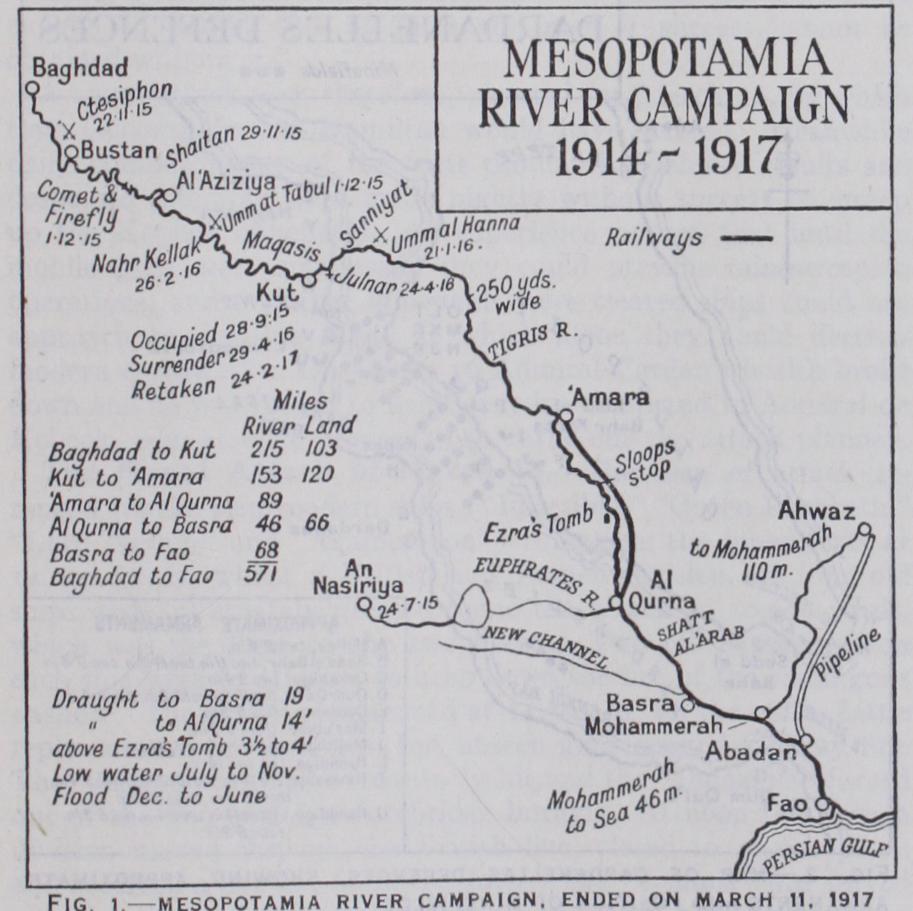
Throughout 1915 the flotilla formed the spearhead of the ad vance of the Army. It protected the oil pipe line by patrolling the Karun River and in April the Euphrates flotilla assisted in defeating the Turkish attack upon Basra. The remarkable amphib ious battle north of Kurnah on May 31, was followed by the dash up the river by the flotilla after the retreating Turks, with General Townshend on board, and the capture of Amara. With the flotilla reinforced by four seaplanes from the Rufiji River, Townshend captured Kut and continued his pursuit of the Turks until he was brought up at Ctesiphon on Oct. 5. The political and military situation in the Near East then led to the illfated attempt upon Baghdad. The naval flotilla consisted of the gunboat "Firefly," the "Comet," two armed launches and four armed horse boats. After the repulse of the army at Ctesiphon, the withdrawal of the river transport was covered by the flotilla with the loss of "Firefly," "Comet" and "Shaitan," which grounded and were abandoned. Townshend reached Kut on Dec. 3, but by the 9th that place was invested and the flotilla was with drawn down river.