The North Sea and Channel 1914
fleet, british, ships, german, submarine, naval, canal, patrol, cruisers and destroyers
Egypt.
By mid-November 1914, the careers of the "Emden" and "Konigsberg" being ended the Indian Ocean was secure. The British cruisers were ordered homewards and Admiral Peirse, in the battleship "Swiftsure," reached Suez on Dec. r and detained in the Canal enough ships to meet the threatened Turkish at tack upon Egypt. During December the "Doris" and the Rus sian cruiser "Askold" made a series of successful raids in the Gulf of Iskanderun and on the Syrian Coast. At the end of January 1915, when the Turkish attack developed, a strong naval force under Peirse's command took up its position in the Canal. The Turks made their attempt on the Canal on February 2 and 3 and were easily repulsed, the Canal traffic being but little interfered with. By Feb. i 1, all threat to the Canal having dis appeared, Peirse was able to send most of his ships to reinforce Carden's forces at the Dardanelles. A further threat to the Canal in April 1915 was frustrated by the presence of strong British and French naval forces.
The Battle of the Dogger Bank.
The year opened with the loss of the battleship "Formidable," which was torpedoed by "U. 24" off the Start on the morning of Jan. 1. In the North Sea the first weeks of January passed quietly, but on the 19th re ports of German activity brought the British battlecruisers into the Heligoland Bight. Nothing was seen, but a Zeppelin raid on the East Coast indicated a repetition of the Scarborough raid. The battlecruisers remained concentrated in a position south of the Dogger Bank, supported by the Grand Fleet battleships to the northward. On the morning of the 24th the Germans were sighted and there followed the battle of the Dogger Bank (q.v.). The German squadron was driven back to its base with the loss of the cruiser "Blucher" and two battlecruisers badly damaged. Beatty's flagship "Lion" was severely damaged but returned safely to Rosyth. After the Dogger Bank action a change was made in the command of the High Sea Fleet and a policy of extreme caution was initiated. The German fleet put to sea only to cover minelaying operations and always retired behind its minefields on the approach of the enemy. Four of these "one day out and one day back" sorties in March, April and May were threatened by the Grand Fleet in force and the Ger mans retired.
The Baltic.
In the Baltic the Russian fleet, assisted by a few British submarines, was successful in holding the older ships of the German fleet in check. In June a German attempt to land troops in Courland in support of their army was defeated by the Russian destroyers and on July 2 the German minelayer "Albatross" was driven ashore by the Russian cruisers and the cruiser "Prinz Adalbert" was torpedoed and seriously damaged by the British submarine "E. 9." In August a part of the High Sea Fleet made a serious attempt to force the Gulf of Riga, but on Aug. 19 the battlecruiser "Moltke" was badly damaged by a torpedo from submarine "E. 1." The operations were abandoned and for some time the Baltic was the scene of only minor operations, but, in the closing months of 1915, the German iron trade with Sweden was harassed by British submarines, which sank 14 steamers engaged in the trade and the cruisers "Prinz Adalbert" and "Bremen" and a destroyer.
The Grand Fleet.
Improvements in the British intelligence, especially in directional wireless, gave timely warning of any movements of the German Fleet. By the end of the first quarter in 1915, the Allied flank in Flanders was stabilized, supplies to the army were ensured by the grip of the Dover and Harwich forces upon the narrow seas while the northern bases had been made practically submarine proof. These factors led to a general re distribution of the British fleet. The Channel fleet was broken up and most of its ships were sent out to the Dardanelles. The Grand Fleet battle squadrons remained at Scapa Flow and Cro marty and the battlecruisers at Rosyth. During the year the Battle fleet swept down the North Sea to the Heligoland Bight no less than 17 times and many other searches were made of the Danish and Norwegian coasts by the battlecruisers and light forces. During one of these cruises "U. 29" was rammed by the "Dreadnought." The British Navy was short of destroyers until the autumn, when the new vessels began to appear. Until then constant calls were made upon the Grand Fleet for destroyers to assist the auxiliary patrol in hunting submarines. The work of the destroyers was incessant and arduous and due to their effi ciency the Germans gained no major success with submarine or mine against the British fleet during the year. The northern blockade was maintained with increasing efficiency by the roth Cruiser squadron, now composed entirely of armed merchant cruisers. The fleet base at Scapa Flow developed into a greattraining establishment for new personnel. A system of gunnery and other training was organised which brought the many new ships joining the fleet to a state of fighting efficiency in minimum time and new officers and men were trained for the ancillary services all over the world. This year of strenuous work was marked by no outstanding event of ter the Dogger Bank action and it closed with the disaster to the armoured cruiser "Natal," lost by internal explosion at Cromarty on New Year's eve. Dur ing August and September, Zeebrugge and Ostend were several times bombarded by the monitors and other ships of the Dover Patrol, in support of the Allied offensive. The results were in conclusive owing to the difficulties of fire observation and to the fact that the ships, finding themselves outranged by the heavy German shore guns were forced to keep at extreme range. Submarine Warfare.—By the beginning of 1915 the ocean high-ways had been made safe for commerce, but the narrow seas around the British Isles were becoming unsafe for any traffic. On Feb. 17, 1915, Germany declared these waters to be a "War Zone" and announced her intention of using submarines to sink merchant-ships. Thus commenced the submarine campaign (q.v.). In the first quarter of 1915, 38 British ships were sunk by submarines and by Dec. 31 this number was swelled to 259. In the same period 48 ships were sunk by mines and the tonnage loss for the year approached 900,00o tons. For these two forms of warfare against trade Britain was unprepared and the sub marine and minelaying tactics of the enemy produced a situation beyond the capacity of the weak and scattered coastal patrol and minesweeping flotillas. Trawlers, drifters, yachts and small steam and motor vessels of all kinds were armed to reinforce the flotillas. By the beginning of 1915, no less than 75o of these craft were in commission and their numbers were rapidly swelled at the opening of submarine warfare. By August 1915 the auxiliary patrol was a complete organization and the coastal waters were divided into twenty-one patrol areas. In each area destroyers and auxiliary craft were employed in submarine hunt ing, minesweeping, guarding channels, guiding traffic, rescue work and in many other duties. The auxiliary ships were manned by seamen, yachtsmen and fishermen, enrolled in the Royal Naval and Royal Naval Volunteer Reserves. As in days of old, the seafaring population of the country, of all classes, came for ward in the hour of need and in its ceaseless watch around the coast until the end of the war, the auxiliary patrol paid a heavy price and rendered to the country service of incalculable value.
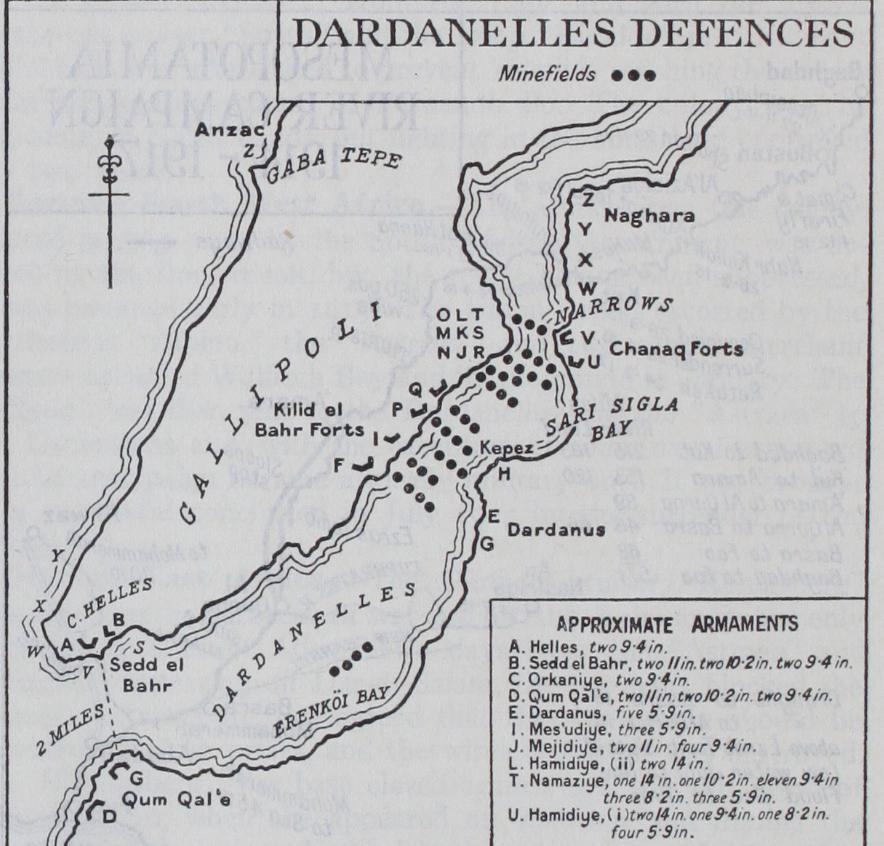
Early in 1915 political complications in the Balkans and the Russian wish for an open Dardanelles to ensure munitions supply, made imperative some demonstration of the Allied power in the Eastern Mediterranean. It was decided to attack the Darda nelles, where, since September, Admiral Carden had been keep ing a close watch. In the redistribution of the British fleet, after the Falkland Islands battle, Carden was strengthened with a num ber of the older battleships and cruisers. The French Govern ment offered a squadron and both naval and military aid was promised by Russia in the Black Sea. By the end of February, Carden's force consisted of the battlecruiser "Inflexible," the new battleship "Queen Elizabeth," 16 old battleships (4 French), 20 destroyers (6 French), a flotilla of 35 minesweeping trawlers and a seaplane carrier were on their way, and a varying number of cruisers and submarines were under his orders. Admiral de Robeck was appointed second in command. The Greek Govern ment handed over the Island of Lemnos as an advanced base and Admiral Wemyss was appointed to command it.
From the first the naval view was that any attack upon the Straits by ships could be only a diversion unless it was backed by a strong military expedition. Steps were accordingly taken to send troops to the Aegean, but the situation on the eastern and western fronts caused delay and it was not until Feb. 20, after the first bombardment, that the decision was made to send out five divisions (4 British and i French).
The First Bombardment.
Bad weather in January made reconnaissance of the Straits difficult, but enough was done to enable Carden to recommend, on Feb. 15, that a naval bombard ment was not a sound operation without a strong military force to consolidate the work of the fleet. But the political situation was critical and Carden was pressed by the War Council to