Worth
french, corps, south, sauer, left and position
WORTH, a village of Alsace, on the Sauer, 6 m. N. of Hage nau, which gives its name to the battle of Aug. 6, 187o, fought between the Germans under the crown prince of Prussia and the French under Marshal MacMahon. The battle is also called Reichshoffen and Froschweiler.
The events which led up to the engagement, and the general situation on the 6th are dealt with under FRANCO-GERMAN WAR. During Aug. 5 the French concentrated in a selected position running nearly north and south along the Sauer Bach on the left front of the German III. Army, which was moving south to seek them. The position is marked from right to left by Morsbronn, the Niederwald, the heights west of Worth and the woods north east of Froschweiler. East of the Sauer the German III. Army was moving south, when their cavalry found the French position about noon. Thereafter the German vedettes held the French under close observation, while the latter moved about within their lines and as far as the village of WOrth as if in peace quarters.
About 5 P.M. some horses were being watered at the Sauer, when a sudden swoop of the enemy's hussars drove the party back to camp. The alarm was sounded, tents were struck and the troops fell in and remained under arms until the confusion died down, when orders were sent to fall out, but not to pitch the tents. The army there bivouacked, and but for this incident the battle of the next day might not have been fought. A sudden storm broke over the bivouacs, and when it was over, many of the men, wet and restless, broke out of camp and went into Worth, which was unoccupied, though Prussians were only 30o yds. from the sentries. These fired, and the officer commanding the Prus sian outposts, hearing the confused murmur of voices, ordered up a battery, and as soon as there was light enough dropped a few shells into WOrth. The stragglers rushed back, the French lines were again alarmed, and several batteries on their side took up the challenge.
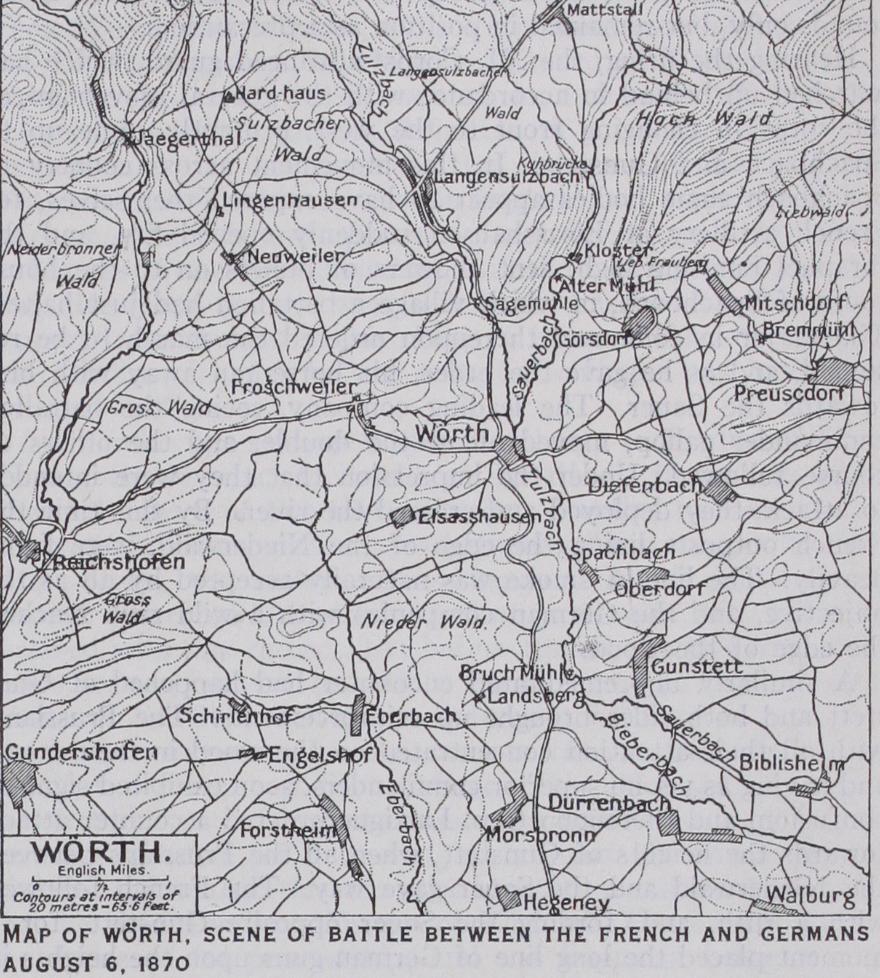
The Prussian guns, as strict orders had been given to avoid all engagement that day, soon withdrew and were about to return to camp, when renewed artillery fire was heard from the south and presently also from the north. In the latter direction, the II.
Bavarian Corps had bivouacked along the Mattstall-Langensulz bach road with orders to continue the march if artillery were heard to the south. This order was contrary to the spirit of the III. Army orders, and, moreover, the V. Prussian Corps to the south was in ignorance of its having been given.
The outpost battery near Worth was heard, and the Bavarians at once moved forward. The leading divisional commander, anxious to prove his loyalty to his new allies—his enemies in i866—ordered his troops to attack, giving the spire of Frosch weiler, which was visible over the woods, as the point of direction. The French, however, were quite ready and a furious fusillade broke out, which was multiplied by the echoes of the forest-clad hills out of all proportion to the numbers engaged. The Prussian officers of the V. Corps near Diefenbach, knowing nothing of the orders the Bavarians had received, were amazed; but when about 10.3o A.M. their comrades were seen retiring, part in disorder, the corps commander, Kirchbach, decided that an effort must be made to relieve the Bavarians. He communicated his intention of attacking to the XI. Corps (Bose) on his left and asked for al: available assistance. A report was also despatched to the crown prince at Sulz, 5 m. away.
Meanwhile the XI. Corps had become involved in an engage ment. The left of the V. Corps' outposts had over night occupied Gunstett and the bank of the Sauer, and the French shortly after daylight on the 6th sent down an unarmed party to fetch water. As this appeared through the mist, the Prussians naturally fired upon it, and the French General Lartigue (to whose division the party belonged), puzzled to account for the firing, brought up some batteries in readiness to repel an attack. These fired a few rounds only, but remained in position as a precaution.