Bends Knots
fig, bight, rope, knot, strand, bend and hitch
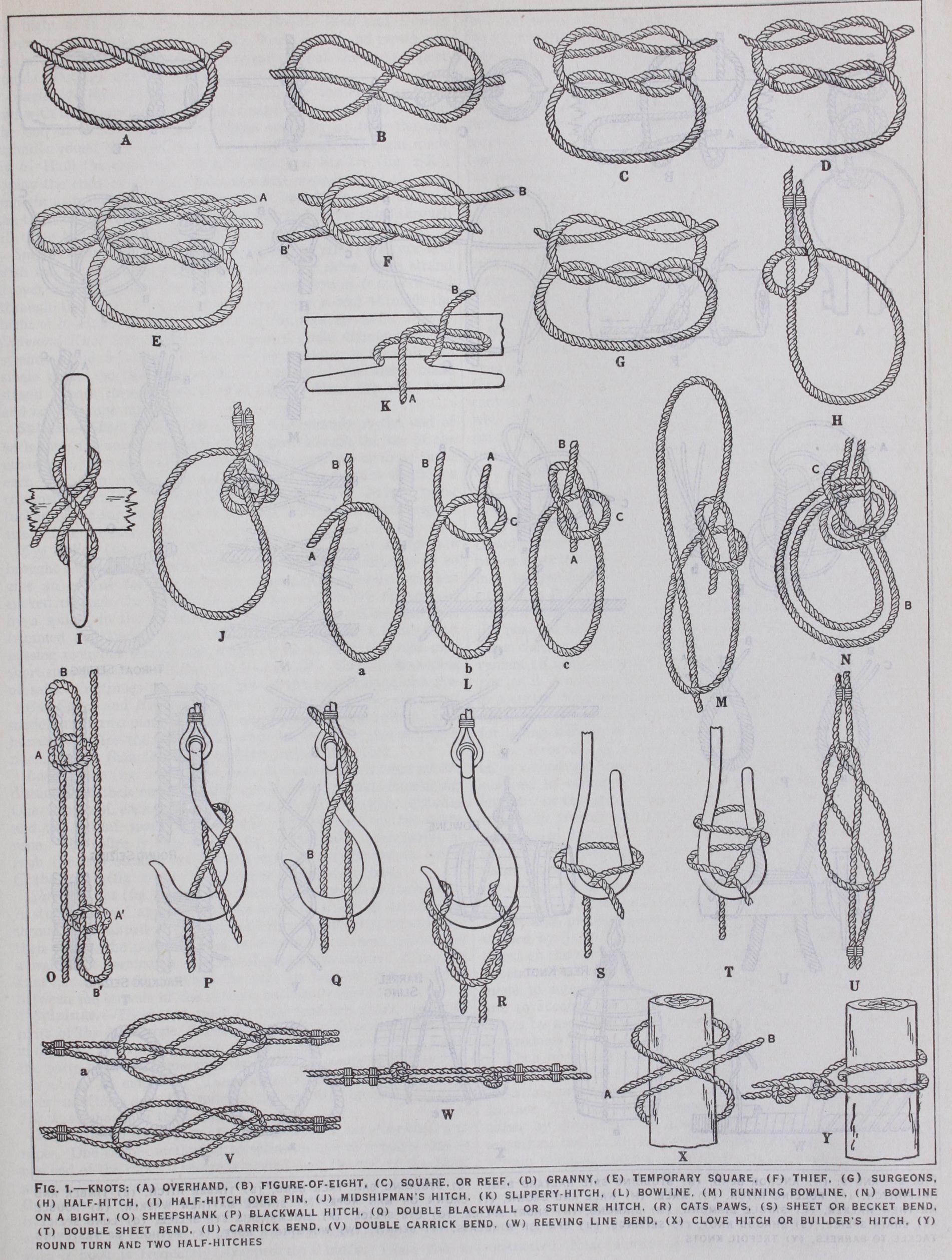
Cat's Paw (fig. i-R). Twist up two parts of a lanyard in opposite directions and hook the tackle through the two eyes thus formed.
Sheet or Becket Bend, also called a Weaver's Knot (fig. -S). Suitable for uniting ropes of different sizes. Pass the end of one rope through a bight of the other, around both parts of the other, and under its own standing part. An ordinary net is a series of sheet bends. Similar in principle is the Double Sheet Bend (fig. 1-T).
Carrick Bend (fig. i-U). Lay the end of one rope over its own part so as to form a bight. Pass the end of the other rope through the bight, etc., as shown in the figure. Double Carrick Bend (fig. i-V). Commonly used for bending hawsers together. If the two parts are of different sizes each part should be seized back on itself. May be tied in either of two ways shown.
Reeving Line Bend (fig. 1-W). Particularly useful when the lines are to be veered through a small pipe.
English or Fisherman's Knot. Used for fastening gut ends, etc. The ends are laid alongside pointing in opposite directions and an overhand is made in each around the end of the other. Two ropes are sometimes united by means of a square knot (fig. 1-C) or by means of two interlinking bowlines, one on each rope.
Clove Hitch or Builder's Knot (fig. i-X). Pass the end a round a spar and cross it over b. Pass it round the spar again and put the end a through the second bight. Two Half Hitches: the half hitch repeated; or a Round Turn and Two Half Hitches (fig. 1-Y). Fisherman's Bend. Take two turns round a spar, then a half hitch round the standing part and between the spar and turns.
An added half hitch round the standing part gives an Anchor Bend (fig. 2-A), used to bend a cable to an anchor; or if in place of the last half hitch the end a is tucked under one of the round turns we obtain a Studding Sail Halyard Bend (fig. 2-B). A Magnus Hitch has two round turns, then a third on the other side of the standing part, with the end through the bight. Stud ding Sail Tack Bend (fig. 2-C). Will not come adrift by the flap ping of the sail.
Timber Hitch (fig. 2-D). Take the end of a rope round a spar, then round the standing part, then several times around its own part against the lay of the rope. Timber and Half Hitch (fig. 2-E).
Used for towing or dragging a spar.
Rolling Hitch (fig. 2-F). Very handy when one rope is to be fastened to the standing part of another or to a spar, as the rope can be put on and taken off very rapidly. For hauling a spar, two round turns are taken round the spar in the direction in which it is to be hauled and a half hitch on the other side of the hauling part.
Knots Worked in the End of a
Knot (fig. 2-G). Unlay the end of a rope and with the strand a form a bight; take the next strand b round the end of a; take the last strand c round the end of b and through the bight made by a. Haul the ends taut.
Wall and Crown (fig. 2-H). Form a wall knot and lay one of the ends a over the knot. Lay b over a and c over b and through the bight of a. Haul the ends taut. Double Wall and Double Crown, or Man Rope Knot (fig. 2-I). Form a wall and crown and let the ends follow their own parts round until all the parts appear double. Put the ends down through the knot.
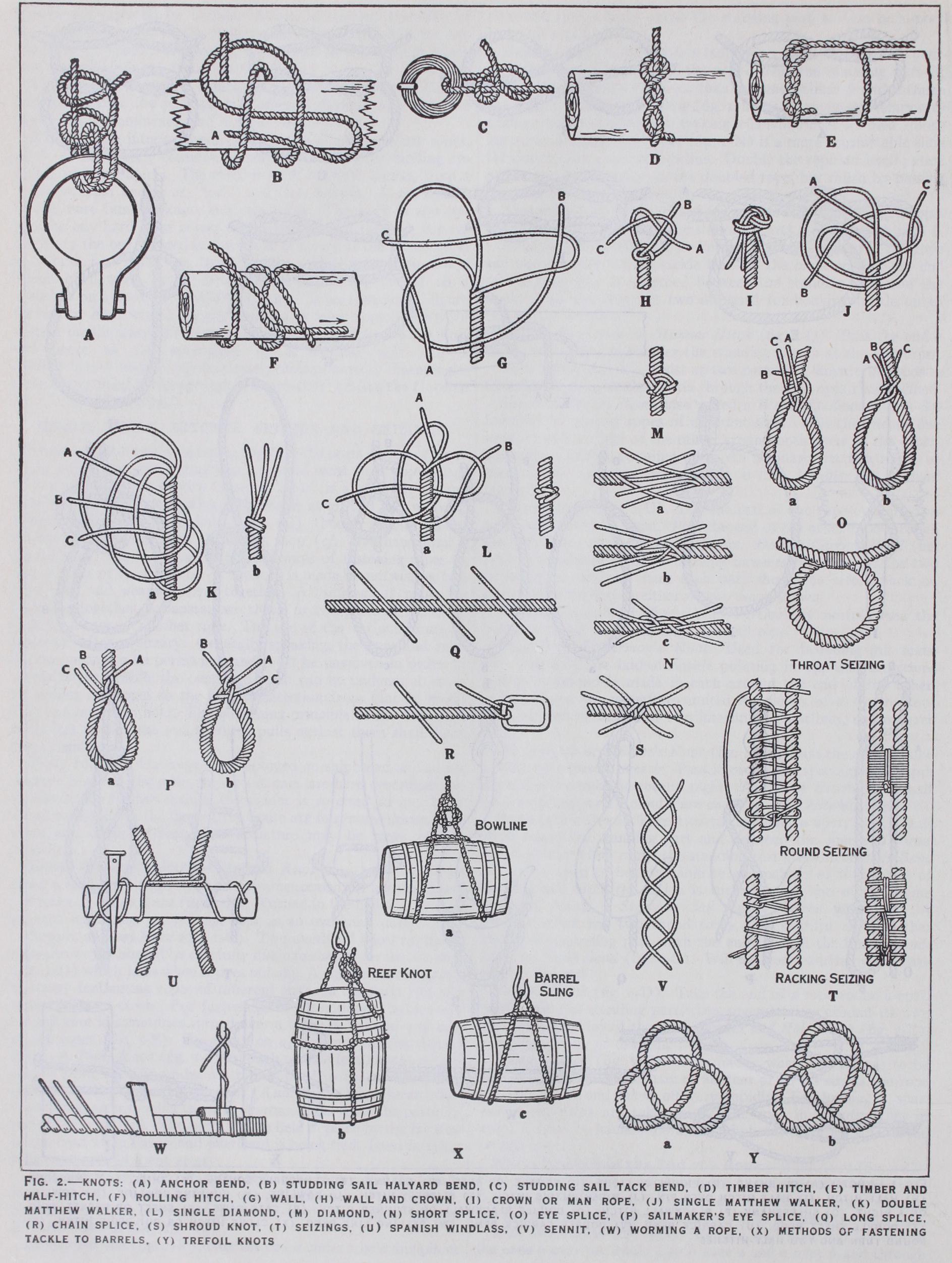
Single Matthew Walker (fig. 2-J). Unlay the end of a rope and with the strand a form a bight ; take the next strand b round the end of a and through the bight made by a; take the last strand c round the ends of a and b and through the bight made by b. Haul the ends taut. Double Matthew Walker (fig. 2-K). Unlay the ends of a rope. Take the first strand round the rope and through its own bight ; the second round the rope, through the bight of the first and through its own bight ; the third through all three bights. Haul the ends taut.
Single Diamond Knot (fig. 2-L). Unlay the ends of a rope and with the strands form three bights down the sides. Pass strand a over b and through the bight of c; pass strand b over c and through the bight of a; pass strand c over a and through the bight of b. Haul the ends taut, and lay the rope up again. Double Diamond Knot (fig. 2-M). First make a single diamond. Make strands a and b follow the lead of the single knot through two single bights, so that they come up on top of the knot; make strand c pass through two double bights. Haul the ends taut and lay the rope up again.