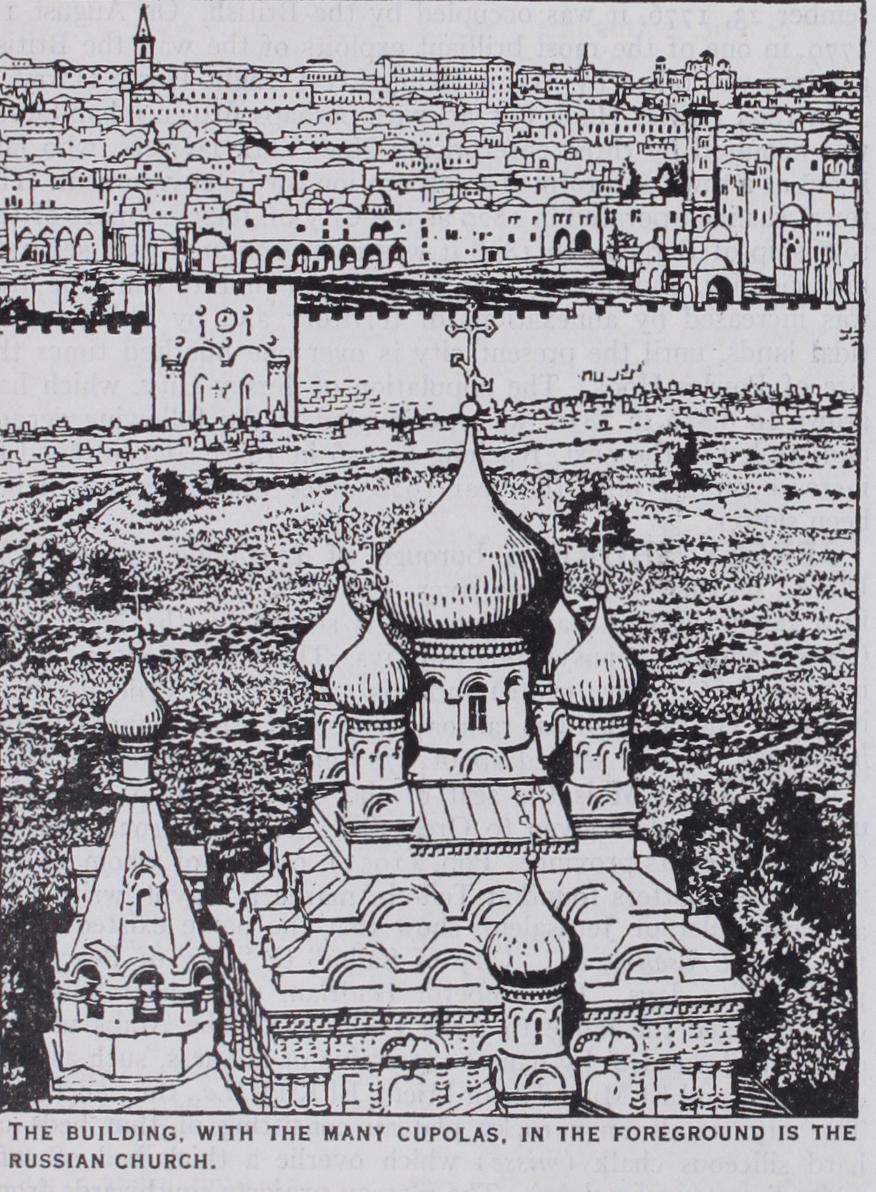
Jerusalem
city, valley, plateau, kidron, west, mean, valleys and holiness
JERUSALEM is the seat of the Government of Palestine under the mandate given to Great Britain in July 1922 and the chief town of its province. Pop. (1931), 90,503, of whom 51,222 were Jews. Letters found at Tell-el-Amarna in Egypt, written by an early ruler of Jerusalem, show that the name existed under the form Urusalim, i.e., "City of Salim" or "City of Peace," in pre-Israelite days. The emperor Hadrian, when he rebuilt the city, changed the name to Aelia Capitolina. The Arabs usually designate Jerusalem by names expressive of holiness, such as Beit el Makdis and El Mukaddis or briefly El Kuds, i.e., the Sanctuary.
The city stands on a rocky plateau consisting of thin beds of hard siliceous chalk (misse) which overlie a thick bed of soft white limestone (meleke). The plateau projects southwards from the main line of the Judean hills, at an average altitude of 2,5ooft. above the Mediterranean and 3,800ft. above the level of the Dead sea. On the east the valley of the Kidron separates this plateau from the ridge of the Mount of Olives, which is ioo to 2ooft. higher, while the Wadi Er Rababi bounds Jerusalem on the west and south, meeting the Valley of Kidron near the lower Pool of Siloam. Both valleys fall rapidly as they approach their point of junction. Originally, the plateau was intersected by a deep valley, called Tyropoeon by Josephus, which followed a course first south-east and then west of south, and joined the two main valleys of Kidron and Er Rababi at Siloam. Another shorter valley, taking an easterly direction, joined the Tyropoeon while a third ravine passed across the northern part of the Haram en closure and fell into the valley of the Kidron. The exact form of these three interior valleys, which had an important influence on the construction and history of the city, is being gradually re vealed by exploration. During the summer months the heat on the plateau is tempered by a sea-breeze, and there is usually a sharp fall of temperature at night but in spring and autumn the oppressive east and south-east winds blow across the heated de pression of the Ghor. A dry season, which lasts from May to October, is followed by a rainy season. Snow falls two years out of three. The mean annual temperature at Jerusalem is 62.8°, the maximum 112° and the minimum 25°. The mean monthly tem perature is lowest in February and highest (76.3°) in August. The mean annual rainfall is about 26 inches, the precipi tation occurring mostly from November to April.
Many factors have made the traditions of holiness that have grown around this city. It became important at an early date as a fortress at the side of the trade-routes that ran from Hebron to Bethel and Shechem, or branched from the Bethel road to Jericho and across Jordan, or ran along the western side of the Dead sea. Melchisedek, the priest king of Jerusalem, held an important position among his neighbours in the story in Genesis. The city set on the Judean hills held out for a long time against the Israelites. When it fell to David it had already a long tradition of holiness, and the conqueror's great concern was to build a temple. Remains have been found of the north wall and tower of the Jebusite city. To the Jews in exile it became the idealized city, and on their return it was the capital of their traditions. After the fall of the city to the Romans its religious meaning led it to become a glorious memory in the West, and later rulers used this to gather enthusiasm to send out armies to capture what was still an important focus of trade. Apart from this political and military interest the city itself has come to mean less and but around it memories have grown up, in men's minds, visions of an ideal city and a perfect order of society.