Kano
city, century, province, wall, hausa, fula, ft, emir and town
KANO, the name of a city and province of Northern Nigeria, British West Africa. Area of the province, 17.602 sq.m. ; pop. (1931) 2,436,844. The people are Hausa, with a considerable admixture of Fula. Situated roughly midway between the Niger and Lake Chad, it is mainly undulating plains, park-like in aspect. Nearly all the province drains to Lake Chad, and through it flows from west to north-east the Hadejia (or Challowa) river. In the north, towards the border of the French Niger colony, semi-arid conditions prevail. The greater part of the province is highly cultivated "and the hedged or fenced roads and fields give an impression of civilization and ordered industry which is al most unparalleled in tropical Africa." (From the official report for 1926.) This description applies particularly to the Kano emirate, which forms the greater part of the province and has a population of 153 per square mile. The province also includes f our small emirates, grouped as the Northern division. Katsina emi rate and Katagum emirate were transferred respectively to the Zaria and Bauchi provinces in 1926.
Kano was one of the original seven Hausa States. Written annals carry the record of its kings back to about A.D. goo.
Legendary history goes back much further. It was conquered by the Songhoi (Songhay) in the early part of the 16th century, and more than once appears to have made at least partial submission to Bornu. Mohammedanism was introduced not later than the 14th century; probably as early as the 12th century. The Hausa system of government and taxation was adopted by the Fula when, in the early part of the 19th century, they overran the Hausa States (see Swum).
The capital is the city of KANO situated in 12° N. and 8° 20' E., 500 m. N.E. of Lagos, in a direct line, and 705 m. by railway.
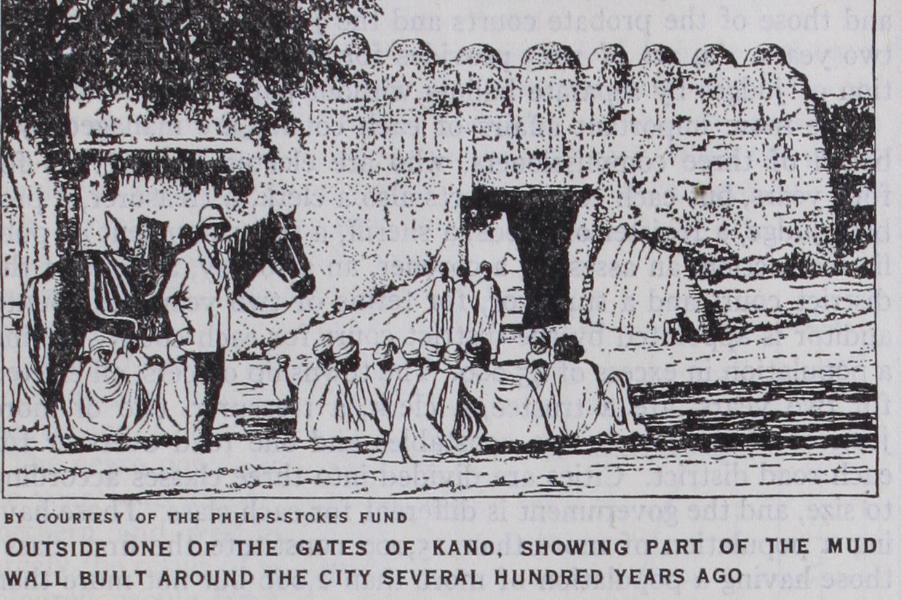
Pop. (1931) 89,162. It is built on an open plain, and is encom passed by a wall i 1 m. in perimeter and pierced by 13 gates. The wall is from 3o to 5o f t. high and about 4o ft. thick at the base. Round the wall is a deep double ditch, a dwarf wall running along its centre. The gates are simply cow-hide, but are set in massive entrance towers. Only about a third of the area (7+ sq.m.) enclosed by the walls is inhabited, the intention of the founders of the city being to wall in ground sufficient to grow food for the inhabitants during a siege. Within the walls are two steep hills, one, Dala, on the north-west, about 120 f t. high, being the most ancient quarter of the town. To its east was a great pond, the Jakara, i 2 m. long, and by its north-east shore is the market of the Arab merchants. Here also was the slave market. The palace of the emir, in front of which is a large open space, consists of a number of buildings covering 33 ac. and surrounded by a wall 20 to 3o ft. high. The houses of Kano are built of clay with (generally) flat roofs impervious to fire. Traces of Moorish influence are evident and the horseshoe arch is common. The
audience hall of the emir's palace-25 ft. square and 18 ft. high —is decorated with designs in black, white, green and yellow, the yellow designs (formed of micaceous sand) glistening like gold. The dome-shaped roof is supported by 20 arches.
Kano is the greatest commercial city in the west-central Sudan and is pre-eminent as a manufacturing centre. The chief industry is the weaving and embroidery of cloth from native grown cotton. Leather goods of all kinds are also manufactured, and from Kano come most of the "morocco leather" goods on the European markets. Dyeing is another large trade, as is the preparation of indigo. In Kano itself is a great market for livestock; camels, horses, oxen, asses and goats being on sale. The trade with the south received a great impetus on the opening of the railway in 1911. About i 2 m. E. of Kano is Nassawara. Formerly the emir's suburban residence, it is now the headquarters of the Brit ish resident.
The city of Kano appears on the map of the Arab geographer, Idrisi, A.D. 1 145 , and the hill of Dala is mentioned in the earliest records as the original site of Kano. Barth, however, concluded that the present town does not date earlier than the second half of the i6th century, and that before the rise of the Fula power (c. 180o) scarcely any great Arab merchant ever visited Kano. The present town may be the successor of an older town occupy ing a position of similar pre-eminence. Kano submitted to the Fula without much resistance, and under them, in the first half of the 19th century, flourished greatly. It was visited by Hugh Clap perton, an English officer, in 1824, and in it Barth lived some time in 1851 and again in 1854. Barth's description of the wealth and importance of the city attracted great attention in Europe, and Kano was subsequently visited by several travellers, missionaries, and students of Hausa, but none was permitted to live perma nently in the city. In the closing years of the century, Kano be came the centre of resistance to British influence, and the emir, Alieu, was the most inveterate of Fula slave raiders. In Feb. 1903 the city was captured by a British force under Col. T. L. N. Mor land, and a new emir, Abbas, a brother of Alieu, installed. Abbas was succeeded, in 1919, by Usuman dan Abdullahi, who was one of the great chiefs to receive the prince of Wales on his visit to Kano in 1925. In 1926 Usuman died, and the council of chiefs chose as emir Abdullahi Chiroma Baiyero, a son of the ex-emir Abbas.
See the works of Clapperton, Lander and Barth ; F. D. Lugard in Geog. Jnl., vol. xxii. (1904) ; Lady Lugard, A Tropical Dependency (1905) ; C. Larymore, A Resident's Wife in Nigeria (1908) ; 0. Temple, Notes on the Tribes, Provinces, Emirates and States of the Northern Provinces of Nigeria (1922) H. F. Backwell (ed.), The Occupation of Hausaland (Lagos, 1927).