Modern Jewellery
worn, diamond, rings, pearls, gold, stone and diamonds
A trimming revived from the 18th century was the velvet rib bon worn at the top of the neck with a small pendant hanging in front. These ribbons were edged with diamonds set on a mounting of platinum covered by black velvet. The fashion of the narrow velvet ribbon was followed by that of the jewelled plaque de con occupying the front of the neck, worn either on a wide velvet ribbon or else attached to a number of rows of pearls clasped tightly round the neck. This again was followed by the diamond dog-collar.
At this period most ladies wore their hair "Pompadour" fashion in front, with a chignon at the back. This enabled them to wear diamond combs and diamond hairpins called fourches, mounted on large tortoiseshell pins. With this way of wearing the hair piled high on top of the head, diamonds and tiaras were no longer worn flat to the head, as in the Empire period and the Victorian era, but were mounted on metal frames, resting on the top of the head. The prevalent shape of the tiara was the so-called "Russian" shape, or sun-rays, which could be turned into a neck lace or the seven points carrying an important stone at the tip of each point. On the occasion of the coronation of King Edward VII. a great many of the tiaras of the English nobility were reset in a new style, and during his reign tiaras were worn at all im portant receptions. On such occasions the ladies also wore large brooches, sometimes called stomachers, occupying the entire front of the dress.
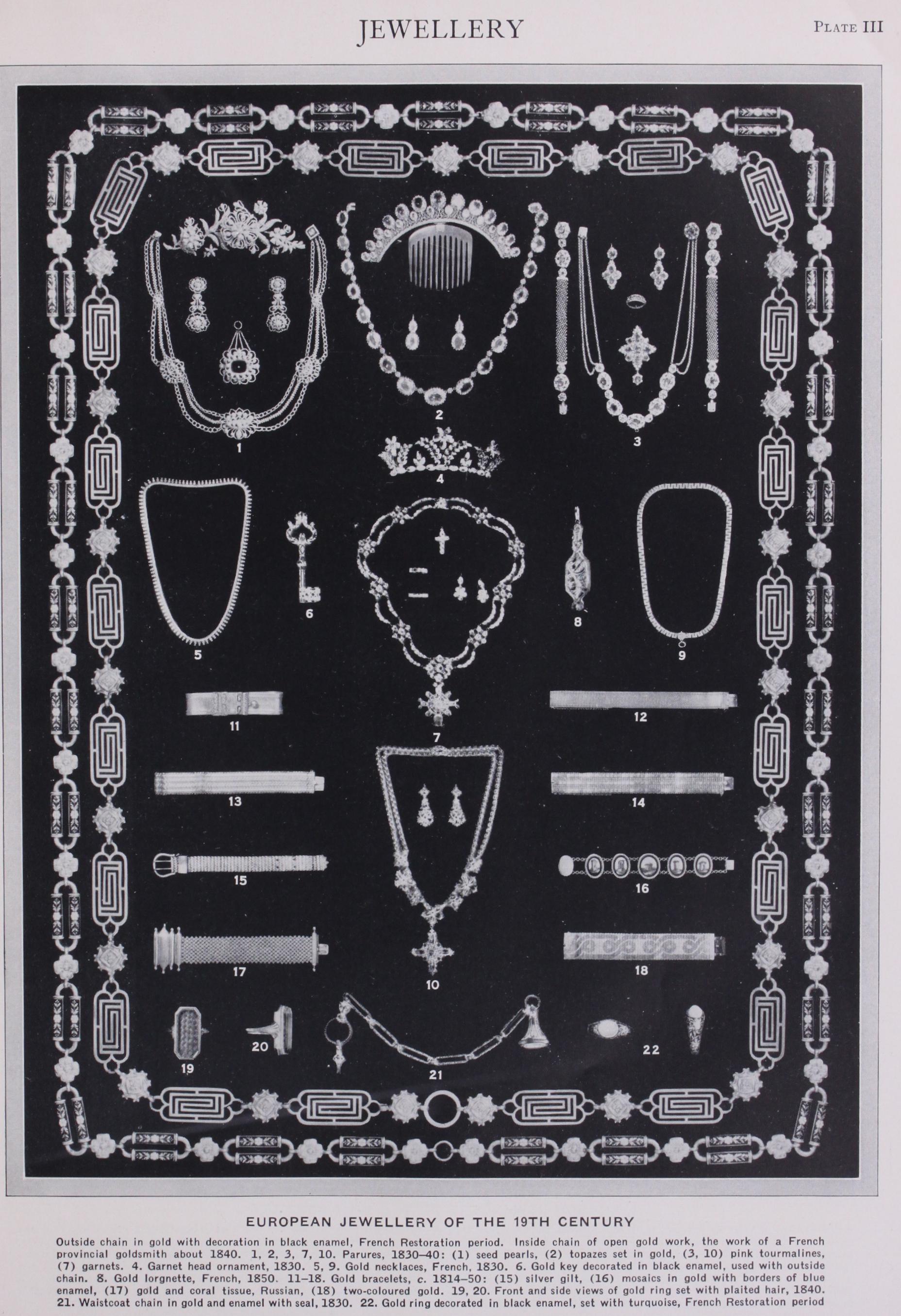
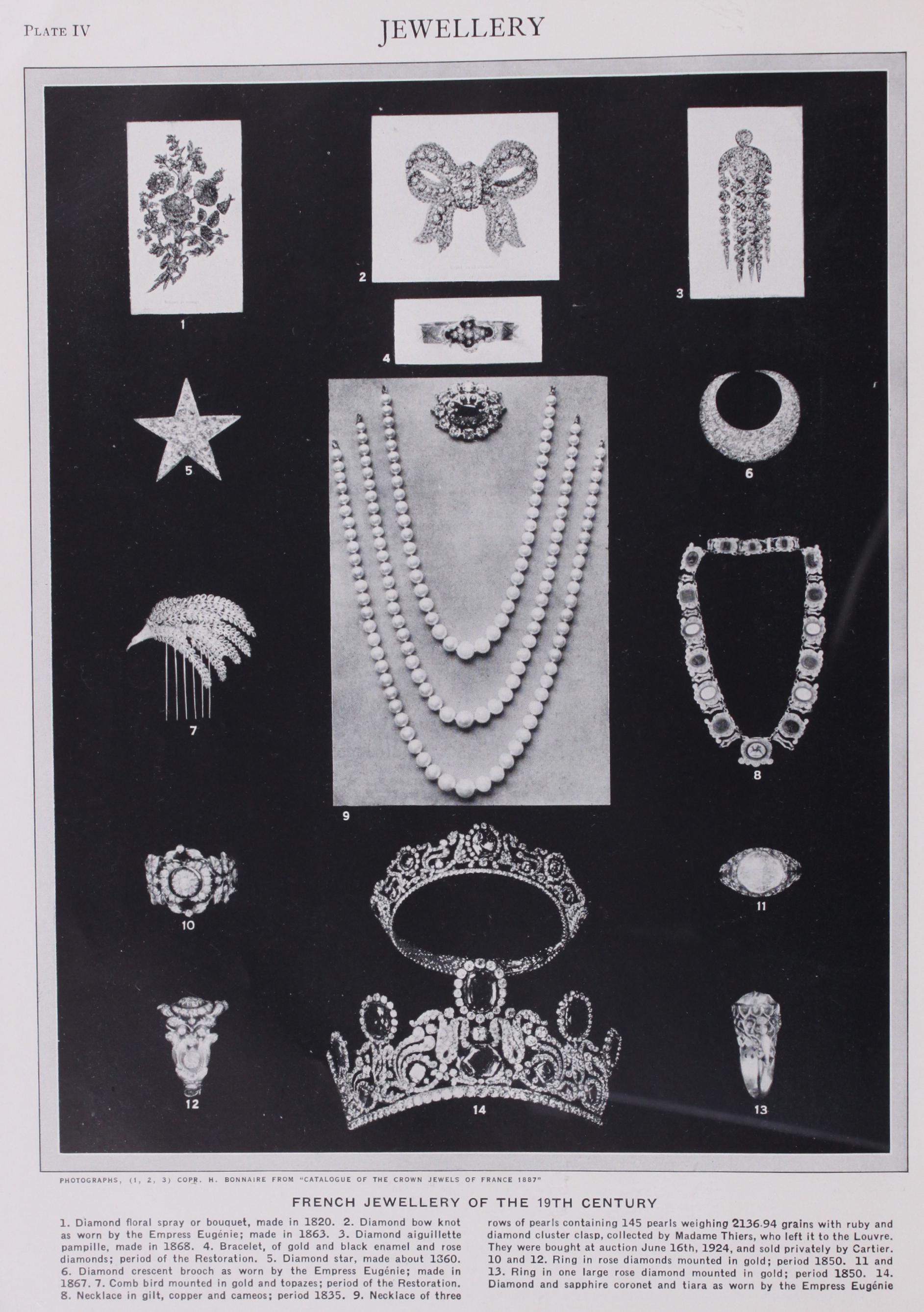
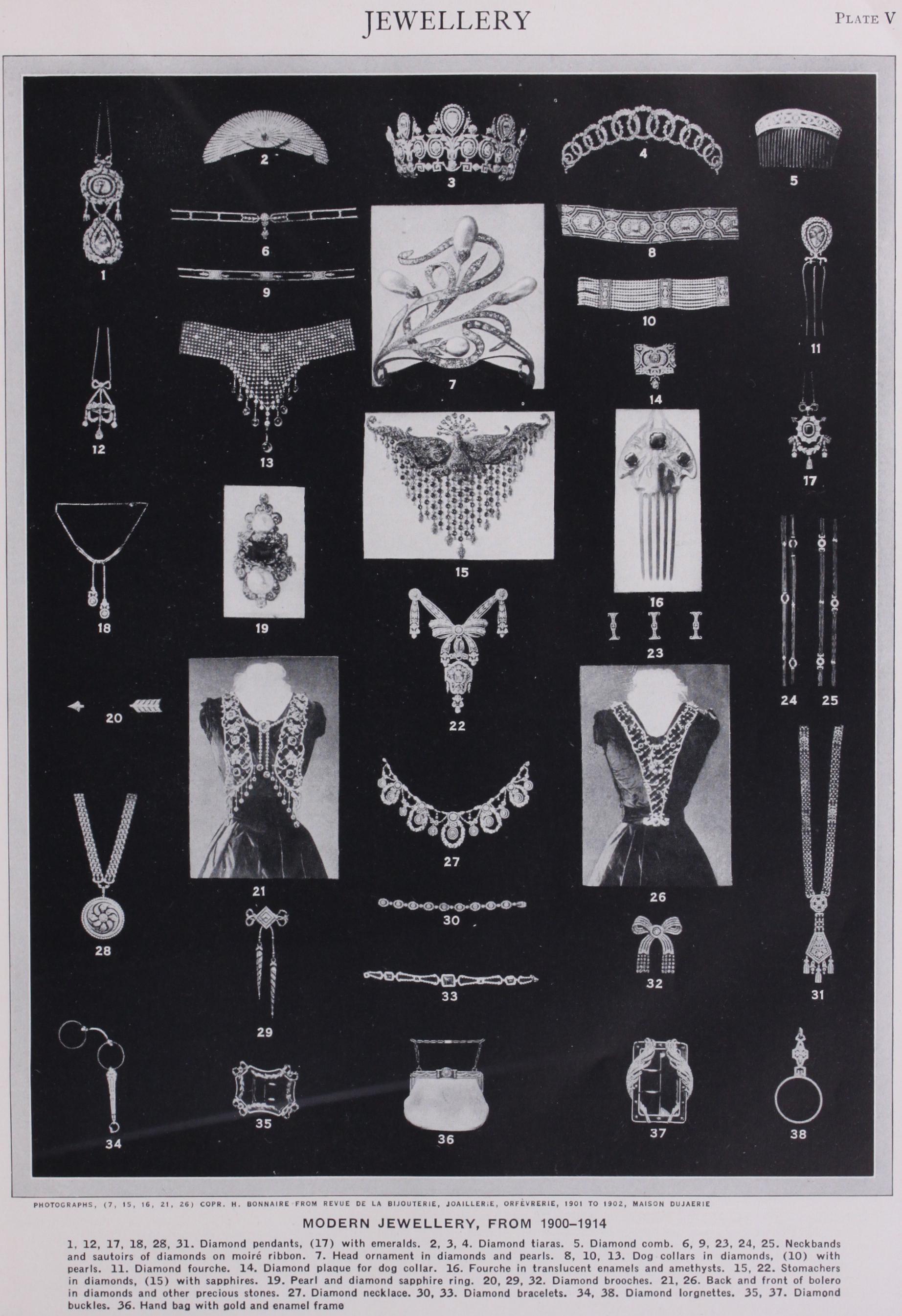
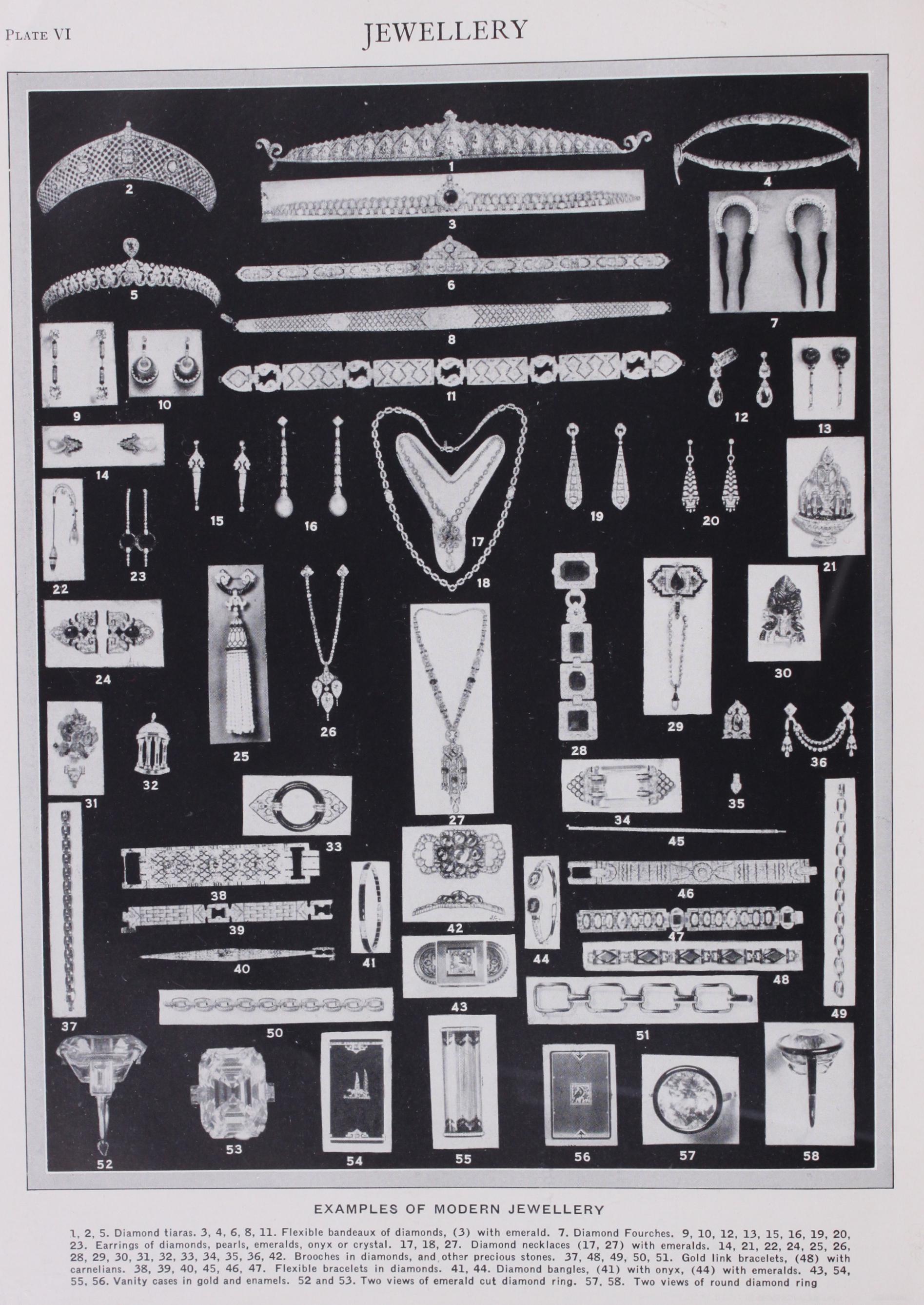
As mentioned above, the great preponderance of diamond rings over all other kinds came from the fact that most ladies chose diamond rings for their engagement rings; the diamond, being indestructible, was considered eminently suitable for such an occasion. These are now always set in platinum. The diamond ring is either a solitaire, a stone weighing from one to ten carats, or a single stone surrounded by one or two rows of smaller diamonds. The actual ring itself sometimes carries three or five smaller diamonds on each side of the main stone. After diamonds, pearls, sapphires, emeralds and rubies are the most worn.
Since 1907 the demand for pearls had grown very quickly. Not only were strings of large pearls worn, but neck-bands, bracelets and chains, made of small pearls strung together in patterns, were sold in numbers. Diamond pendants, which could
no longer be worn on the neck because of the fashion of strings of pearls, were worn on long chains, hanging below the decol letage. The great quest of pearls took European jewellers to India, from whence they brought back emerald beads, until then worn almost exclusively in Indian jewels, and engraved emeralds of all shapes became a factor on the stone market of Europe. The dominating note of the jewels at the end of this period was the combination of diamonds and black onyx.
Jewellery for men's wear was mostly confined to rings, links, studs, waistcoat buttons, scarf pins and watch chains. For rings the favourite shapes were signet rings in gold, and the gypsy ring in gold or platinum. Of the fancy shapes the snake rings were mostly in favour. The keynote of the rings, like all the jewellery worn by men, was simplicity and unostentatious ness, in comparison with the jewels worn at the beginning of the century. This is also exemplified in the watich-chains which used to be composed of heavy links of gold and enamel, but were now made of fine, delicate links of gold and black enamel. Scarf pins were very much smaller, to suit the ties, which had also decreased very much in size. The pearl scarf pin was the favour ite. For waistcoat buttons the favourite stones were the onyx and diamond.
The word cuff-links was new and described the two buttons united by a chain which began to be worn at this period. Until 187o the buttons in these links were generally of a very simple character, made of gold and only remarkable because of the work in the gold itself. It was only from about 188o that precious stones were included in sleeve-links, and then only for the eve ning. From the inclusion of a single stone in the centre of the link, these gradually began to be done in precious stones set in platinum.