Skirtings and Dados Mouldings
moulding, skirting, wall, wood, fixed, planted, joinery and framing
MOULDINGS, SKIRTINGS AND DADOS are used in joinery to relieve plain surfaces by the contrasts of light and shade formed by their members, and to ornament or accentuate those particular portions which the de signer may wish to bring into prominence. Skill and discrimination are required in designing and applying mouldings, but the crafts man must be able to appreciate the beauty and refinement of a moulding in order to interpret the ideas of the designer and drafts man. The character of a moulding is greatly affected by the nature and appearance of the wood in which it is worked. A section suit able for a hard regularly grained wood, such as mahogany, would probably look insignificant if worked in a softer wood with pro nounced markings. Mouldings worked on woods of the former type may consist of small and delicate members ; woods of the latter class require bold treatment.
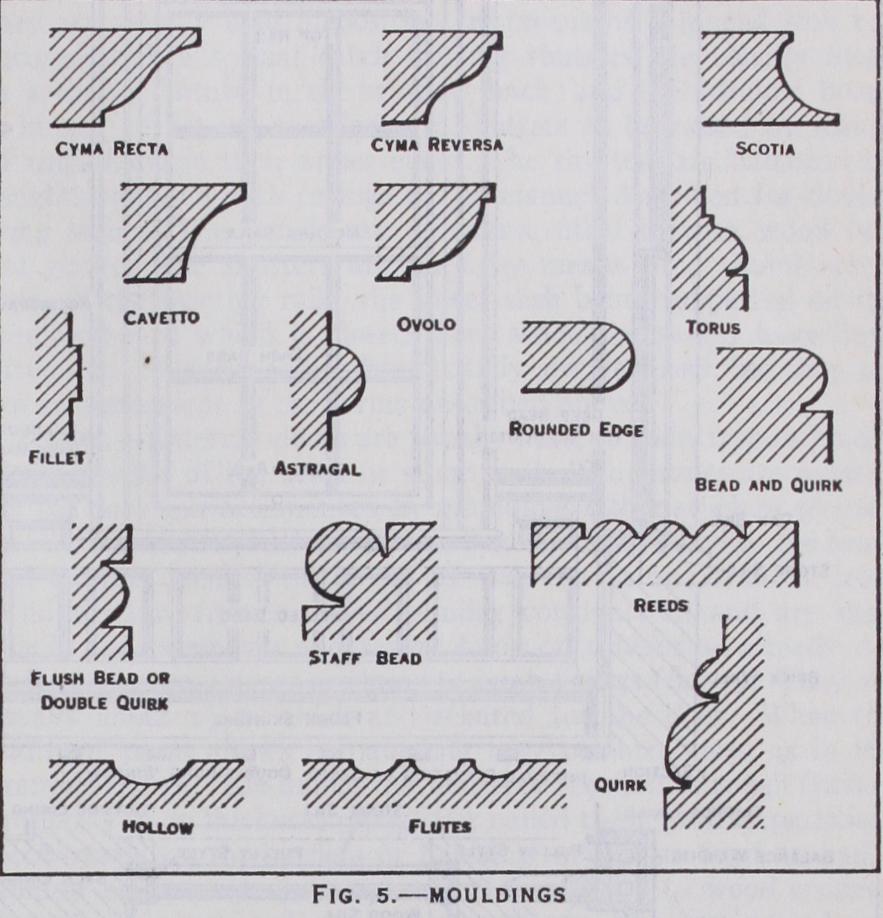
The mouldings of joinery, as well as of all other moulded work used in connection with a building, are usually worked in accord ance with full-sized detail drawings prepared by the architect, and are designed by him to conform with the style and class of build ing. There are, however, a number of moulded forms in common use which have particular names; sections are shown of many of these in fig. 5. Most of them occur in the classic architecture of both Greeks and Romans. A striking distinction, however, existed in the mouldings of these two peoples ; the curves of the Greek mouldings were either derived from conic sections or drawn in freehand, while in typical Roman work the curved components were segments of a circle. Numerous examples of the use of these forms occur in ordinary joinery work, and may be recognized on reference to the illustrations.
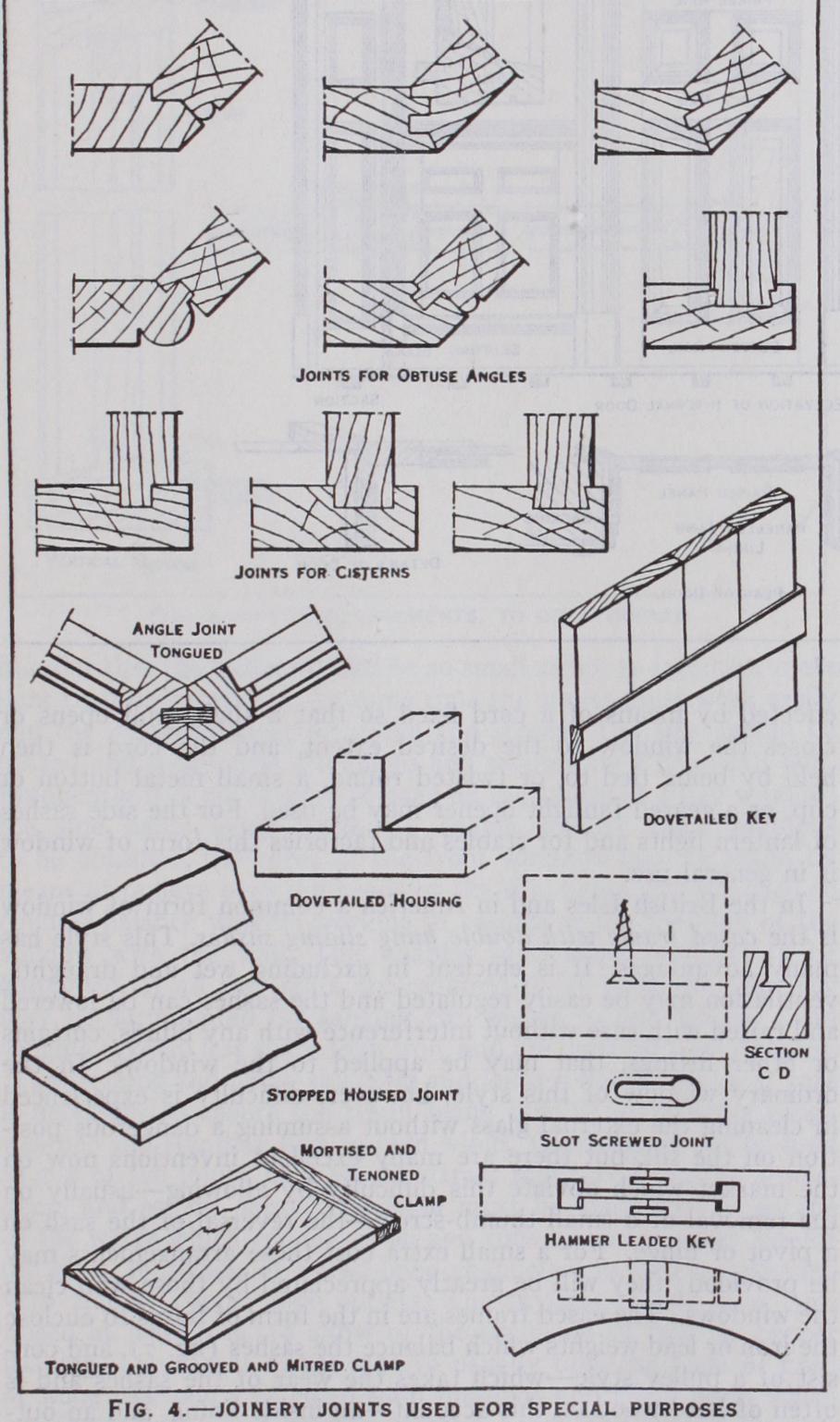
Mouldings may be either stuck or planted on. A stuck mould ing is worked directly on the solid framing; a planted moulding is separately worked and fixed in position with nails or screws. Beads and other small mouldings should always be stuck; larger ones are usually planted on. In the case of mouldings planted on panelled work, the nails should be driven. through the moulding into the style or rail of the framing, and not into the panel. By adopting the former method the panel is free to expand and contract with out altering the good appearance of the work, but if the moulding be fixed to the panel it will, when the latter shrinks, be pulled out of place, leaving an unsightly gap between the moulding and the framing; or if sturdy mouldings be used, the panel may split under the strain.
Planted mouldings are cut to intersect on plain mitres, but mouldings stuck on the solid are scribed whenever the section of the moulding will permit. Scribing consists of cutting away the
end of one moulding to form an exact reverse of the moulding profile so as to allow the cut surfaces to fit closely down on to the adjacent moulding. The advantage of scribing is that the appearance of the joint is less affected by shrinkage. In machine made joinery the scribing and tenoning are effected in one opera tion by the tenoning machine, while mitreing is done by hand. Skirtings.—In joinery, a skirting is a board fixed around the base of an internal wall to form an ornamental base for the wall (see fig. 7). It also covers the joint between the flooring and the wall, and protects the base of the wall from injury. Skirtings may be placed in two classes—those formed from a plain board with its upper edge either left square or moulded, and those formed of two or more separate members and termed a built-up skirting (fig. 6). Small angle fillets or mouldings are often used as skirt ings. The skirting should be worked so as to allow it to be fixed with the heart side of the wood outwards ; any tendency to warp will then only serve to press the top edge more closely to the wall. In good work a groove should be formed in the floor and the skirting tongued into it so that an open joint is avoided should shrinkage occur. The skirting should be nailed only near the top to wood grounds secured to breeze fixing blocks in the brickwork. These grounds are about to I in. thick, i.e., the same thickness as the plaster, and are gen erally splayed or grooved on the edge to form a key for the plaster. A rough coat of plaster should always be laid on the wall behind the skirting to keep out vermin.
Dados.—A dado, like a skirting, is useful both in a decorative and a protective sense. It is filled in to ornament and protect that portion of the wall between the chair or dado rail and the skirting. It may be of horizontal boards battened at the back and with cross tongued and glued joints, presenting a perfectly smooth surface, or of matched boarding fixed vertically, or of panelled framing. The last method is of course the most ornate and admits of great variety of design. The work is fixed to rough framed wood grounds which are nailed to fixing blocks built into the brickwork. Fig. 7 shows an example of a panelled dado with capping moulding and skirting. A picture rail also is shown; it is a small moulding with the top edge grooved to take the metal hooks from which pictures are hung.