La Tene
fig, phase, greek, vessels, period, central and east
LA TENE ("the Shallows"), the site which gave its name to the culture of the second Iron Age of Central and Western Europe, lies in Switzerland, at the east end of the Lake of Neuchatel. It was not the starting-point of that culture, as it seems only to have been occupied from the Middle La Tene period ; but it was here that objects characteristic of the La Tene civilization were first identified. Dechelette and Forrer hold it to be a prehistoric customs station, but P. Vouga is probably correct in regarding it as a fortified and garrisoned depOt, a distributing-centre of weapons and other objects. Reinecke divides the La Tene Period into four phases (A–D), the first two corresponding to Dechelette's I. ; the third and fourth to Dechelette's II. and III.
Phase A.
The domain of phase A, the Earliest La Tene period, which according to Reinecke's latest chronology, began c. 55o and lasted till c. 425 or 420 B.C., may be divided into a central, west ern and eastern area. In the first, the middle Rhine and adjacent regions, A is best represented by the remarkably rich group of burials known as the "chieftains' graves" which extend from Wiirttemberg to the province of Luxembourg (Eygenbilsen). The western area is situated in east and north-east France. Most of the rich chariot-burials in Champagne may be assigned to phase A.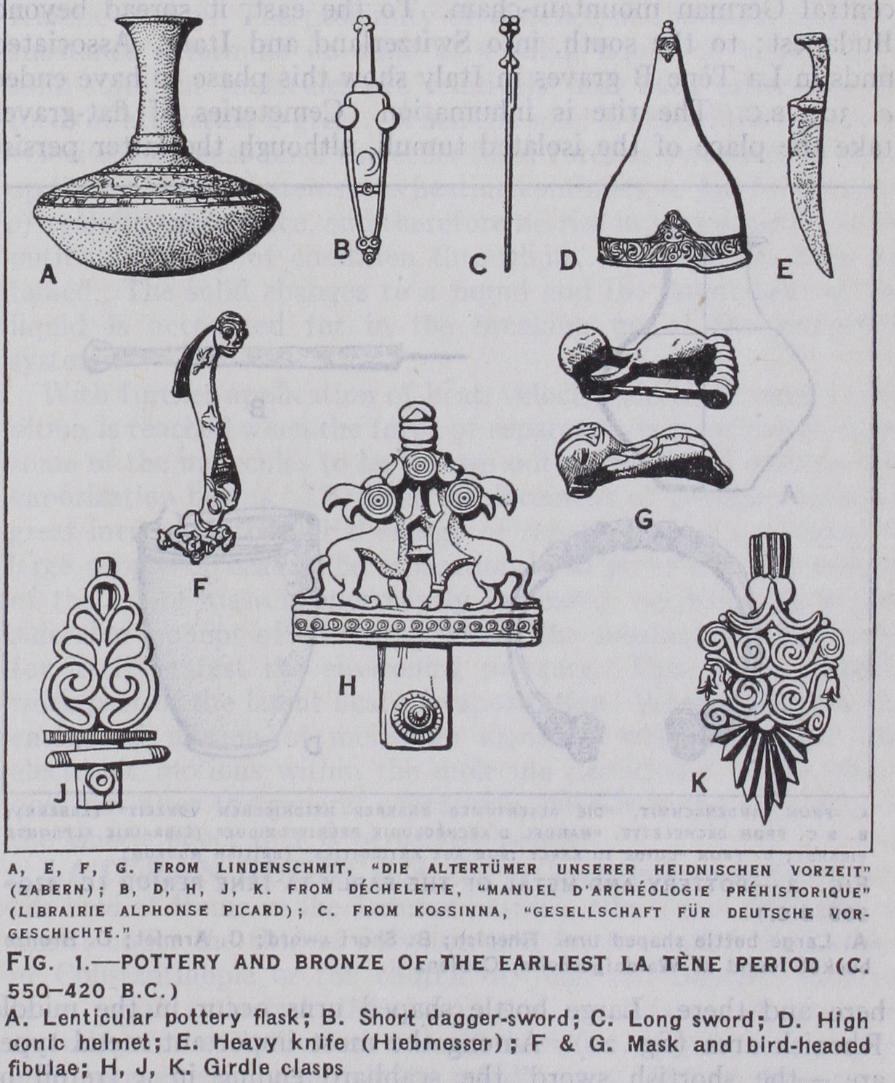
The eastern area lies in east Bavaria, west Bohemia, etc. Here a strong influence from upper Italy made itself felt; but in the central and western areas the Greek influence was paramount, reaching those regions from the Greek colonies in south France. Although flat-graves already occur (as in the Marne area), the rite is usually inhumation under a tumulus; cremation is occasion ally met with in the "chieftains' graves." In the latter, native pottery is rare ; it is replaced by metal vessels. In the west, we find mono- and polychrome pottery, and vessels influenced by Etruscan bucchero ware. Unpainted vessels occur in Brittany with rich curvilinear incised ornamentation and bird motifs. As phase A has not been worked out in France, we cannot yet say which examples of these types belong to phase A and which to B (the Breton Group probably survived into C) but Greek in fluence is apparent both in form and ornamentation. In the
east, we find distinctive pottery, the most typical, perhaps, being the flask with lenticular body (fig. ia). In the eastern group, contemporary Greek influence was far less strongly felt. The potter's wheel was introduced in A but many vessels are hand made. Attic pottery and Greek wine-jars occur on a few sites in the western and central areas. Among the chief metal types are:—the short dagger-sword (fig. Ib); long swords (fig. lc); high, conic helmets (fig. rd) ; large heavy knives (Hiebmesser) (fig. ie) ; the Ceatosa, mask and bird-headed fibulae (brooches) (fig. 1, f and g) ; torcs, arm- and finger-rings (bronze and gold); girdle clasps (fig. I, h, j, k) ; horse harness and parts of chariots. Most important is the series of Greek bronze vessels (6th and 5th centuries B.c.) : wine-flagons, stamnoi, dishes, etc. Barbaric copies of the flagons Occur. The Earliest La Tene period is not repre sented in the British Isles.
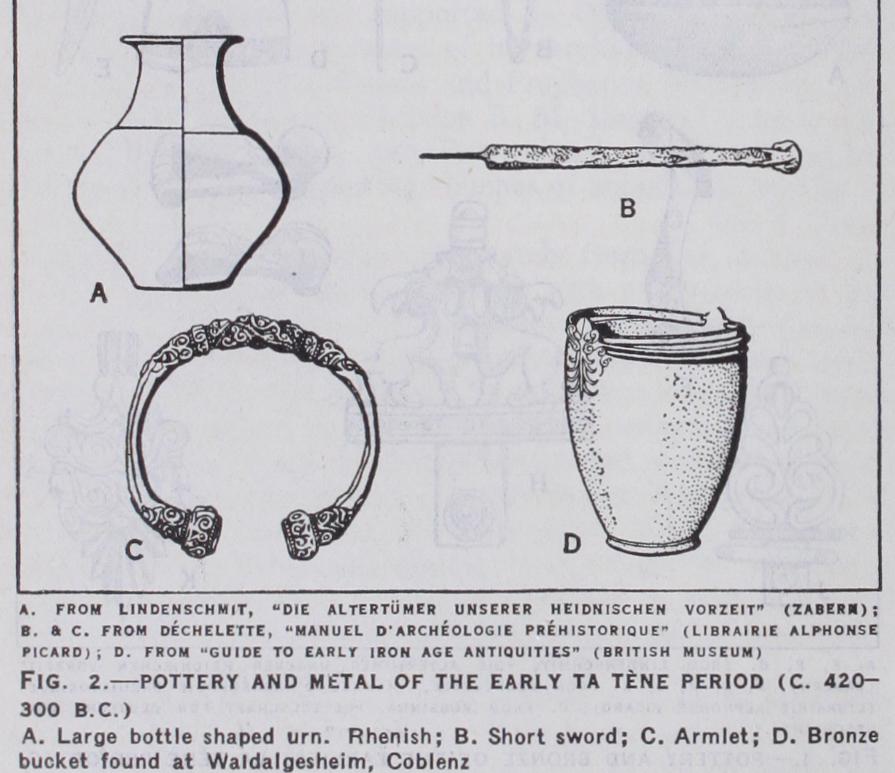
Phase B.—The Early La Tene period reveals a greater uni formity of culture than phase A and embraces a wider area. We find it in Britain, and in the provinces immediately north of the central German mountain-chain. To the east, it spread beyond Budapest ; to the south, into Switzerland and Italy. Associated finds in La Tene B graves in Italy show this phase to have ended c. 30o B.C. The rite is inhumation. Cemeteries of flat-graves take the place of the isolated tumuli, although the latter persist here and there. Large bottle shaped urns occur in the middle Rhenish area (fig. 2a). Among the most important metal types are :—the shortish sword, the scabbard ending in a trefoil or open-work chape (fig. 2b), the fibula with foot bent back towards the bow, a number of torcs and armlets, the types with "buffer" or "seal-top" terminals being very characteristic (fig. 2c) ; small phallic figurines in bronze. There was a great falling off in the imported Greek bronze vessels, the bucket found at Waldalges heim (see fig. 2d) being the only new type. The earliest Celtic coins were struck in this period, which also saw the spread of the La Tene culture into Britain.