La Tene
fig, period, art, phase, influence, greek, der, iron, celts and britain
Phase C.—The Middle La Tene Period covers the time before and after 200 B.C. The Celts abandoned to the conquering Teu tonic peoples the provinces to the north of the central German mountains. A great expansion of Celtic power took place to the east into the middle and lower Danubian areas, the Balkan penin sula and Asia Minor. The rite is the same as in B, for, cremation, though not unknown, is excep tional. In the Marne area, pot tery is rare; the forms of the ves sels in south Germany reveal Hel lenistic influence. Among the chief metal types are :—longer swords (the points less tapered than in B) with bell-shaped guards, their scabbards, of ten finely decorated, ending in strangulated (fig. 3a) or cordi form chapes ; broad-bladed spear heads; large oval to oblong wooden shields with iron "trig ger-guard" bosses (see fig. 3h); fibulae with feet clasping the bows; chain girdles (fig. 3d) ; a variety of bronze armlets (fig. 3e) ; band-shaped glass bangles (fig. 3f). Torcs are rare. On the continent red enamel is substi tuted for coral though enamelled objects are found as early as the fifth century. Coinage becomes more general among the main : land Celts. This phase is sparsely represented in England. The La Tene culture also appears in Ireland.
Phase D.
The Late La Tene Period extends from 120 or Ioo B.C. to 15 B.C. or A.D. I. The rite is cremation. Unpainted and painted (fig. 4a) pottery is found, the latter only on the continent. Wheel-made vessels are more frequent than in phases A–C. Arretine ware and narrow Italian amphorae (fig. 4b) are also found. In south-east Britain, the Belgic or Aylesford pottery is well represented ; in the western regions we find the "Glaston bury" ware. Among the more typical metal objects are :—the long slashing sword with blunt point and rounded chape (fig. 4c); scabbards, often "laddered"; ellipsoid (fig. 4d) and round iron shield-bosses; shields, wooden on the continent, bronze in Britain (Witham [C], Battersea [D] [figs. 3c and 4n ) ; spear-heads are frequent as in A–C ; the fibula with open catch-piece, the foot and bow forming a continuous line; clasps (fig. 4e) ; smooth glass bangles; iron (and clay) fire-dogs; many tools of iron; bronze imported vessels of southern origin (situlae, lidded flagons and skillets). Minting of coins in south-east and east Britain began in the Late La Tene period. The introduction of writing probably took place in this phase. When the La Tene culture in the mainland had been brought to a close by Roman conquest, it continued to flourish in Britain into the first century A.D. The engraved mirrors (fig. 4h), and much of the best British enamel-work dates from this period. Phase D witnessed a marked development in industry and agriculture, and the growth of towns (Bibracte—Stradonitz—Velem St. Veit, etc.). It was largely due to the development of town-life that the culture of the Late La Tene period was more homogeneous than that of the phases which preceded it.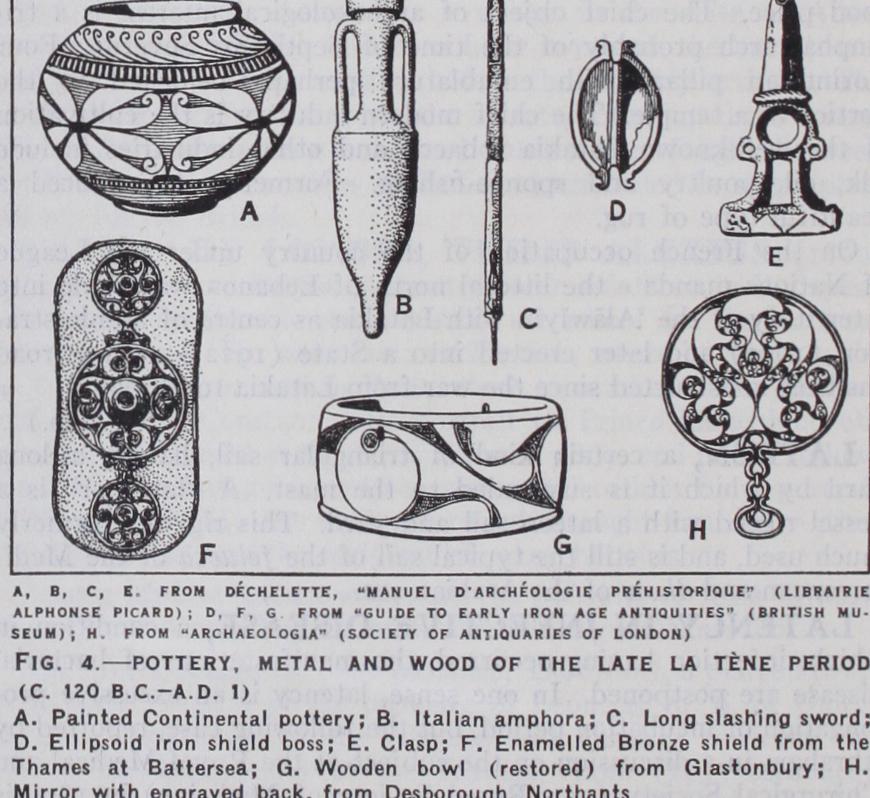
Continental Celts.
Among the continental Celts, art reached its zenith at the outset of the La Tene period ; in each succeeding phase it declined, till, in D, it had lost much of its vitality. The chief formative influences were :—( ) Legacies of the Hallstatt and Bronze Age styles. These are discernible both in technique and ornamentation, the latter being for the most part rigidly geometric. (2) The influence of more or less contemporary Greek art. This was chiefly felt in the ornamentation, the plant-motifs being mainly derived from Greek models (the palmette, free tendril designs, etc.) ; we also find S-patterns and other motifs.The figural art was to some extent derived from upper Italy (viz., influence of the situla style ; and the finely incised zoomorphic designs, as on the Rodenbach field-flask; see Ebert, Reallexikon. "Rodenbach" s.v.) but Greek influence must also be taken into account. Reinecke traces three stages in the development of La Tene art : more or less faithful representations of Greek originals; a perversion of Greek prototypes, some of the features being exaggerated, others suppressed, disintegrations and combinations taking place ; and the development of new forms from these bar barized reproductions of Greek models. By phase C the art had developed so far along these lines that it is often difficult to recognize the classical tradition. As opposed to the Hallstatt style, the design as a whole was treated in a freer and more or ganic manner, though a tendency to mechanical repetition does occur, especially during the Earliest Period. As the influence of classic tradition diminished, the art grew to be less repre sentational and more abstract in feeling. The Scythic influence, though possibly of importance later, can hardly have played a part in the genesis of La Tene style. Among the insular Celts, La Tene art did not reach its zenith until the latter part of the period (cf. the wooden bowl from Glastonbury, fig. 4g and figs. 3a, 3c, 4b and 40. As zoomorphic ornamentation played a leading role in Teutonic art of later times, so, in the Celtic art of the La Tene period, plant-motifs and their derivatives, espe cially eccentric geometrical patterns, were of paramount im portance. (J. M. DE N.) BIBLIOGRAPHY.-(a) Site. P. Vonga, La Tene (1923) ; M. Ebert, Reallexikon der Vorgeschichte (1924, etc.) s.v. "La Tene"; (b) General. A. J. Evans, "A Late Celtic Urnfield at Aylesford," Archaeologia LII. (189o) ; L. Morel, La Champagne Souterraine (Chalons-sur-Marne, 1898) ; P. Reinecke, "Zur Kenntnis der La-Tene-Denkinaler der Zone nordwarts der Alpen," Mainzer Festschrift (1902) , in L. Lindenschmit, Altertiimer unserer heidnischen Vorzeit, v. in Wiener Prahistorische Zeitschrift (1915) and Bayerische Vorgeschichtsfreund I.—II. and V.; F. Quilling, Die Nauheimer Funde (1903) ; • G. Kossinna, Die Deutsche Vorgeschichte (IATurzburg, 19n) ; and Ursprung and Verbreitung der Germanen 9 (1826-27) ; J. Dechelette, Manuel d'Archeologie, II. (1908, etc., but see P. Favret, La Necropole . . . des Jogasses, Revue Archeol., 1927 I. and II.) ; R. Beltz, "Die Latenefibeln" Zeit schrift fur Ethnologie (1911) ; A. Bulleid and H. St. G. Gray, The Glastonbury Lake Village (1911-19) ; M. Pirontet, "Contribution a l'Etude des Celtes" in L'Anthropologie xxix. (1918-19) and xxx. (192o) ; P. Schumacher, Siedlungs- and Kulturgeschichte der Rhein lande, vol. i. (1921), also in Prdhistorische Zeitschrift vi. (1915) and viii. (1916) and L. Lindenschmidt, Altertiimer, vol. v. ; J. P. Bushe Fox, Excavation of the Late Celtic Iron-field at Swarling (1925) ; R. A. Smith, British Museum Guide to Early Iron Age Antiquities (1925) ; L. V. Merhart, in Wiener Priihistorische Zeitschrift, xiii. (1926) and xiv. (1927). See M. Ebert, Reallexikon "Latenestil," and sections in articles dealing with the individual regions. C. Fox, Archaeol. Cambrensis (1927), P. 44.