Lace
laces, brussels, pattern, bobbin, century, thread, needle, spain and mesh
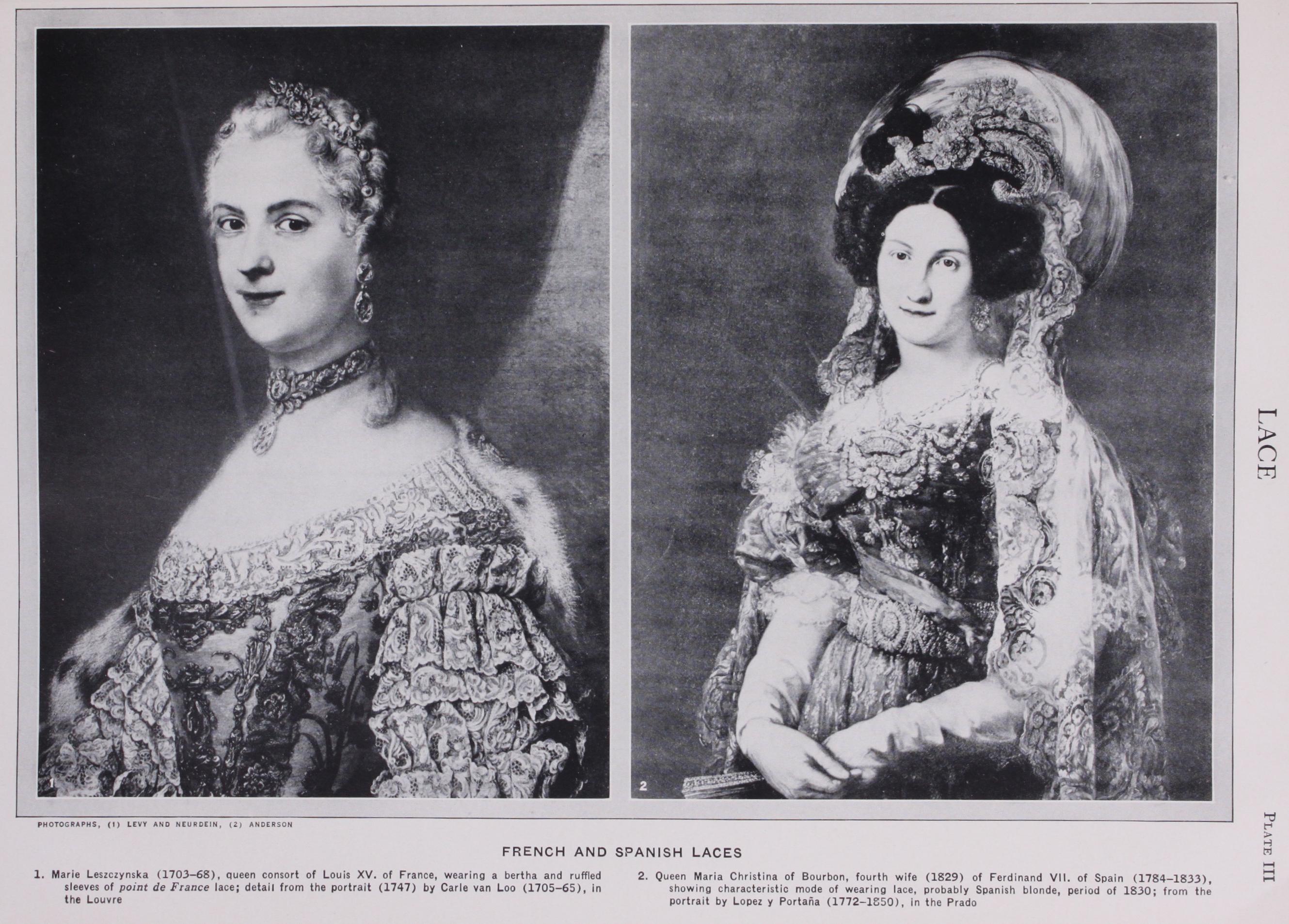
Smaller centres in the Mirecourt and the Haute Loire continued to produce the simpler bobbin laces such as were used in the head dresses of the peasant class while Chantilly, Caen, Bayeux and Le Puy specialized more particularly in black lace which became fashionable toward the middle of the i 7th century at the time of the marriage of the young king (Louis XIV.) to the Infanta of Spain in 166o. While this vogue lapsed during the 18th century it was revived again during the Louis XVI. period and attained great popularity in the middle of the 19th century (c. 1851) when for 25 years or more fashion decreed that every lady's wardrobe should include a Kashmir •or Paisley shawl for winter, and for the summer a black or white so-called Chantilly shawl, many of which were produced at Brussels and Ghent.
The fall of Napoleon brought to a close the brilliant era of lace making in France, and while exquisite fabrics were still available during the Restoration period when the bishops officiating at the coronation of Charles X. were resplendent in lace-trimmed vest ments, the revival was of short duration and, in spite of the at tempt on the part of the Empress Eugenie to bring relief to the impoverished lace-makers by placing large orders, the industries were finally forced to the wall owing to the increasing popularity of machine-made fabrics.
Belgium.
Despite the fact that Italy disputes with Belgium the invention of bobbin lace, Belgium will always stand pre-emi nent in the art as it was developed in that country in the 18th century at the height of its greatest period. While records fail to throw any light on the early history of lace-making in the Low Countries, save in occasional evidences discovered in paint ings of the 15th century, existing documents prove that in Brus sels the art was already a thriving industry in the second half of the 16th century. After that date, however, Belgium is rich in dated documents. The earliest of these is the bedspread pre served in the Brussels museum. The fabric, of unbleached linen thread, is designed in a series of compartments; in two of these appear the crowned monogram of Albert and Isabella, while in others are the arms of Brabant, of Spain and of England, the lily of France and the eagle of Austria. Among the personages represented are Philip II., Roman emperors, the legendary figure of Sainte Gudule and a number of figures associated with the celebrated Cortege de l'Ommegang du Sablon.
Of slightly later date is the splendid cover in the Victoria and Albert Museum said to have belonged to Philip IV. of Spain which bears in its design the crowned Austrian eagle surmounted by the collar of the Golden Fleece. From an historical point a piece of equal interest is the flounce of point d'Angleterre in the Brussels collection (Pl. VII., fig. 7), a work executed presumably at the time of the marriage of Charles III. (afterwards Charles VI. of Spain), and Elizabeth of Brunswick. This lace designed in the
earlier style of the points de France, combines in its pattern the interlaced monogram of these sovereigns and also their portraits surmounted by the Austrian crown. These with the splendid pieces preserved in the church treasuries of the 18th century and the number of historical works produced during the World War, form an important group illustrating the historical sequence of Belgian work during the past three centuries.
Eugene van Overloop in his guide to the Brussels collection, classifies Belgian laces according to districts under four general heads: (1) The laces of Brussels and the so-called Brabant laces. (2) The laces of Flanders. (3) The laces of Mechlin and those of the Antwerp district. (4) The laces of Valenciennes and their prototypes the laces of Binche.
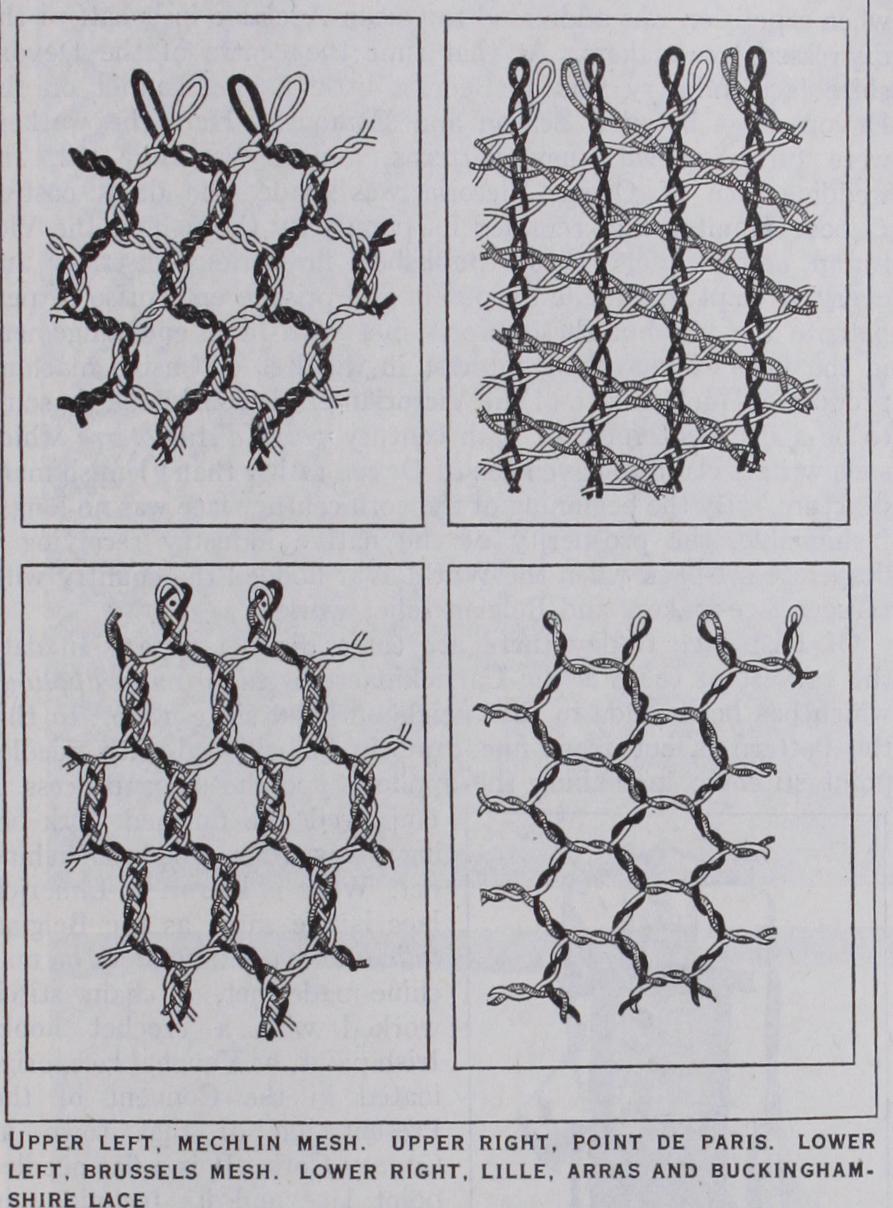
In technique, Belgian laces may be divided as follows: (I) Bobbin laces: (a) Those made with a continuous thread on a stationary pillow; a process termed fil continu, such as Binche, Valenciennes, Mechlin, Lille, point de Paris, point de Flandre or trolle kant. (Kant is the old Flemish word for lace ; trolle kant is a Flemish lace with a pattern outlined with a heavier thread than the body of the lace.) (b) Those made in sections—on a movable pillow that may be turned to follow the curves of the pattern—and the tie-bars (brides) or mesh added later; a work described as a pieces rapportees. In this variety the bobbins are at times supplemented by a crochet hook when the edges of the pattern have to be connected or additional threads have to be added in working the mesh, the hook drawing a loop of thread through a pin-hole in the edge of the work, in which loop a free bobbin is passed to draw the knot tight, as in the bobbin laces of the i6th and early 17th centuries, the guipure laces of Brussels and Bruges and the modern Duchesse. (c) The Brussels hand made bobbin net (droschel or vrai reseau) made in narrow strips of one or more inches in width placed side by side and joined with the point de raccroche. The weaving of this delicate hexagonal mesh that has two sides braided and four sides twisted is one of Belgium's greatest achievements in lace-making. (2) Needle point laces : Those worked on cloth-backed parchment or paper; the Brussels point a l'aiguille or point de gaze. (3) Bobbin and needlepoint laces, which combine both techniques, the pattern usually worked on the pillow and the tie-bars or the mesh worked in with the needle. Modern lace of this type is often termed point d'Angleterre. (4) Applied laces: Those in which the pattern, worked with bobbins or by needle, is applied on hand-made or machine-made net ; Brussels applique. (5) Embroidered machine net : this, when the pattern is in chain stitch worked with , a crochet hook, is termed tambour work or tulle brode; when the pattern is embroidered with a needle it is called broderie a l'aiguille.